Cagayan River
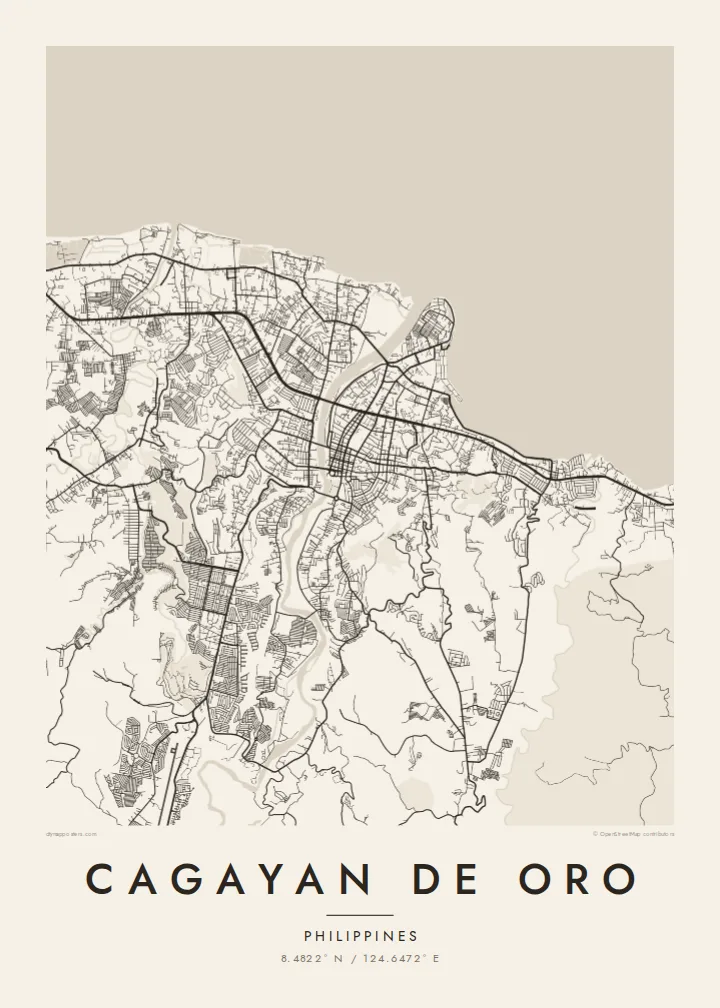
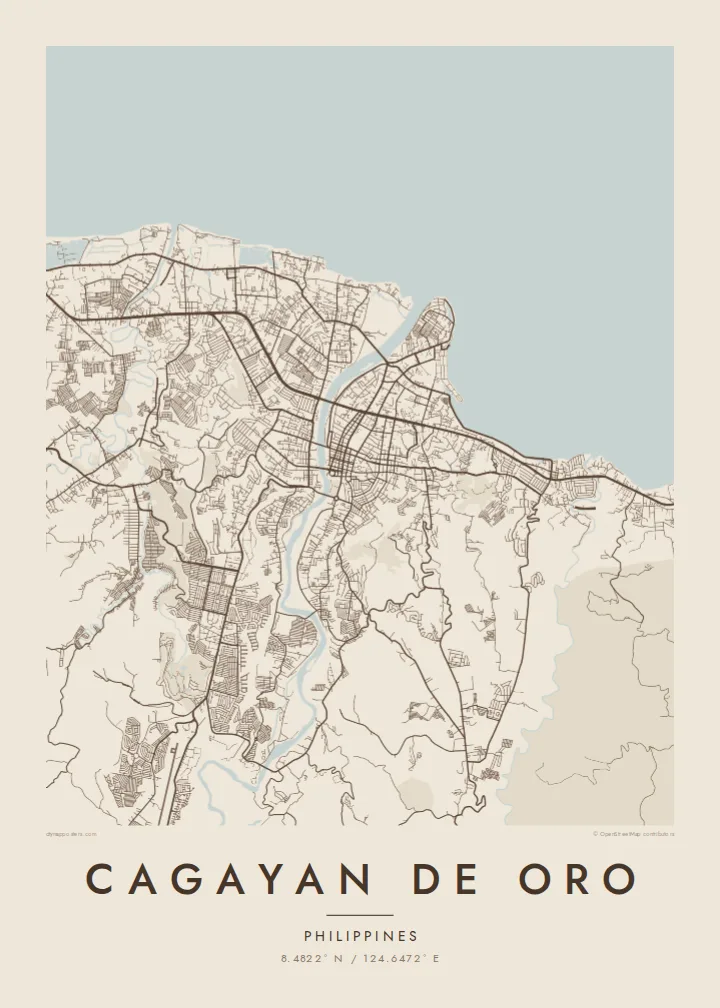
The river runs through the heart of the city to Macajalar Bay, forming the central line of the map with neighbourhoods and bridges arranged along both banks.
Fakatino mape mukamuka · Philippines
8.4822° N / 124.6472° E
A river city on Macajalar Bay, split by the winding Cagayan River as it runs from the uplands to the sea.



Taha e taone, lima e onoonoaga
Tapaki e taha puhala ke kitia ai ki luga he puipui. Kua tatai e totogi he tau puhala oti — pete he lolomi, poloka, po ke faila HD.
 Tau pikselo mooli · faila lolomi 24 × 36″
Maama mitaki ke lolomi
Ko e 100% e fahi mooli mai he faila lolomi. Ko e tau poster oti — pete kua lolomi, poloka, po ke utu hifo — kua taute ke he ha mautolu a tau tokoluga (server) ke he 300 DPI, hokotia ke he 7,200 × 10,800 piksela, ke maeke ai e tau ala ikiiki tote ke maaliali fakamitaki he lolomi 24 × 36″.
He Pā


Ko e mape
Cagayan de Oro sits on the northern coast of Mindanao, where the Cagayan River empties into Macajalar Bay. The river divides the city from south to north, and the map follows it: older streets and the downtown core cluster near its lower course, while newer districts climb the higher ground on either side. The coastline forms a gentle curve along the top of the frame.
The name recalls the gold once panned from the river, and the city has long called itself the City of Golden Friendship. Today the Cagayan is better known for whitewater rafting on its upper reaches. The river also carries risk: in 2011 Tropical Storm Washi, known locally as Sendong, caused severe flooding along its banks and changed how the city plans its riverside.
A Cagayan de Oro map poster brings these elements together in one clean composition: the river curving through the grid, bridges stitching the two banks together, and the bay closing the view to the north. As the main gateway to Northern Mindanao, the city has roads fanning out in several directions, which gives the design a strong sense of movement.
The river runs through the heart of the city to Macajalar Bay, forming the central line of the map with neighbourhoods and bridges arranged along both banks.
The city's northern edge is a broad, curving shoreline on the bay, giving the poster a clean boundary between streets and open water.
South of the coast the land climbs onto higher ground cut by the river valley, and the street pattern loosens as it moves away from downtown.
Taute ke ha hau
Lafi e aho, taha higoa po ke taha kupu haau, hiki e fakatino, lahi po ke tuaga.
Ko e kitiaaga nakai totogi kua tote e maaliali mo e fakamailoga vai. Ko e tau lolomi mo e tau faila HD kua taute ke he 300 DPI, hokotia ke he 7,200 × 10,800 px, nakai fai fakamailoga vai.
Ko e ha Cagayan de Oro
For many people in Mindanao, Cagayan de Oro is where they studied, found work or changed buses on the way home. For those who have moved abroad, a map of the river and the bay is a steady reminder of a city that shaped them.
Make it personal with a custom title, a subtitle for a date or a barangay name, and the coordinates line. Choose from Classic black & white, Noir, Paper, Blueprint and Sand, then print it yourself or order it framed from a print partner.
Talaage e poster Cagayan de Oro| Lahi he lolomi | Maama | Tau faila |
|---|---|---|
| 30 × 40 cm11.8 × 15.7″ | 3,543 × 4,724 px | PNG · PDF |
| 29.7 × 42 cm (A3)11.7 × 16.5″ | 3,508 × 4,961 px | PNG · PDF |
| 42 × 59.4 cm (A2)16.5 × 23.4″ | 4,961 × 7,016 px | PNG · PDF |
| 45.7 × 61 cm18 × 24″ | 5,400 × 7,200 px | PNG · PDF |
| 50 × 70 cm19.7 × 27.6″ | 5,906 × 8,268 px | PNG · PDF |
| 61 × 91.4 cm24 × 36″ | 7,200 × 10,800 px | PNG · PDF |
Ke fakatatai, ko e fakatino noa kua 900 px e laulahi, fai fakamailoga mo e mo e tau mata komipiuta ni. Ko e tau faila HD kua ato hoko ke he 8× e maama ke he tau faahi takitaha mo e lolomi mitaki he lahi katoa he fakatino.
Fifili e taha puhala i luga he kupega, ti fifili e Poster Lolomi — e lahi mo e, kaeke ke manako ai koe, taha poloka — po ke Tau Faila HD Fakaeletonika. Ko e fakaotiaga totogi ko e taha gahua ni, ti ko e kupega he hau a talaaga ka fakafou fakahaga i mua he fakaotiaga e totogi.
Kua lolomi ai ke he pepa mitaki 200 gsm matte he taha he tau lahi ono, mai he 30 × 40 cm ke hoko ke he 24 × 36″. Kamata e tau poster lolomi mai he $39, kua putoia ai e utaaga.
E. Fifili e poloka akau malolō ke he lanu uli, tea, akau oki mooli, po ke akau pouli. Kua fakalataha mo e sioga malolō nakai malepe ti kua mautali ke tautau. Kamata e tau poster poloka mai he $99, kua putoia ai e utaaga.
Nakai totogi e fakafano ke he motu 60+. Ko e fakatino taha kua lolomi he fenoga lolomi ha mautolu kua tata mo e tau motu 30+, kua hoko mai he tau aho gahua 3–7. Maeke ia koe ke kikite e tuaga mo e fakamuitua he lalo he Haku Tau Fakatonu. Ke he falu motu kua 2–5 e tau tapu, ti ka nakai fakafano a mautolu ki ai, to fakaha he api tupe ia ki mua he totogi.
Fakafano mai e taha ata ki a mautolu he loto he 14 e tau aho tali mai he hokoaga, ti to lolomi foki e mautolu nakai totogi po ke liu atu e totogi ki a koe.
E. He editor i luga he kupega nei, hikihiki e matakupu, e matakupu lalo mo e laini coordinates ke he taha mena kua manako a koe ki ai, ti fifili e puhala mo e lahi. Ko e tau talaaga lolomi, poloka mo e fakaeletonika oti kua fakaaoga tonu e hau a fakatino.
Ma e $9 ka moua e koe e tau faila PNG 300 DPI mo e PDF kua mautali ke lolomi he tau lahi ono oti, nakai fai fakamailoga vai, ke lolomi i fe mena. Nakai maopoopo agaia? Utu hifo fakamua e kitiaaga nakai totogi ne fai fakamailoga vai.
Tata mai
