The Loa River
Chile's longest river passes along Calama, and the narrow band of fields and trees on its banks is the reason a town could grow here in one of the driest deserts on earth.
Fakatino mape mukamuka · Chile
22.4567° S / 68.9237° W
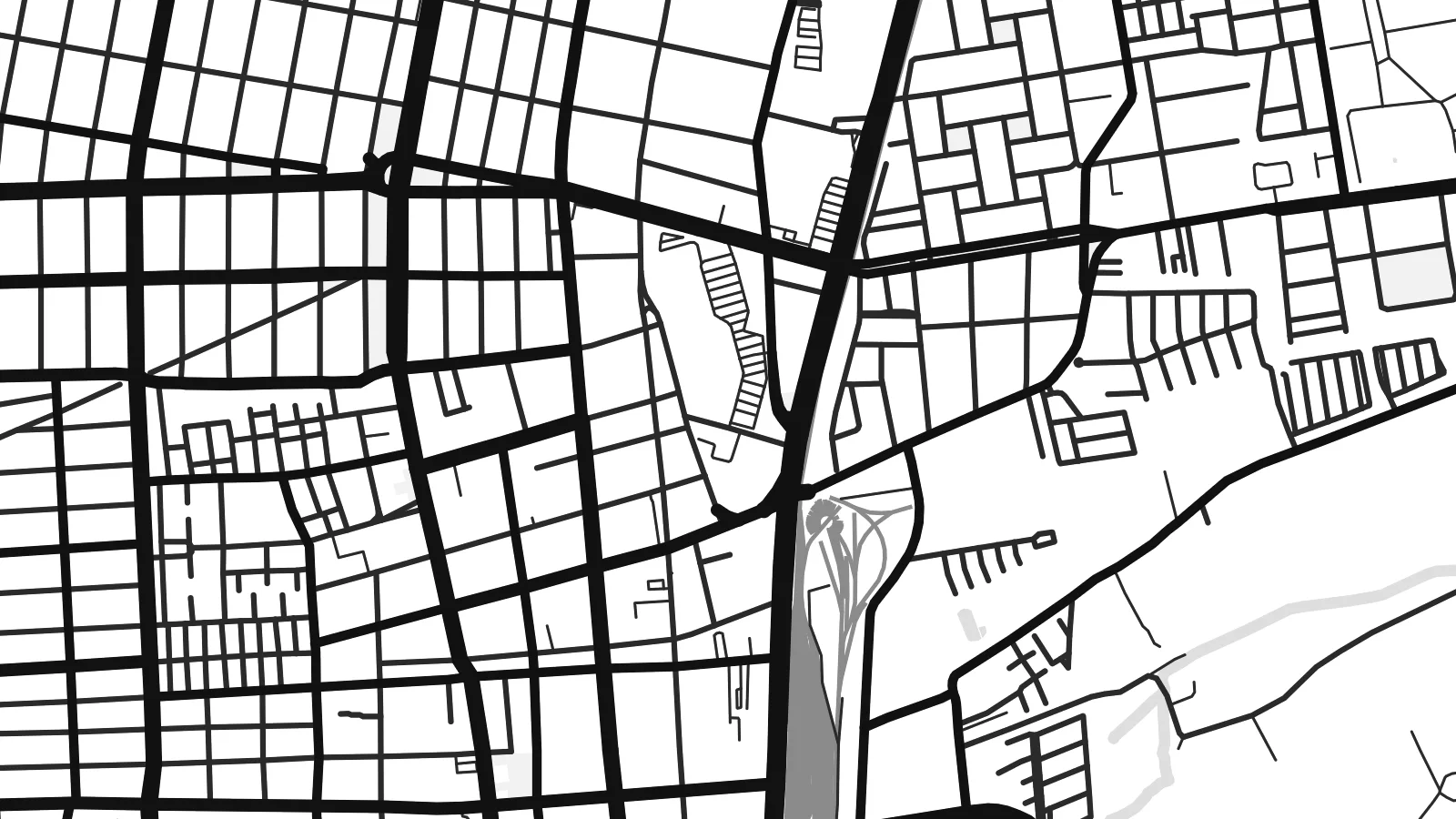
An oasis grid on the Loa River, ringed by open Atacama desert and the vast terraced pit of Chuquicamata to the north.


Taha e taone, lima e onoonoaga
Tapaki e taha puhala ke kitia ai ki luga he puipui. Kua tatai e totogi he tau puhala oti — pete he lolomi, poloka, po ke faila HD.
 Tau pikselo mooli · faila lolomi 24 × 36″
Maama mitaki ke lolomi
Ko e 100% e fahi mooli mai he faila lolomi. Ko e tau poster oti — pete kua lolomi, poloka, po ke utu hifo — kua taute ke he ha mautolu a tau tokoluga (server) ke he 300 DPI, hokotia ke he 7,200 × 10,800 piksela, ke maeke ai e tau ala ikiiki tote ke maaliali fakamitaki he lolomi 24 × 36″.
He Pā


Ko e mape
From above, Calama is a compact block of streets surrounded by bare desert. The Loa River, the longest in Chile, curves along the town's edge, and a thin strip of green follows its banks. Beyond that the map turns almost empty: dry plains, a few highways and the long lines of mining roads heading out into the high Atacama.
The city grew as the service centre for copper. A short distance north lies Chuquicamata, one of the largest open-pit copper mines in the world, and its stepped rings read on a map like a contour drawing cut into the ground. Calama is also the usual starting point for travellers going on to San Pedro de Atacama and the salt flats beyond.
A Calama map poster shows a city defined by contrast. Dense residential blocks and the airport runway sit on one side, open desert on the other, with the river as the single soft line running through. In black and white the empty ground becomes part of the design, giving the streets a sharp, almost architectural outline.
Chile's longest river passes along Calama, and the narrow band of fields and trees on its banks is the reason a town could grow here in one of the driest deserts on earth.
The huge open-pit copper mine sits a short drive north of the city. Its terraced walls form concentric rings that stand out clearly on any map of the area.
Past the last streets there is little but open ground and straight roads. That emptiness frames the city tightly and makes its street pattern easy to read at poster scale.
Taute ke ha hau
Lafi e aho, taha higoa po ke taha kupu haau, hiki e fakatino, lahi po ke tuaga.
Ko e kitiaaga nakai totogi kua tote e maaliali mo e fakamailoga vai. Ko e tau lolomi mo e tau faila HD kua taute ke he 300 DPI, hokotia ke he 7,200 × 10,800 px, nakai fai fakamailoga vai.
Ko e ha Calama
Calama is a place people come to for work, for the mines or on the way into the Atacama, and many keep a strong tie to it afterwards. A map poster keeps the street grid, the river and the surrounding desert in one clean image.
You can personalise the title, subtitle and coordinates line, for example with a year spent in the north or the name of a neighbourhood. Choose from five styles: Classic black & white, Noir, Paper, Blueprint or Sand, which suits the desert setting well.
Talaage e poster Calama| Lahi he lolomi | Maama | Tau faila |
|---|---|---|
| 30 × 40 cm11.8 × 15.7″ | 3,543 × 4,724 px | PNG · PDF |
| 29.7 × 42 cm (A3)11.7 × 16.5″ | 3,508 × 4,961 px | PNG · PDF |
| 42 × 59.4 cm (A2)16.5 × 23.4″ | 4,961 × 7,016 px | PNG · PDF |
| 45.7 × 61 cm18 × 24″ | 5,400 × 7,200 px | PNG · PDF |
| 50 × 70 cm19.7 × 27.6″ | 5,906 × 8,268 px | PNG · PDF |
| 61 × 91.4 cm24 × 36″ | 7,200 × 10,800 px | PNG · PDF |
Ke fakatatai, ko e fakatino noa kua 900 px e laulahi, fai fakamailoga mo e mo e tau mata komipiuta ni. Ko e tau faila HD kua ato hoko ke he 8× e maama ke he tau faahi takitaha mo e lolomi mitaki he lahi katoa he fakatino.
Fifili e taha puhala i luga he kupega, ti fifili e Poster Lolomi — e lahi mo e, kaeke ke manako ai koe, taha poloka — po ke Tau Faila HD Fakaeletonika. Ko e fakaotiaga totogi ko e taha gahua ni, ti ko e kupega he hau a talaaga ka fakafou fakahaga i mua he fakaotiaga e totogi.
Kua lolomi ai ke he pepa mitaki 200 gsm matte he taha he tau lahi ono, mai he 30 × 40 cm ke hoko ke he 24 × 36″. Kamata e tau poster lolomi mai he $39, kua putoia ai e utaaga.
E. Fifili e poloka akau malolō ke he lanu uli, tea, akau oki mooli, po ke akau pouli. Kua fakalataha mo e sioga malolō nakai malepe ti kua mautali ke tautau. Kamata e tau poster poloka mai he $99, kua putoia ai e utaaga.
Nakai totogi e fakafano ke he motu 60+. Ko e fakatino taha kua lolomi he fenoga lolomi ha mautolu kua tata mo e tau motu 30+, kua hoko mai he tau aho gahua 3–7. Maeke ia koe ke kikite e tuaga mo e fakamuitua he lalo he Haku Tau Fakatonu. Ke he falu motu kua 2–5 e tau tapu, ti ka nakai fakafano a mautolu ki ai, to fakaha he api tupe ia ki mua he totogi.
Fakafano mai e taha ata ki a mautolu he loto he 14 e tau aho tali mai he hokoaga, ti to lolomi foki e mautolu nakai totogi po ke liu atu e totogi ki a koe.
E. He editor i luga he kupega nei, hikihiki e matakupu, e matakupu lalo mo e laini coordinates ke he taha mena kua manako a koe ki ai, ti fifili e puhala mo e lahi. Ko e tau talaaga lolomi, poloka mo e fakaeletonika oti kua fakaaoga tonu e hau a fakatino.
Ma e $9 ka moua e koe e tau faila PNG 300 DPI mo e PDF kua mautali ke lolomi he tau lahi ono oti, nakai fai fakamailoga vai, ke lolomi i fe mena. Nakai maopoopo agaia? Utu hifo fakamua e kitiaaga nakai totogi ne fai fakamailoga vai.
