Plaza 9 de Julio
The main square sits at the centre of the colonial grid, a single open block surrounded by the cathedral, the Cabildo and arcaded streets leading out in four directions.
Fakatino mape mukamuka · Argentina
24.8065° S / 65.4200° W
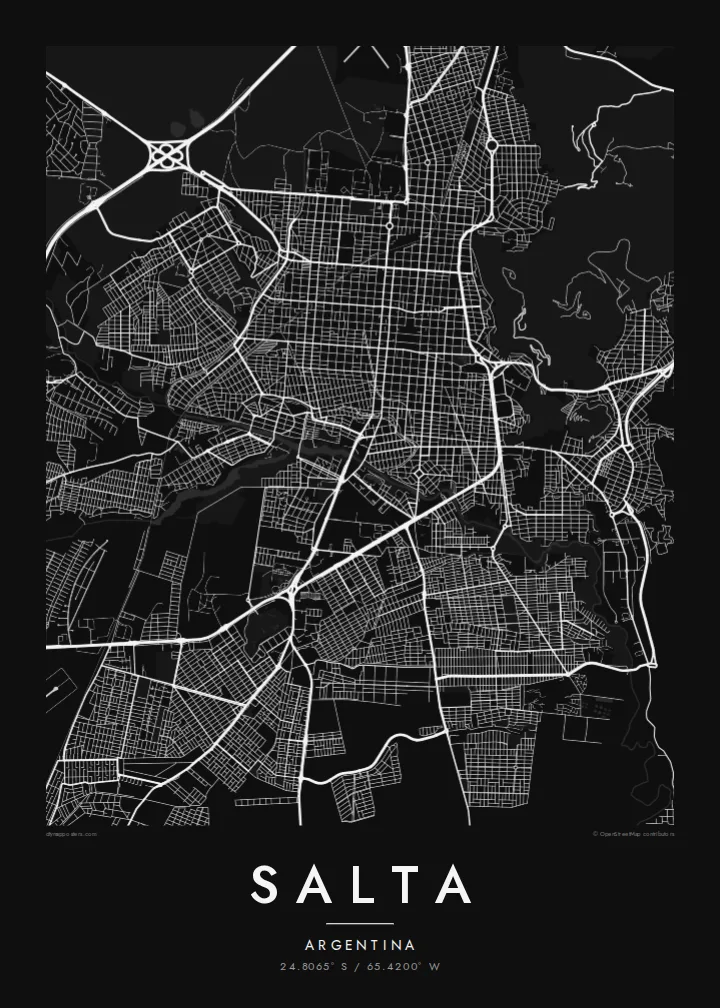
A colonial grid in Argentina's Lerma Valley, laid out from a central plaza, with a hill rising on its eastern edge.



Taha e taone, lima e onoonoaga
Tapaki e taha puhala ke kitia ai ki luga he puipui. Kua tatai e totogi he tau puhala oti — pete he lolomi, poloka, po ke faila HD.
 Tau pikselo mooli · faila lolomi 24 × 36″
Maama mitaki ke lolomi
Ko e 100% e fahi mooli mai he faila lolomi. Ko e tau poster oti — pete kua lolomi, poloka, po ke utu hifo — kua taute ke he ha mautolu a tau tokoluga (server) ke he 300 DPI, hokotia ke he 7,200 × 10,800 piksela, ke maeke ai e tau ala ikiiki tote ke maaliali fakamitaki he lolomi 24 × 36″.
He Pā


Ko e mape
Salta was founded in 1582 in the Lerma Valley, a green basin in the foothills of the Andes in northwest Argentina. The Spanish plan is still clear on the map: a chessboard of square blocks around Plaza 9 de Julio, where the cathedral and the colonial Cabildo face each other across the square. The grid extends in every direction with remarkable consistency.
On the eastern edge, Cerro San Bernardo rises abruptly above the city, and a cable car climbs to the top from a park at its foot. The street pattern stops where the slope begins. To the south, the Arenales River crosses the valley, and newer neighbourhoods spread north and west along wide avenues toward the surrounding farmland.
Salta is often called Salta la Linda, and it is a common starting point for trips into the Andean valleys and the high puna, including the Train to the Clouds. A Salta map poster focuses on the city itself: a disciplined grid, a hill that interrupts it and a valley opening out beyond.
The main square sits at the centre of the colonial grid, a single open block surrounded by the cathedral, the Cabildo and arcaded streets leading out in four directions.
The hill rises sharply on the city's eastern side. Its wooded slopes break the grid and give the composition a strong natural edge.
Regular square blocks extend from the centre in every direction, a textbook Spanish colonial plan that makes a striking pattern in black and white.
Taute ke ha hau
Lafi e aho, taha higoa po ke taha kupu haau, hiki e fakatino, lahi po ke tuaga.
Ko e kitiaaga nakai totogi kua tote e maaliali mo e fakamailoga vai. Ko e tau lolomi mo e tau faila HD kua taute ke he 300 DPI, hokotia ke he 7,200 × 10,800 px, nakai fai fakamailoga vai.
Ko e ha Salta
Travellers heading north into the Andes often remember Salta as the calm, handsome city at the start of the road. For Salteños it is simply home, and most of them could find their way around the grid by the plaza without looking.
Write your own title and subtitle, perhaps a travel date or a family name, and keep or change the coordinates line. Choose Classic black & white, Noir, Paper, Blueprint or Sand, then take the $9 HD files or a printed poster with an optional wooden frame.
Talaage e poster Salta| Lahi he lolomi | Maama | Tau faila |
|---|---|---|
| 30 × 40 cm11.8 × 15.7″ | 3,543 × 4,724 px | PNG · PDF |
| 29.7 × 42 cm (A3)11.7 × 16.5″ | 3,508 × 4,961 px | PNG · PDF |
| 42 × 59.4 cm (A2)16.5 × 23.4″ | 4,961 × 7,016 px | PNG · PDF |
| 45.7 × 61 cm18 × 24″ | 5,400 × 7,200 px | PNG · PDF |
| 50 × 70 cm19.7 × 27.6″ | 5,906 × 8,268 px | PNG · PDF |
| 61 × 91.4 cm24 × 36″ | 7,200 × 10,800 px | PNG · PDF |
Ke fakatatai, ko e fakatino noa kua 900 px e laulahi, fai fakamailoga mo e mo e tau mata komipiuta ni. Ko e tau faila HD kua ato hoko ke he 8× e maama ke he tau faahi takitaha mo e lolomi mitaki he lahi katoa he fakatino.
Fifili e taha puhala i luga he kupega, ti fifili e Poster Lolomi — e lahi mo e, kaeke ke manako ai koe, taha poloka — po ke Tau Faila HD Fakaeletonika. Ko e fakaotiaga totogi ko e taha gahua ni, ti ko e kupega he hau a talaaga ka fakafou fakahaga i mua he fakaotiaga e totogi.
Kua lolomi ai ke he pepa mitaki 200 gsm matte he taha he tau lahi ono, mai he 30 × 40 cm ke hoko ke he 24 × 36″. Kamata e tau poster lolomi mai he $39, kua putoia ai e utaaga.
E. Fifili e poloka akau malolō ke he lanu uli, tea, akau oki mooli, po ke akau pouli. Kua fakalataha mo e sioga malolō nakai malepe ti kua mautali ke tautau. Kamata e tau poster poloka mai he $99, kua putoia ai e utaaga.
Nakai totogi e fakafano ke he motu 60+. Ko e fakatino taha kua lolomi he fenoga lolomi ha mautolu kua tata mo e tau motu 30+, kua hoko mai he tau aho gahua 3–7. Maeke ia koe ke kikite e tuaga mo e fakamuitua he lalo he Haku Tau Fakatonu. Ke he falu motu kua 2–5 e tau tapu, ti ka nakai fakafano a mautolu ki ai, to fakaha he api tupe ia ki mua he totogi.
Fakafano mai e taha ata ki a mautolu he loto he 14 e tau aho tali mai he hokoaga, ti to lolomi foki e mautolu nakai totogi po ke liu atu e totogi ki a koe.
E. He editor i luga he kupega nei, hikihiki e matakupu, e matakupu lalo mo e laini coordinates ke he taha mena kua manako a koe ki ai, ti fifili e puhala mo e lahi. Ko e tau talaaga lolomi, poloka mo e fakaeletonika oti kua fakaaoga tonu e hau a fakatino.
Ma e $9 ka moua e koe e tau faila PNG 300 DPI mo e PDF kua mautali ke lolomi he tau lahi ono oti, nakai fai fakamailoga vai, ke lolomi i fe mena. Nakai maopoopo agaia? Utu hifo fakamua e kitiaaga nakai totogi ne fai fakamailoga vai.
Tata mai
