The Iapó River
The river loops past the town in a series of soft bends. Its curve gives the map a natural boundary and a flowing counterpoint to the straight central streets.
Fakatino mape mukamuka · Brazil
24.7893° S / 50.0123° W
An old tropeiro town on the Iapó River, its historic centre set among the open plateau fields of the Campos Gerais


Taha e taone, lima e onoonoaga
Tapaki e taha puhala ke kitia ai ki luga he puipui. Kua tatai e totogi he tau puhala oti — pete he lolomi, poloka, po ke faila HD.
 Tau pikselo mooli · faila lolomi 24 × 36″
Maama mitaki ke lolomi
Ko e 100% e fahi mooli mai he faila lolomi. Ko e tau poster oti — pete kua lolomi, poloka, po ke utu hifo — kua taute ke he ha mautolu a tau tokoluga (server) ke he 300 DPI, hokotia ke he 7,200 × 10,800 piksela, ke maeke ai e tau ala ikiiki tote ke maaliali fakamitaki he lolomi 24 × 36″.
He Pā


Ko e mape
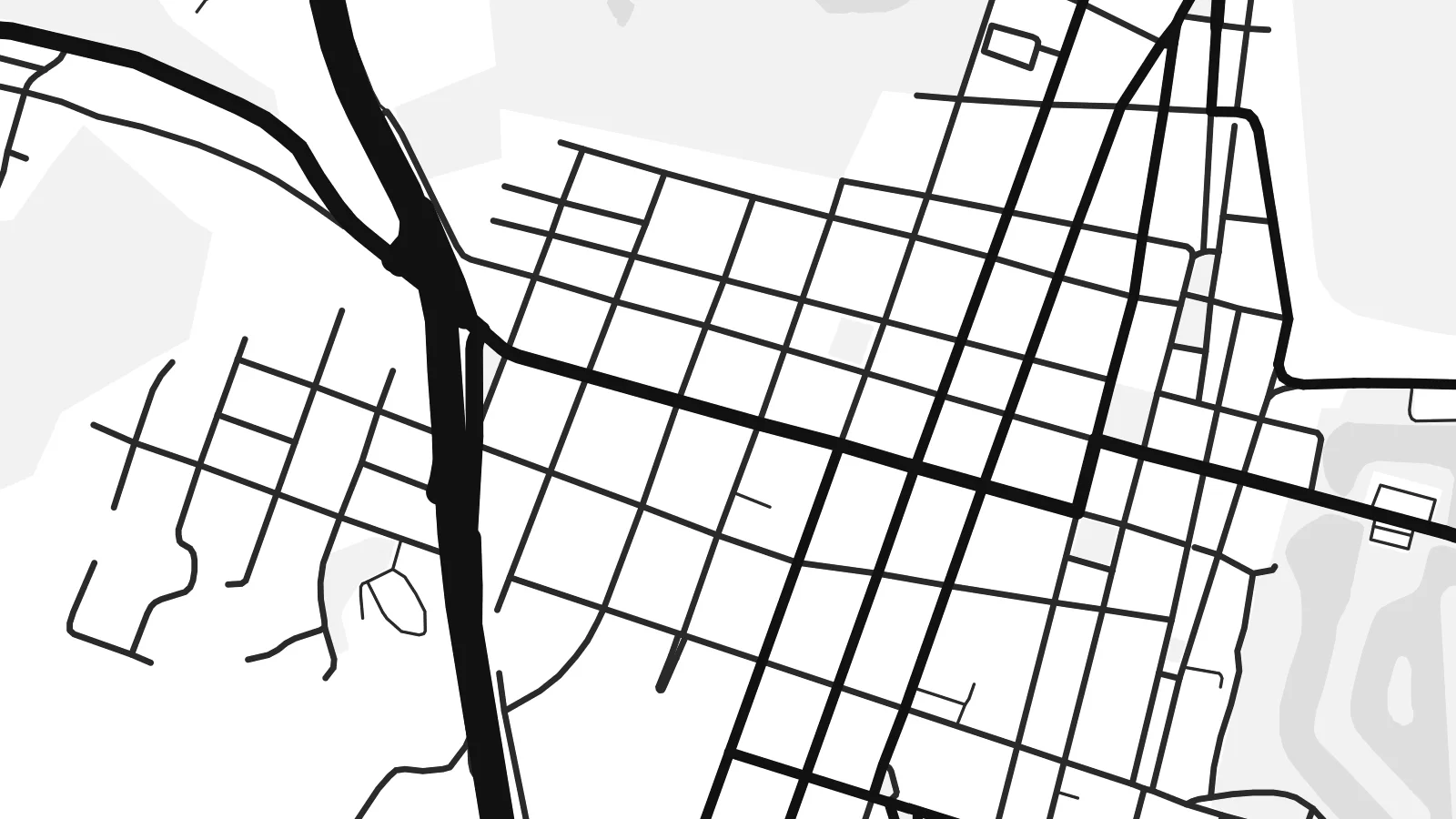
Castro is one of the oldest towns in Paraná. It grew in the eighteenth century as a stopping place on the cattle-drovers' route that linked the southern plains with the markets of São Paulo. The Iapó River passes along the town, and the historic core sits on the ground above it. On a map, this origin shows in a compact central grid, with roads leaving toward the surrounding countryside.
Around the town lies the Campos Gerais, a high, open plateau of grassland, farms and scattered woods. That openness gives the map generous margins, where rural roads and field boundaries replace dense streets. Castro is known today as a major dairy region, a tradition closely tied to the Dutch immigrant colony of Castrolanda, founded nearby in the mid-twentieth century.
Newer neighbourhoods have spread out from the centre along the main roads, and the river's winding course gives them an irregular edge on one side. A Castro map poster brings together the orderly old centre, the curving Iapó and the looser streets beyond, making a composition that feels both historic and clearly linked to its farmland.
The river loops past the town in a series of soft bends. Its curve gives the map a natural boundary and a flowing counterpoint to the straight central streets.
The oldest blocks form a small, regular grid on the higher ground. It is a reminder of the town's beginnings as a rest stop for cattle drovers.
Beyond the built area, long rural roads cross the open Campos Gerais. In a minimalist style they read as spare lines across wide, quiet space.
Taute ke ha hau
Lafi e aho, taha higoa po ke taha kupu haau, hiki e fakatino, lahi po ke tuaga.
Ko e kitiaaga nakai totogi kua tote e maaliali mo e fakamailoga vai. Ko e tau lolomi mo e tau faila HD kua taute ke he 300 DPI, hokotia ke he 7,200 × 10,800 px, nakai fai fakamailoga vai.
Ko e ha Castro
The poster suits anyone from Castro or Castrolanda, and families whose history runs through the farms of the Campos Gerais. A custom title and subtitle can name a farm, a family or a year of arrival, while the coordinates line pins the exact place.
Sand suits the rural character with warm tones, and Paper gives a gentle, almanac-like finish. The $9 digital files come in six print sizes as 300 DPI PNG and print-ready PDF. You can also order a matte printed poster, with an optional wooden frame, for delivery.
Talaage e poster Castro| Lahi he lolomi | Maama | Tau faila |
|---|---|---|
| 30 × 40 cm11.8 × 15.7″ | 3,543 × 4,724 px | PNG · PDF |
| 29.7 × 42 cm (A3)11.7 × 16.5″ | 3,508 × 4,961 px | PNG · PDF |
| 42 × 59.4 cm (A2)16.5 × 23.4″ | 4,961 × 7,016 px | PNG · PDF |
| 45.7 × 61 cm18 × 24″ | 5,400 × 7,200 px | PNG · PDF |
| 50 × 70 cm19.7 × 27.6″ | 5,906 × 8,268 px | PNG · PDF |
| 61 × 91.4 cm24 × 36″ | 7,200 × 10,800 px | PNG · PDF |
Ke fakatatai, ko e fakatino noa kua 900 px e laulahi, fai fakamailoga mo e mo e tau mata komipiuta ni. Ko e tau faila HD kua ato hoko ke he 8× e maama ke he tau faahi takitaha mo e lolomi mitaki he lahi katoa he fakatino.
Fifili e taha puhala i luga he kupega, ti fifili e Poster Lolomi — e lahi mo e, kaeke ke manako ai koe, taha poloka — po ke Tau Faila HD Fakaeletonika. Ko e fakaotiaga totogi ko e taha gahua ni, ti ko e kupega he hau a talaaga ka fakafou fakahaga i mua he fakaotiaga e totogi.
Kua lolomi ai ke he pepa mitaki 200 gsm matte he taha he tau lahi ono, mai he 30 × 40 cm ke hoko ke he 24 × 36″. Kamata e tau poster lolomi mai he $39, kua putoia ai e utaaga.
E. Fifili e poloka akau malolō ke he lanu uli, tea, akau oki mooli, po ke akau pouli. Kua fakalataha mo e sioga malolō nakai malepe ti kua mautali ke tautau. Kamata e tau poster poloka mai he $99, kua putoia ai e utaaga.
Nakai totogi e fakafano ke he motu 60+. Ko e fakatino taha kua lolomi he fenoga lolomi ha mautolu kua tata mo e tau motu 30+, kua hoko mai he tau aho gahua 3–7. Maeke ia koe ke kikite e tuaga mo e fakamuitua he lalo he Haku Tau Fakatonu. Ke he falu motu kua 2–5 e tau tapu, ti ka nakai fakafano a mautolu ki ai, to fakaha he api tupe ia ki mua he totogi.
Fakafano mai e taha ata ki a mautolu he loto he 14 e tau aho tali mai he hokoaga, ti to lolomi foki e mautolu nakai totogi po ke liu atu e totogi ki a koe.
E. He editor i luga he kupega nei, hikihiki e matakupu, e matakupu lalo mo e laini coordinates ke he taha mena kua manako a koe ki ai, ti fifili e puhala mo e lahi. Ko e tau talaaga lolomi, poloka mo e fakaeletonika oti kua fakaaoga tonu e hau a fakatino.
Ma e $9 ka moua e koe e tau faila PNG 300 DPI mo e PDF kua mautali ke lolomi he tau lahi ono oti, nakai fai fakamailoga vai, ke lolomi i fe mena. Nakai maopoopo agaia? Utu hifo fakamua e kitiaaga nakai totogi ne fai fakamailoga vai.
Tata mai
