Thamirabarani river
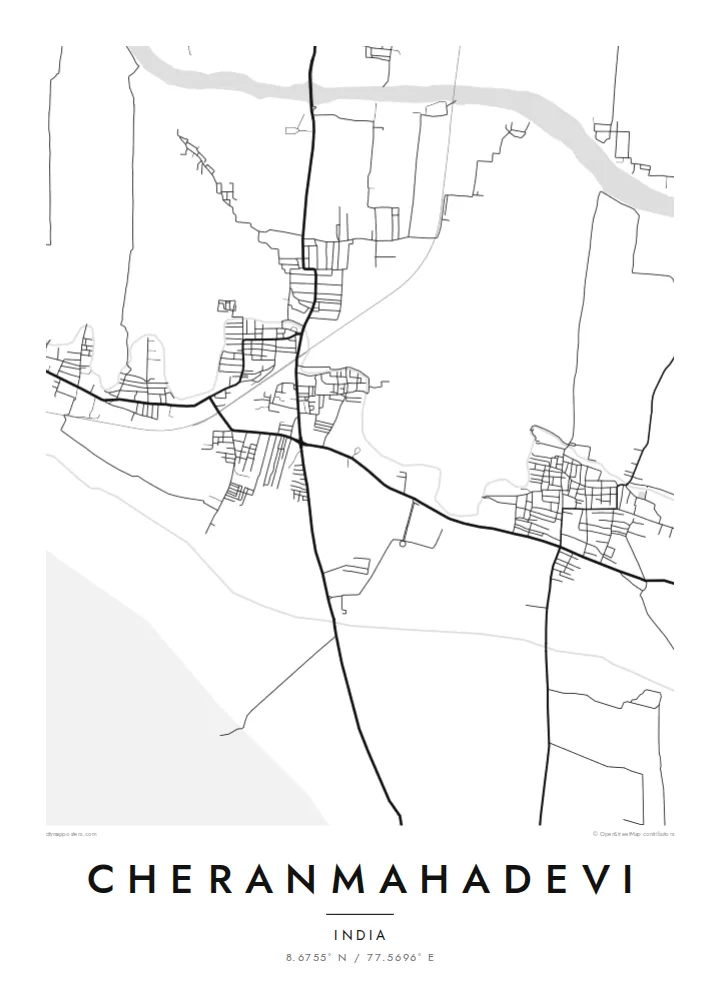
The river curves past the town. Its banks and islands show as soft pale shapes against the darker lines of the streets, and they anchor the whole composition.
Fakatino mape mukamuka · India
8.6755° N / 77.5696° E
A compact Tamil town on the Thamirabarani, its streets on one bank and fields following the river channels outward
Taha e taone, lima e onoonoaga
Tapaki e taha puhala ke kitia ai ki luga he puipui. Kua tatai e totogi he tau puhala oti — pete he lolomi, poloka, po ke faila HD.
 Tau pikselo mooli · faila lolomi 24 × 36″
Maama mitaki ke lolomi
Ko e 100% e fahi mooli mai he faila lolomi. Ko e tau poster oti — pete kua lolomi, poloka, po ke utu hifo — kua taute ke he ha mautolu a tau tokoluga (server) ke he 300 DPI, hokotia ke he 7,200 × 10,800 piksela, ke maeke ai e tau ala ikiiki tote ke maaliali fakamitaki he lolomi 24 × 36″.
He Pā


Ko e mape
Cheranmahadevi sits in Tirunelveli district in the far south of Tamil Nadu, beside the Thamirabarani, the river that waters much of this corner of the state. From above, the town is a tight cluster of lanes pressed against the water. Around it, irrigated paddy land is divided by channels that run roughly parallel to the river's course, so the countryside reads as a series of fine lines.
The town's older streets are short and closely packed, typical of a temple town in the south, while newer roads stretch out along the routes to Tirunelveli and Ambasamudram. To the west the land begins rising toward the Western Ghats. On a map this gives the town a clear sense of direction: river, town, fields, and hills beyond the edge of the frame.
Cheranmahadevi also has a place in the history of the Indian independence movement. In the 1920s a gurukulam was founded here by the nationalist V. V. S. Aiyar, and it became the subject of a well-known controversy. A Cheranmahadevi map poster records the town as it is now, a small grid of streets held between a working river and the fields it feeds.
The river curves past the town. Its banks and islands show as soft pale shapes against the darker lines of the streets, and they anchor the whole composition.
Thin canals leave the river and cross the surrounding farmland. In black and white they read almost like contour lines, spreading outward from the settlement.
The centre is a dense knot of short streets and small blocks, a contrast to the open agricultural land that surrounds it on every side.
Taute ke ha hau
Lafi e aho, taha higoa po ke taha kupu haau, hiki e fakatino, lahi po ke tuaga.
Ko e kitiaaga nakai totogi kua tote e maaliali mo e fakamailoga vai. Ko e tau lolomi mo e tau faila HD kua taute ke he 300 DPI, hokotia ke he 7,200 × 10,800 px, nakai fai fakamailoga vai.
Ko e ha Cheranmahadevi
People who grew up along the Thamirabarani, or who have family in Tirunelveli district, often want something that shows exactly where home sits in relation to the river. A plain line drawing of the town does that more quietly than a photograph can.
The HD file costs $9 and comes in six print sizes, each as a 300 DPI PNG and a print-ready PDF. You can change the title, subtitle and coordinates line, and choose Classic, Noir, Paper, Blueprint or Sand. A free 900 px preview lets you check it first.
Talaage e poster Cheranmahadevi| Lahi he lolomi | Maama | Tau faila |
|---|---|---|
| 30 × 40 cm11.8 × 15.7″ | 3,543 × 4,724 px | PNG · PDF |
| 29.7 × 42 cm (A3)11.7 × 16.5″ | 3,508 × 4,961 px | PNG · PDF |
| 42 × 59.4 cm (A2)16.5 × 23.4″ | 4,961 × 7,016 px | PNG · PDF |
| 45.7 × 61 cm18 × 24″ | 5,400 × 7,200 px | PNG · PDF |
| 50 × 70 cm19.7 × 27.6″ | 5,906 × 8,268 px | PNG · PDF |
| 61 × 91.4 cm24 × 36″ | 7,200 × 10,800 px | PNG · PDF |
Ke fakatatai, ko e fakatino noa kua 900 px e laulahi, fai fakamailoga mo e mo e tau mata komipiuta ni. Ko e tau faila HD kua ato hoko ke he 8× e maama ke he tau faahi takitaha mo e lolomi mitaki he lahi katoa he fakatino.
Fifili e taha puhala i luga he kupega, ti fifili e Poster Lolomi — e lahi mo e, kaeke ke manako ai koe, taha poloka — po ke Tau Faila HD Fakaeletonika. Ko e fakaotiaga totogi ko e taha gahua ni, ti ko e kupega he hau a talaaga ka fakafou fakahaga i mua he fakaotiaga e totogi.
Kua lolomi ai ke he pepa mitaki 200 gsm matte he taha he tau lahi ono, mai he 30 × 40 cm ke hoko ke he 24 × 36″. Kamata e tau poster lolomi mai he $39, kua putoia ai e utaaga.
E. Fifili e poloka akau malolō ke he lanu uli, tea, akau oki mooli, po ke akau pouli. Kua fakalataha mo e sioga malolō nakai malepe ti kua mautali ke tautau. Kamata e tau poster poloka mai he $99, kua putoia ai e utaaga.
Nakai totogi e fakafano ke he motu 60+. Ko e fakatino taha kua lolomi he fenoga lolomi ha mautolu kua tata mo e tau motu 30+, kua hoko mai he tau aho gahua 3–7. Maeke ia koe ke kikite e tuaga mo e fakamuitua he lalo he Haku Tau Fakatonu. Ke he falu motu kua 2–5 e tau tapu, ti ka nakai fakafano a mautolu ki ai, to fakaha he api tupe ia ki mua he totogi.
Fakafano mai e taha ata ki a mautolu he loto he 14 e tau aho tali mai he hokoaga, ti to lolomi foki e mautolu nakai totogi po ke liu atu e totogi ki a koe.
E. He editor i luga he kupega nei, hikihiki e matakupu, e matakupu lalo mo e laini coordinates ke he taha mena kua manako a koe ki ai, ti fifili e puhala mo e lahi. Ko e tau talaaga lolomi, poloka mo e fakaeletonika oti kua fakaaoga tonu e hau a fakatino.
Ma e $9 ka moua e koe e tau faila PNG 300 DPI mo e PDF kua mautali ke lolomi he tau lahi ono oti, nakai fai fakamailoga vai, ke lolomi i fe mena. Nakai maopoopo agaia? Utu hifo fakamua e kitiaaga nakai totogi ne fai fakamailoga vai.
Tata mai
