Plateau setting
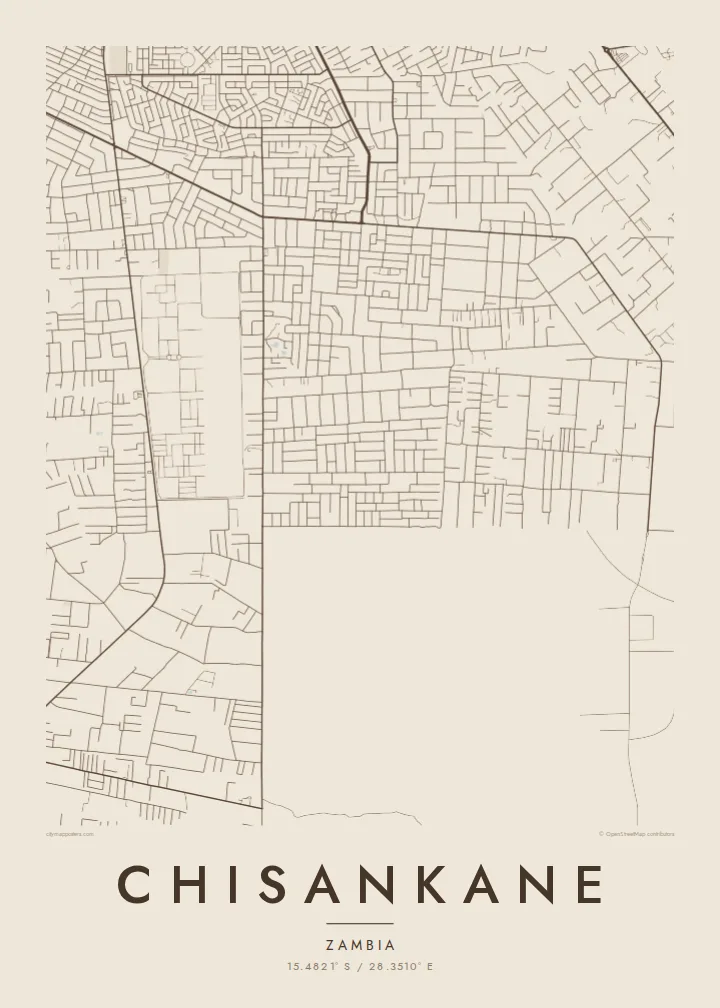
The area sits on the flat, open plateau of central Zambia. With few natural barriers, streets and plots spread outward evenly, which gives the map a broad, horizontal feel.
Fakatino mape mukamuka · Zambia
15.4821° S / 28.3510° E
A residential area on the edge of the Lusaka region, where plotted streets meet open plateau land and unpaved tracks.


Taha e taone, lima e onoonoaga
Tapaki e taha puhala ke kitia ai ki luga he puipui. Kua tatai e totogi he tau puhala oti — pete he lolomi, poloka, po ke faila HD.
 Tau pikselo mooli · faila lolomi 24 × 36″
Maama mitaki ke lolomi
Ko e 100% e fahi mooli mai he faila lolomi. Ko e tau poster oti — pete kua lolomi, poloka, po ke utu hifo — kua taute ke he ha mautolu a tau tokoluga (server) ke he 300 DPI, hokotia ke he 7,200 × 10,800 piksela, ke maeke ai e tau ala ikiiki tote ke maaliali fakamitaki he lolomi 24 × 36″.
He Pā


Ko e mape
Chisankane lies in Lusaka Province, close to Zambia's capital, on the high central plateau that gives the region its relatively mild climate. From above, it reads as a patchwork of residential plots, straight access roads and unpaved tracks, with density thinning out toward open land. There is no coastline or major river to organise the map, so its character comes from the pattern of plots and roads.
Like many settlements around Lusaka, it has grown as the capital has expanded, and the street layout shows that process. Some parts are laid out in regular blocks, while others follow older paths and field boundaries. The contrast between planned streets and informal lanes is visible even at a small scale and gives the map an uneven, lived-in texture.
A Chisankane map poster records a place in the middle of change, part suburb and part countryside. It will look different in ten years, which is part of its value. For families who built a home here, or who left for work elsewhere, the map fixes one moment in the growth of the neighbourhood.
The area sits on the flat, open plateau of central Zambia. With few natural barriers, streets and plots spread outward evenly, which gives the map a broad, horizontal feel.
In the more planned sections, residential plots line up along straight roads in regular rows. They form small rectangular cells that repeat across that part of the map.
Toward the edges, unpaved tracks and old field boundaries take over from planned streets. Their looser lines show where the settlement meets the surrounding land.
Taute ke ha hau
Lafi e aho, taha higoa po ke taha kupu haau, hiki e fakatino, lahi po ke tuaga.
Ko e kitiaaga nakai totogi kua tote e maaliali mo e fakamailoga vai. Ko e tau lolomi mo e tau faila HD kua taute ke he 300 DPI, hokotia ke he 7,200 × 10,800 px, nakai fai fakamailoga vai.
Ko e ha Chisankane
A map of a neighbourhood like Chisankane is usually personal: the street where a house was built, or the area a family moved to from elsewhere. Framed, it becomes a record of where life happened, not a tourist souvenir.
The title, subtitle and coordinates line can be edited to add a family name or the year a home was finished. Choose Classic black & white, Noir, Paper, Blueprint or Sand. Download HD files for $9, or order a matte print shipped from a nearby print partner.
Talaage e poster Chisankane| Lahi he lolomi | Maama | Tau faila |
|---|---|---|
| 30 × 40 cm11.8 × 15.7″ | 3,543 × 4,724 px | PNG · PDF |
| 29.7 × 42 cm (A3)11.7 × 16.5″ | 3,508 × 4,961 px | PNG · PDF |
| 42 × 59.4 cm (A2)16.5 × 23.4″ | 4,961 × 7,016 px | PNG · PDF |
| 45.7 × 61 cm18 × 24″ | 5,400 × 7,200 px | PNG · PDF |
| 50 × 70 cm19.7 × 27.6″ | 5,906 × 8,268 px | PNG · PDF |
| 61 × 91.4 cm24 × 36″ | 7,200 × 10,800 px | PNG · PDF |
Ke fakatatai, ko e fakatino noa kua 900 px e laulahi, fai fakamailoga mo e mo e tau mata komipiuta ni. Ko e tau faila HD kua ato hoko ke he 8× e maama ke he tau faahi takitaha mo e lolomi mitaki he lahi katoa he fakatino.
Fifili e taha puhala i luga he kupega, ti fifili e Poster Lolomi — e lahi mo e, kaeke ke manako ai koe, taha poloka — po ke Tau Faila HD Fakaeletonika. Ko e fakaotiaga totogi ko e taha gahua ni, ti ko e kupega he hau a talaaga ka fakafou fakahaga i mua he fakaotiaga e totogi.
Kua lolomi ai ke he pepa mitaki 200 gsm matte he taha he tau lahi ono, mai he 30 × 40 cm ke hoko ke he 24 × 36″. Kamata e tau poster lolomi mai he $39, kua putoia ai e utaaga.
E. Fifili e poloka akau malolō ke he lanu uli, tea, akau oki mooli, po ke akau pouli. Kua fakalataha mo e sioga malolō nakai malepe ti kua mautali ke tautau. Kamata e tau poster poloka mai he $99, kua putoia ai e utaaga.
Nakai totogi e fakafano ke he motu 60+. Ko e fakatino taha kua lolomi he fenoga lolomi ha mautolu kua tata mo e tau motu 30+, kua hoko mai he tau aho gahua 3–7. Maeke ia koe ke kikite e tuaga mo e fakamuitua he lalo he Haku Tau Fakatonu. Ke he falu motu kua 2–5 e tau tapu, ti ka nakai fakafano a mautolu ki ai, to fakaha he api tupe ia ki mua he totogi.
Fakafano mai e taha ata ki a mautolu he loto he 14 e tau aho tali mai he hokoaga, ti to lolomi foki e mautolu nakai totogi po ke liu atu e totogi ki a koe.
E. He editor i luga he kupega nei, hikihiki e matakupu, e matakupu lalo mo e laini coordinates ke he taha mena kua manako a koe ki ai, ti fifili e puhala mo e lahi. Ko e tau talaaga lolomi, poloka mo e fakaeletonika oti kua fakaaoga tonu e hau a fakatino.
Ma e $9 ka moua e koe e tau faila PNG 300 DPI mo e PDF kua mautali ke lolomi he tau lahi ono oti, nakai fai fakamailoga vai, ke lolomi i fe mena. Nakai maopoopo agaia? Utu hifo fakamua e kitiaaga nakai totogi ne fai fakamailoga vai.
Tata mai
