The hill fort
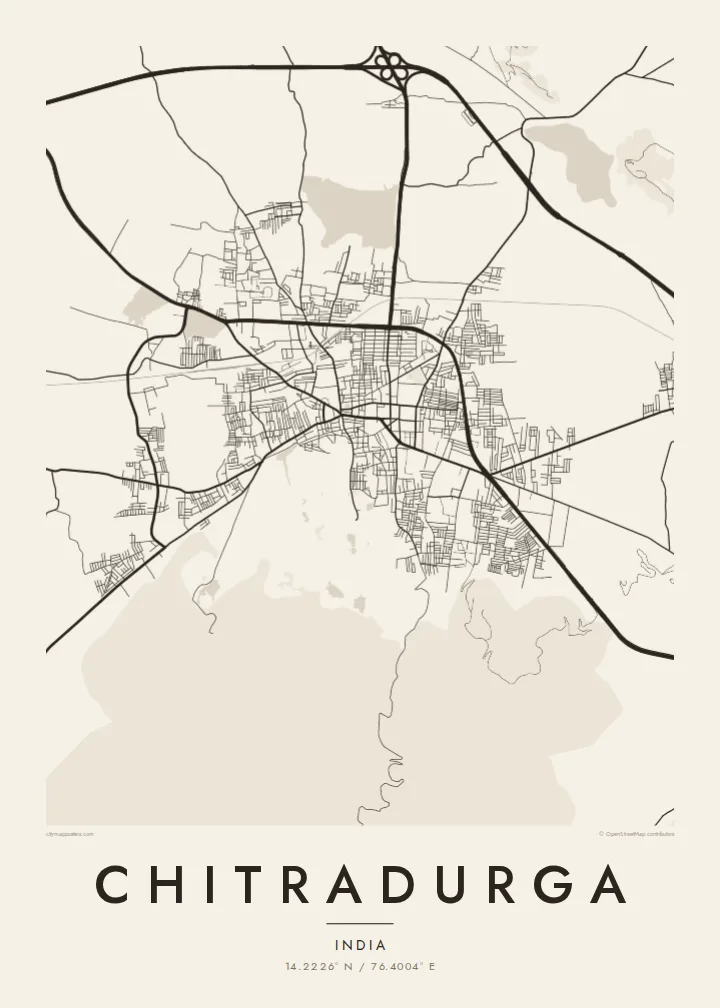
The fort's walls climb the boulder-covered hill in successive rings. On the poster the hill is a broad open shape with only a few paths, which sets it clearly apart from the town below.
Fakatino mape mukamuka · India
14.2226° N / 76.4004° E
A town wrapped around a granite hill fort, where boulder-strewn slopes and rings of stone walls push the streets outward.




Taha e taone, lima e onoonoaga
Tapaki e taha puhala ke kitia ai ki luga he puipui. Kua tatai e totogi he tau puhala oti — pete he lolomi, poloka, po ke faila HD.
 Tau pikselo mooli · faila lolomi 24 × 36″
Maama mitaki ke lolomi
Ko e 100% e fahi mooli mai he faila lolomi. Ko e tau poster oti — pete kua lolomi, poloka, po ke utu hifo — kua taute ke he ha mautolu a tau tokoluga (server) ke he 300 DPI, hokotia ke he 7,200 × 10,800 piksela, ke maeke ai e tau ala ikiiki tote ke maaliali fakamitaki he lolomi 24 × 36″.
He Pā


Ko e mape
Chitradurga, a district headquarters in central Karnataka, grew at the foot of a rocky hill covered in enormous granite boulders. Crowning it is Chitradurga Fort, a stone fortress built up over several centuries and strengthened by the Nayaka rulers of the region. On a map the fort shows as a large, nearly empty area of hillside, with the town's streets crowded tightly around its lower edge.
The fort is known locally as Elu Suttina Kote, the fort of seven rounds, after its concentric lines of walls. One of the town's best-known stories concerns Onake Obavva, a woman remembered for defending a gap in the walls with a wooden pestle during a siege in the eighteenth century. The national highway between Bengaluru and Pune passes close to the town.
A Chitradurga map poster brings out an unusual composition. Where most towns have a dense centre, this one has a hollow of rock and ramparts surrounded by streets. In black and white the contrast is sharp: dense lanes on one side, the pale mass of the hill on the other, and the lines of fortification between them.
The fort's walls climb the boulder-covered hill in successive rings. On the poster the hill is a broad open shape with only a few paths, which sets it clearly apart from the town below.
The streets closest to the fort are narrow and irregular, following the curve of the hill's base. They are the most densely drawn part of the map.
The main highway runs past the town as a long, straight line. Its rigid course contrasts with the curving streets and the rough outline of the hill.
Taute ke ha hau
Lafi e aho, taha higoa po ke taha kupu haau, hiki e fakatino, lahi po ke tuaga.
Ko e kitiaaga nakai totogi kua tote e maaliali mo e fakamailoga vai. Ko e tau lolomi mo e tau faila HD kua taute ke he 300 DPI, hokotia ke he 7,200 × 10,800 px, nakai fai fakamailoga vai.
Ko e ha Chitradurga
Chitradurga is a strong choice for anyone with roots in the district, or for travellers who climbed the fort and remember the view over the rooftops. It reads well at larger sizes, where the rings of walls and the dense old streets have room to show.
The title, subtitle and coordinates line can all be changed, so the poster can name a family home, a college year or a special date. Choose one of five styles: Classic black & white, Noir, Paper, Blueprint or Sand. Noir makes the pale hill stand out especially clearly.
Talaage e poster Chitradurga| Lahi he lolomi | Maama | Tau faila |
|---|---|---|
| 30 × 40 cm11.8 × 15.7″ | 3,543 × 4,724 px | PNG · PDF |
| 29.7 × 42 cm (A3)11.7 × 16.5″ | 3,508 × 4,961 px | PNG · PDF |
| 42 × 59.4 cm (A2)16.5 × 23.4″ | 4,961 × 7,016 px | PNG · PDF |
| 45.7 × 61 cm18 × 24″ | 5,400 × 7,200 px | PNG · PDF |
| 50 × 70 cm19.7 × 27.6″ | 5,906 × 8,268 px | PNG · PDF |
| 61 × 91.4 cm24 × 36″ | 7,200 × 10,800 px | PNG · PDF |
Ke fakatatai, ko e fakatino noa kua 900 px e laulahi, fai fakamailoga mo e mo e tau mata komipiuta ni. Ko e tau faila HD kua ato hoko ke he 8× e maama ke he tau faahi takitaha mo e lolomi mitaki he lahi katoa he fakatino.
Fifili e taha puhala i luga he kupega, ti fifili e Poster Lolomi — e lahi mo e, kaeke ke manako ai koe, taha poloka — po ke Tau Faila HD Fakaeletonika. Ko e fakaotiaga totogi ko e taha gahua ni, ti ko e kupega he hau a talaaga ka fakafou fakahaga i mua he fakaotiaga e totogi.
Kua lolomi ai ke he pepa mitaki 200 gsm matte he taha he tau lahi ono, mai he 30 × 40 cm ke hoko ke he 24 × 36″. Kamata e tau poster lolomi mai he $39, kua putoia ai e utaaga.
E. Fifili e poloka akau malolō ke he lanu uli, tea, akau oki mooli, po ke akau pouli. Kua fakalataha mo e sioga malolō nakai malepe ti kua mautali ke tautau. Kamata e tau poster poloka mai he $99, kua putoia ai e utaaga.
Nakai totogi e fakafano ke he motu 60+. Ko e fakatino taha kua lolomi he fenoga lolomi ha mautolu kua tata mo e tau motu 30+, kua hoko mai he tau aho gahua 3–7. Maeke ia koe ke kikite e tuaga mo e fakamuitua he lalo he Haku Tau Fakatonu. Ke he falu motu kua 2–5 e tau tapu, ti ka nakai fakafano a mautolu ki ai, to fakaha he api tupe ia ki mua he totogi.
Fakafano mai e taha ata ki a mautolu he loto he 14 e tau aho tali mai he hokoaga, ti to lolomi foki e mautolu nakai totogi po ke liu atu e totogi ki a koe.
E. He editor i luga he kupega nei, hikihiki e matakupu, e matakupu lalo mo e laini coordinates ke he taha mena kua manako a koe ki ai, ti fifili e puhala mo e lahi. Ko e tau talaaga lolomi, poloka mo e fakaeletonika oti kua fakaaoga tonu e hau a fakatino.
Ma e $9 ka moua e koe e tau faila PNG 300 DPI mo e PDF kua mautali ke lolomi he tau lahi ono oti, nakai fai fakamailoga vai, ke lolomi i fe mena. Nakai maopoopo agaia? Utu hifo fakamua e kitiaaga nakai totogi ne fai fakamailoga vai.
Tata mai
