Temple tanks
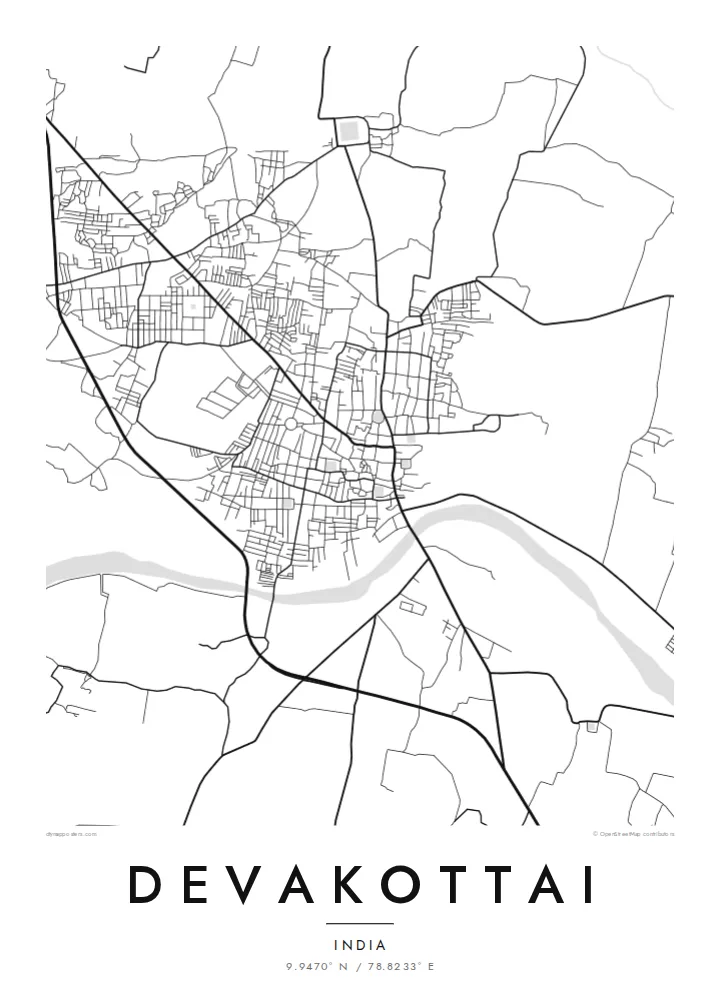
Water tanks, traditionally tied to temples across this region, show up as crisp geometric voids among the streets and are among the most recognisable shapes on the whole map.
Fakatino mape mukamuka · India
9.9470° N / 78.8233° E
A Chettinad town of long merchant streets and square temple tanks, spread across the flat plain of southern Tamil Nadu


Taha e taone, lima e onoonoaga
Tapaki e taha puhala ke kitia ai ki luga he puipui. Kua tatai e totogi he tau puhala oti — pete he lolomi, poloka, po ke faila HD.
 Tau pikselo mooli · faila lolomi 24 × 36″
Maama mitaki ke lolomi
Ko e 100% e fahi mooli mai he faila lolomi. Ko e tau poster oti — pete kua lolomi, poloka, po ke utu hifo — kua taute ke he ha mautolu a tau tokoluga (server) ke he 300 DPI, hokotia ke he 7,200 × 10,800 piksela, ke maeke ai e tau ala ikiiki tote ke maaliali fakamitaki he lolomi 24 × 36″.
He Pā


Ko e mape
Devakottai lies in Sivaganga district, in the Chettinad region of Tamil Nadu, a stretch of dry, level country long associated with the Nattukottai Chettiar trading community. Much of the town's wealth came from their commerce, and the plan still shows it: long, fairly straight streets lined with deep plots, where large family houses once reached back from one road almost to the next.
From above, the flatness of the land is the first thing the map reveals. No hills bend the streets, so the pattern follows older lanes, temple precincts and the tanks that hold water through the dry months. These square and rectangular reservoirs appear as clean open shapes within the grid, small pauses in an otherwise continuous weave of streets.
A Devakottai map poster records that ordered, low-lying town in fine black line. The mansions Chettinad is known for do not appear as pictures, but their long plots and regular frontages leave a trace in the rhythm of the streets. Toward the edges, roads run out across open farmland to neighbouring villages, and the density of the centre gives way to scattered lines.
Water tanks, traditionally tied to temples across this region, show up as crisp geometric voids among the streets and are among the most recognisable shapes on the whole map.
Streets in the older part of town run long and straight, echoing the deep house plots of the Chettiar merchant families who built much of Devakottai.
With no hills to steer them, the roads leaving town radiate freely across the flat countryside of Sivaganga district, giving the poster a loose, star-like fringe.
Taute ke ha hau
Lafi e aho, taha higoa po ke taha kupu haau, hiki e fakatino, lahi po ke tuaga.
Ko e kitiaaga nakai totogi kua tote e maaliali mo e fakamailoga vai. Ko e tau lolomi mo e tau faila HD kua taute ke he 300 DPI, hokotia ke he 7,200 × 10,800 px, nakai fai fakamailoga vai.
Ko e ha Devakottai
Many families with roots in Chettinad now live far from it, in Chennai or overseas. A map of Devakottai is a plain, dignified way to keep an ancestral town in view, one that suits a home where a photograph might feel too sentimental.
Add a family name as the title, a year in the subtitle, or keep the coordinates. Paper and Sand give the plan a warm tone, and Classic black & white keeps it crisp. Digital files come in six sizes, or order a matte print with an optional frame.
Talaage e poster Devakottai| Lahi he lolomi | Maama | Tau faila |
|---|---|---|
| 30 × 40 cm11.8 × 15.7″ | 3,543 × 4,724 px | PNG · PDF |
| 29.7 × 42 cm (A3)11.7 × 16.5″ | 3,508 × 4,961 px | PNG · PDF |
| 42 × 59.4 cm (A2)16.5 × 23.4″ | 4,961 × 7,016 px | PNG · PDF |
| 45.7 × 61 cm18 × 24″ | 5,400 × 7,200 px | PNG · PDF |
| 50 × 70 cm19.7 × 27.6″ | 5,906 × 8,268 px | PNG · PDF |
| 61 × 91.4 cm24 × 36″ | 7,200 × 10,800 px | PNG · PDF |
Ke fakatatai, ko e fakatino noa kua 900 px e laulahi, fai fakamailoga mo e mo e tau mata komipiuta ni. Ko e tau faila HD kua ato hoko ke he 8× e maama ke he tau faahi takitaha mo e lolomi mitaki he lahi katoa he fakatino.
Fifili e taha puhala i luga he kupega, ti fifili e Poster Lolomi — e lahi mo e, kaeke ke manako ai koe, taha poloka — po ke Tau Faila HD Fakaeletonika. Ko e fakaotiaga totogi ko e taha gahua ni, ti ko e kupega he hau a talaaga ka fakafou fakahaga i mua he fakaotiaga e totogi.
Kua lolomi ai ke he pepa mitaki 200 gsm matte he taha he tau lahi ono, mai he 30 × 40 cm ke hoko ke he 24 × 36″. Kamata e tau poster lolomi mai he $39, kua putoia ai e utaaga.
E. Fifili e poloka akau malolō ke he lanu uli, tea, akau oki mooli, po ke akau pouli. Kua fakalataha mo e sioga malolō nakai malepe ti kua mautali ke tautau. Kamata e tau poster poloka mai he $99, kua putoia ai e utaaga.
Nakai totogi e fakafano ke he motu 60+. Ko e fakatino taha kua lolomi he fenoga lolomi ha mautolu kua tata mo e tau motu 30+, kua hoko mai he tau aho gahua 3–7. Maeke ia koe ke kikite e tuaga mo e fakamuitua he lalo he Haku Tau Fakatonu. Ke he falu motu kua 2–5 e tau tapu, ti ka nakai fakafano a mautolu ki ai, to fakaha he api tupe ia ki mua he totogi.
Fakafano mai e taha ata ki a mautolu he loto he 14 e tau aho tali mai he hokoaga, ti to lolomi foki e mautolu nakai totogi po ke liu atu e totogi ki a koe.
E. He editor i luga he kupega nei, hikihiki e matakupu, e matakupu lalo mo e laini coordinates ke he taha mena kua manako a koe ki ai, ti fifili e puhala mo e lahi. Ko e tau talaaga lolomi, poloka mo e fakaeletonika oti kua fakaaoga tonu e hau a fakatino.
Ma e $9 ka moua e koe e tau faila PNG 300 DPI mo e PDF kua mautali ke lolomi he tau lahi ono oti, nakai fai fakamailoga vai, ke lolomi i fe mena. Nakai maopoopo agaia? Utu hifo fakamua e kitiaaga nakai totogi ne fai fakamailoga vai.
Tata mai
