Old village core
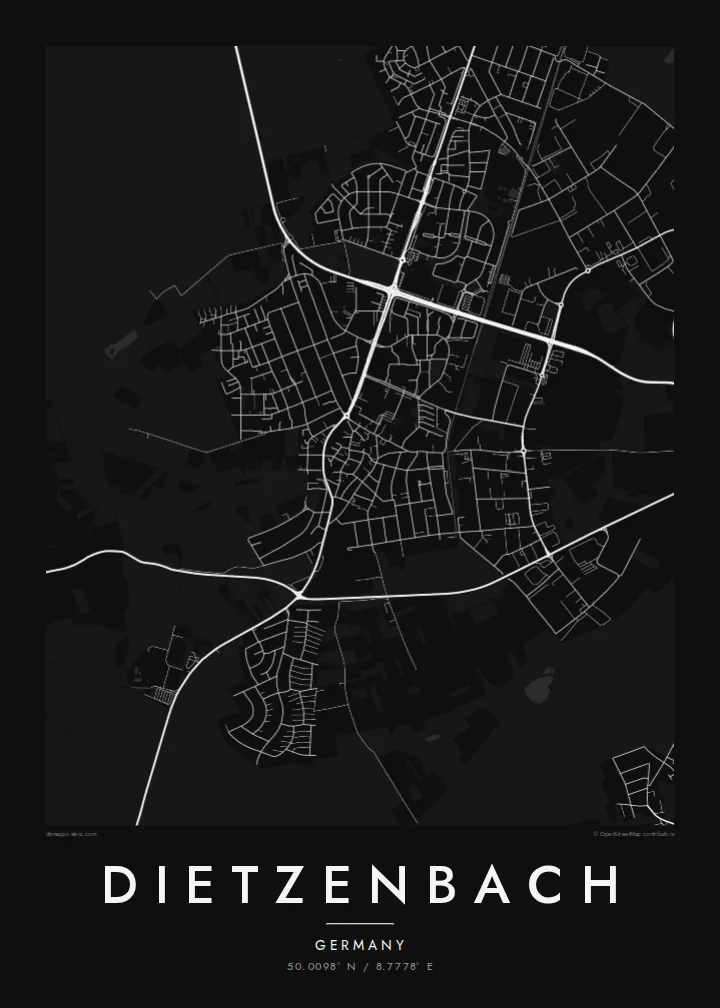
The historic centre keeps the irregular, curving streets of a Hessian village. On the poster it forms a dense, slightly organic knot at the middle of the map.
Fakatino mape mukamuka · Germany
50.0098° N / 8.7778° E
A compact Hessian town south of Frankfurt, where an old village core meets post-war housing and wooded edges.



Taha e taone, lima e onoonoaga
Tapaki e taha puhala ke kitia ai ki luga he puipui. Kua tatai e totogi he tau puhala oti — pete he lolomi, poloka, po ke faila HD.
 Tau pikselo mooli · faila lolomi 24 × 36″
Maama mitaki ke lolomi
Ko e 100% e fahi mooli mai he faila lolomi. Ko e tau poster oti — pete kua lolomi, poloka, po ke utu hifo — kua taute ke he ha mautolu a tau tokoluga (server) ke he 300 DPI, hokotia ke he 7,200 × 10,800 piksela, ke maeke ai e tau ala ikiiki tote ke maaliali fakamitaki he lolomi 24 × 36″.
He Pā


Ko e mape
Dietzenbach lies in southern Hesse, a short distance south-east of Frankfurt am Main, and is the administrative seat of the district of Offenbach. For most of its history it was a small village. It grew rapidly in the decades after the Second World War, and that growth is plain to see on a map, where different building eras sit side by side.
At the centre, the irregular lanes of the old village core curve around the church and the older houses. Around them spread later residential quarters with longer, straighter streets, larger blocks and cul-de-sacs, along with commercial areas on the outskirts. Fields and woodland close in on several sides, as they do around many Rhine-Main towns set between forest and farmland.
A Dietzenbach map poster shows these layers as they are. The tight knot of the historic centre, the looser geometry of the newer districts and the green margins of the town are all drawn with the same care. The map reads as a portrait of how a village became a town within a single lifetime.
The historic centre keeps the irregular, curving streets of a Hessian village. On the poster it forms a dense, slightly organic knot at the middle of the map.
Residential districts built as the town expanded have longer streets and larger blocks. They give the map a clear contrast between old and new ways of laying out a town.
Woodland and fields surround the town. They leave calm open areas at the edges of the poster and show where the built-up area ends and the Rhine-Main countryside begins.
Taute ke ha hau
Lafi e aho, taha higoa po ke taha kupu haau, hiki e fakatino, lahi po ke tuaga.
Ko e kitiaaga nakai totogi kua tote e maaliali mo e fakamailoga vai. Ko e tau lolomi mo e tau faila HD kua taute ke he 300 DPI, hokotia ke he 7,200 × 10,800 px, nakai fai fakamailoga vai.
Ko e ha Dietzenbach
Dietzenbach is home to many families who came from elsewhere and stayed, and to commuters who work in Frankfurt but live here. A map of its streets marks a personal chapter: the place where a household settled or where children grew up.
The title, subtitle and coordinates can be personalised, for example with a street name or the year you moved in. Choose from Classic black & white, Noir, Paper, Blueprint and Sand, and receive print-ready PDFs and 300 DPI PNGs in six sizes.
Talaage e poster Dietzenbach| Lahi he lolomi | Maama | Tau faila |
|---|---|---|
| 30 × 40 cm11.8 × 15.7″ | 3,543 × 4,724 px | PNG · PDF |
| 29.7 × 42 cm (A3)11.7 × 16.5″ | 3,508 × 4,961 px | PNG · PDF |
| 42 × 59.4 cm (A2)16.5 × 23.4″ | 4,961 × 7,016 px | PNG · PDF |
| 45.7 × 61 cm18 × 24″ | 5,400 × 7,200 px | PNG · PDF |
| 50 × 70 cm19.7 × 27.6″ | 5,906 × 8,268 px | PNG · PDF |
| 61 × 91.4 cm24 × 36″ | 7,200 × 10,800 px | PNG · PDF |
Ke fakatatai, ko e fakatino noa kua 900 px e laulahi, fai fakamailoga mo e mo e tau mata komipiuta ni. Ko e tau faila HD kua ato hoko ke he 8× e maama ke he tau faahi takitaha mo e lolomi mitaki he lahi katoa he fakatino.
Fifili e taha puhala i luga he kupega, ti fifili e Poster Lolomi — e lahi mo e, kaeke ke manako ai koe, taha poloka — po ke Tau Faila HD Fakaeletonika. Ko e fakaotiaga totogi ko e taha gahua ni, ti ko e kupega he hau a talaaga ka fakafou fakahaga i mua he fakaotiaga e totogi.
Kua lolomi ai ke he pepa mitaki 200 gsm matte he taha he tau lahi ono, mai he 30 × 40 cm ke hoko ke he 24 × 36″. Kamata e tau poster lolomi mai he $39, kua putoia ai e utaaga.
E. Fifili e poloka akau malolō ke he lanu uli, tea, akau oki mooli, po ke akau pouli. Kua fakalataha mo e sioga malolō nakai malepe ti kua mautali ke tautau. Kamata e tau poster poloka mai he $99, kua putoia ai e utaaga.
Nakai totogi e fakafano ke he motu 60+. Ko e fakatino taha kua lolomi he fenoga lolomi ha mautolu kua tata mo e tau motu 30+, kua hoko mai he tau aho gahua 3–7. Maeke ia koe ke kikite e tuaga mo e fakamuitua he lalo he Haku Tau Fakatonu. Ke he falu motu kua 2–5 e tau tapu, ti ka nakai fakafano a mautolu ki ai, to fakaha he api tupe ia ki mua he totogi.
Fakafano mai e taha ata ki a mautolu he loto he 14 e tau aho tali mai he hokoaga, ti to lolomi foki e mautolu nakai totogi po ke liu atu e totogi ki a koe.
E. He editor i luga he kupega nei, hikihiki e matakupu, e matakupu lalo mo e laini coordinates ke he taha mena kua manako a koe ki ai, ti fifili e puhala mo e lahi. Ko e tau talaaga lolomi, poloka mo e fakaeletonika oti kua fakaaoga tonu e hau a fakatino.
Ma e $9 ka moua e koe e tau faila PNG 300 DPI mo e PDF kua mautali ke lolomi he tau lahi ono oti, nakai fai fakamailoga vai, ke lolomi i fe mena. Nakai maopoopo agaia? Utu hifo fakamua e kitiaaga nakai totogi ne fai fakamailoga vai.
