Suruga Bay shore
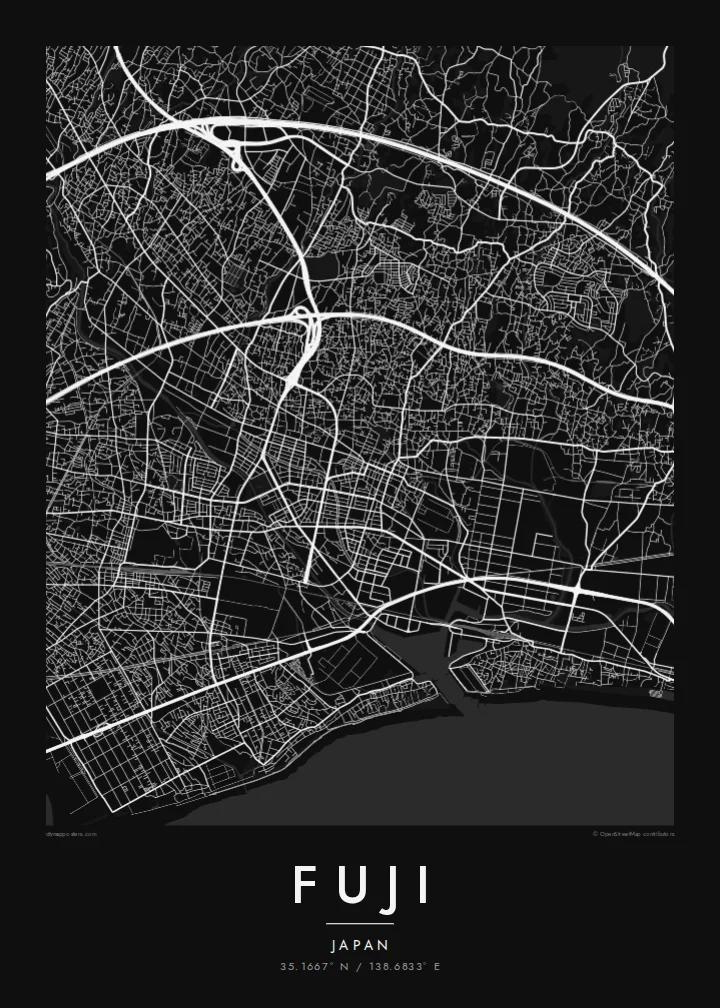
A long, nearly straight coastline closes the southern edge of the city, giving the map a firm baseline against the open water of the bay.
Fakatino mape mukamuka · Japan
35.1667° N / 138.6833° E
An industrial city spreading from the shore of Suruga Bay toward the lower slopes of Mount Fuji.



Taha e taone, lima e onoonoaga
Tapaki e taha puhala ke kitia ai ki luga he puipui. Kua tatai e totogi he tau puhala oti — pete he lolomi, poloka, po ke faila HD.
 Tau pikselo mooli · faila lolomi 24 × 36″
Maama mitaki ke lolomi
Ko e 100% e fahi mooli mai he faila lolomi. Ko e tau poster oti — pete kua lolomi, poloka, po ke utu hifo — kua taute ke he ha mautolu a tau tokoluga (server) ke he 300 DPI, hokotia ke he 7,200 × 10,800 piksela, ke maeke ai e tau ala ikiiki tote ke maaliali fakamitaki he lolomi 24 × 36″.
He Pā


Ko e mape
Fuji lies in eastern Shizuoka Prefecture, on the coastal plain between Suruga Bay and the southern foot of Mount Fuji. On a map the city appears as a broad band of development stretching inland from the sea, its streets climbing gently as the ground rises toward the mountain. The Fuji River, known as one of Japan's fastest-flowing rivers, forms a wide channel on the western side.
Fuji has long been a major centre of paper production, supplied by plentiful groundwater from the mountain, and large mills with tall chimneys are a familiar sight. From above they appear as big industrial blocks near the coast and along the rail lines. The Tōkaidō Shinkansen and the main Tōkaidō line both cross the city from east to west.
Beyond the built-up area, fields and tea plantations extend up the slopes, and on clear days the mountain dominates the view north. A Fuji map poster centres on the city's dense core while hinting at the land rising toward Japan's highest peak. The mix of coastline, industry and rising ground gives the print an unusual sense of direction.
A long, nearly straight coastline closes the southern edge of the city, giving the map a firm baseline against the open water of the bay.
The wide riverbed on the western side carries water from the mountains down to the sea. It is one of the most prominent natural lines on the print.
Large industrial sites linked to the paper industry sit near the coast and the rail lines, forming broad geometric blocks among the residential streets.
Taute ke ha hau
Lafi e aho, taha higoa po ke taha kupu haau, hiki e fakatino, lahi po ke tuaga.
Ko e kitiaaga nakai totogi kua tote e maaliali mo e fakamailoga vai. Ko e tau lolomi mo e tau faila HD kua taute ke he 300 DPI, hokotia ke he 7,200 × 10,800 px, nakai fai fakamailoga vai.
Ko e ha Fuji
Fuji suits anyone with ties to Shizuoka, people fascinated by Japan's most famous mountain and those who have watched it from the city's streets. The print is quieter than a mountain photograph, but just as closely tied to the place.
Personalise the title, subtitle and coordinates line, perhaps with the name in Japanese or the date of a visit. Choose Classic black & white, Noir, Paper, Blueprint or Sand. Noir gives the coastline a particularly striking contrast.
Talaage e poster Fuji| Lahi he lolomi | Maama | Tau faila |
|---|---|---|
| 30 × 40 cm11.8 × 15.7″ | 3,543 × 4,724 px | PNG · PDF |
| 29.7 × 42 cm (A3)11.7 × 16.5″ | 3,508 × 4,961 px | PNG · PDF |
| 42 × 59.4 cm (A2)16.5 × 23.4″ | 4,961 × 7,016 px | PNG · PDF |
| 45.7 × 61 cm18 × 24″ | 5,400 × 7,200 px | PNG · PDF |
| 50 × 70 cm19.7 × 27.6″ | 5,906 × 8,268 px | PNG · PDF |
| 61 × 91.4 cm24 × 36″ | 7,200 × 10,800 px | PNG · PDF |
Ke fakatatai, ko e fakatino noa kua 900 px e laulahi, fai fakamailoga mo e mo e tau mata komipiuta ni. Ko e tau faila HD kua ato hoko ke he 8× e maama ke he tau faahi takitaha mo e lolomi mitaki he lahi katoa he fakatino.
Fifili e taha puhala i luga he kupega, ti fifili e Poster Lolomi — e lahi mo e, kaeke ke manako ai koe, taha poloka — po ke Tau Faila HD Fakaeletonika. Ko e fakaotiaga totogi ko e taha gahua ni, ti ko e kupega he hau a talaaga ka fakafou fakahaga i mua he fakaotiaga e totogi.
Kua lolomi ai ke he pepa mitaki 200 gsm matte he taha he tau lahi ono, mai he 30 × 40 cm ke hoko ke he 24 × 36″. Kamata e tau poster lolomi mai he $39, kua putoia ai e utaaga.
E. Fifili e poloka akau malolō ke he lanu uli, tea, akau oki mooli, po ke akau pouli. Kua fakalataha mo e sioga malolō nakai malepe ti kua mautali ke tautau. Kamata e tau poster poloka mai he $99, kua putoia ai e utaaga.
Nakai totogi e fakafano ke he motu 60+. Ko e fakatino taha kua lolomi he fenoga lolomi ha mautolu kua tata mo e tau motu 30+, kua hoko mai he tau aho gahua 3–7. Maeke ia koe ke kikite e tuaga mo e fakamuitua he lalo he Haku Tau Fakatonu. Ke he falu motu kua 2–5 e tau tapu, ti ka nakai fakafano a mautolu ki ai, to fakaha he api tupe ia ki mua he totogi.
Fakafano mai e taha ata ki a mautolu he loto he 14 e tau aho tali mai he hokoaga, ti to lolomi foki e mautolu nakai totogi po ke liu atu e totogi ki a koe.
E. He editor i luga he kupega nei, hikihiki e matakupu, e matakupu lalo mo e laini coordinates ke he taha mena kua manako a koe ki ai, ti fifili e puhala mo e lahi. Ko e tau talaaga lolomi, poloka mo e fakaeletonika oti kua fakaaoga tonu e hau a fakatino.
Ma e $9 ka moua e koe e tau faila PNG 300 DPI mo e PDF kua mautali ke lolomi he tau lahi ono oti, nakai fai fakamailoga vai, ke lolomi i fe mena. Nakai maopoopo agaia? Utu hifo fakamua e kitiaaga nakai totogi ne fai fakamailoga vai.
Tata mai
