The Narmada to the north
The broad Narmada runs just north of the town. On the poster it becomes a wide, calm band of empty space, set against the denser grain of streets along its southern bank.
Fakatino mape mukamuka · India
21.6438° N / 73.0121° E
An industrial edge town south of the Narmada, where village lanes meet planned estate blocks and highway ribbons near Ankleshwar


Taha e taone, lima e onoonoaga
Tapaki e taha puhala ke kitia ai ki luga he puipui. Kua tatai e totogi he tau puhala oti — pete he lolomi, poloka, po ke faila HD.
 Tau pikselo mooli · faila lolomi 24 × 36″
Maama mitaki ke lolomi
Ko e 100% e fahi mooli mai he faila lolomi. Ko e tau poster oti — pete kua lolomi, poloka, po ke utu hifo — kua taute ke he ha mautolu a tau tokoluga (server) ke he 300 DPI, hokotia ke he 7,200 × 10,800 piksela, ke maeke ai e tau ala ikiiki tote ke maaliali fakamitaki he lolomi 24 × 36″.
He Pā


Ko e mape
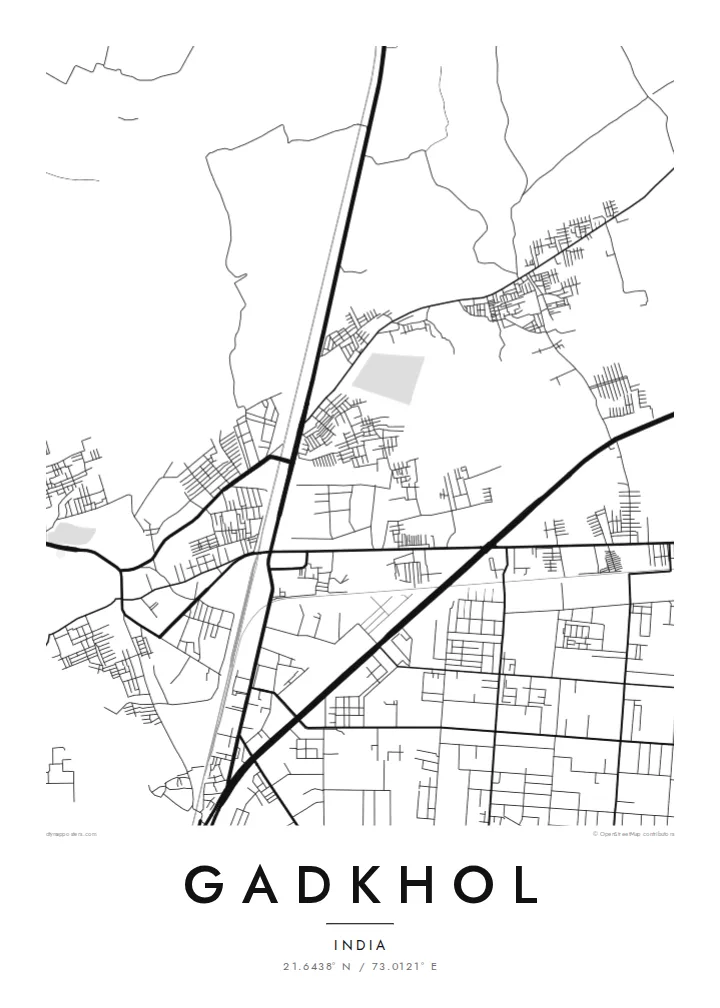
Gadkhol sits on the southern side of the Narmada in Gujarat's Bharuch district, close against Ankleshwar. From above, the older settlement is a tight cluster of short, irregular lanes. Around it, broader straight roads mark later growth. Open fields and the long curve of the river are never far away, and the line between village and town looks soft rather than drawn.
The wider area is known for industry. Ankleshwar's industrial estates lie nearby, and their large rectangular plots and service roads look very different from the smaller residential blocks. Rail lines and major highways run through this stretch of Gujarat, so long straight lines cut across the map at a steady angle and give the smaller street pattern a clear frame.
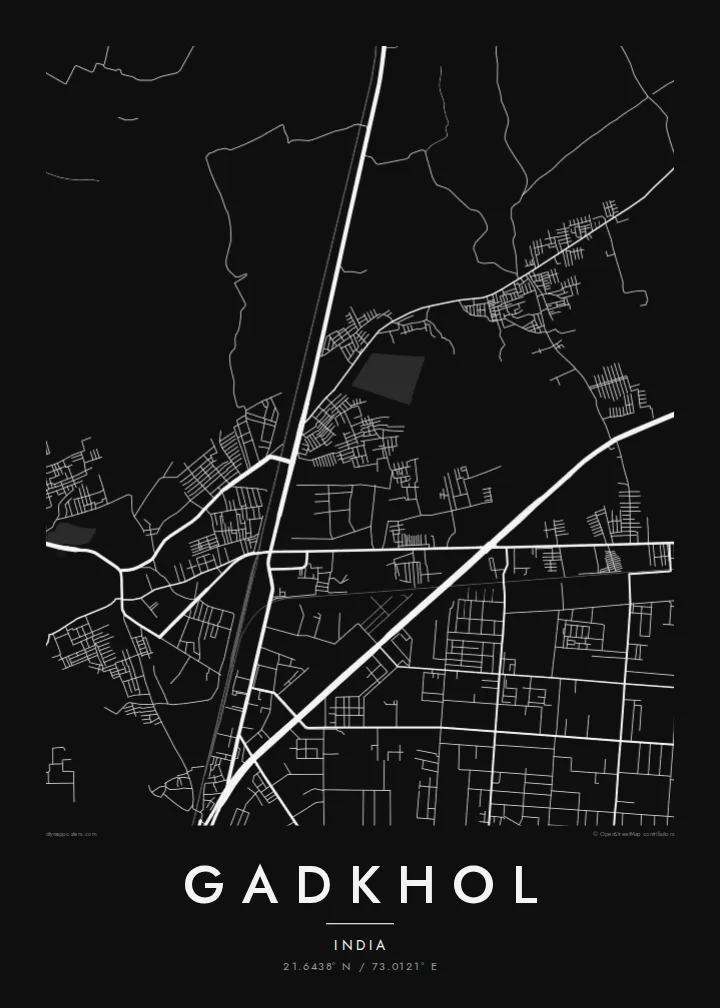
A Gadkhol map poster shows how one place can hold several scales at once: the village core, newer housing laid out in rows, and the big geometry of transport and industry. In monochrome, the Narmada becomes a wide blank band to the north, and the built-up land to its south reads as a dense, textured field.
The broad Narmada runs just north of the town. On the poster it becomes a wide, calm band of empty space, set against the denser grain of streets along its southern bank.
The oldest part of Gadkhol is a knot of short, bending lanes. It prints as a darker, finer patch among the straighter roads laid out around it later.
Highway and rail alignments cross the area in long, confident lines. They give the composition a strong diagonal structure and link Gadkhol visually to Ankleshwar and the river crossings toward Bharuch.
Taute ke ha hau
Lafi e aho, taha higoa po ke taha kupu haau, hiki e fakatino, lahi po ke tuaga.
Ko e kitiaaga nakai totogi kua tote e maaliali mo e fakamailoga vai. Ko e tau lolomi mo e tau faila HD kua taute ke he 300 DPI, hokotia ke he 7,200 × 10,800 px, nakai fai fakamailoga vai.
Ko e ha Gadkhol
For people from Gadkhol or the Ankleshwar area, this map records a familiar mix of lanes, fields and river. It works well as a reminder of home, a gift for family who moved away, or a note of where a working life began.
You can change the title, the subtitle and the coordinates line, for example to add a family name or a date. Then pick one of five styles: Classic black & white, Noir, Paper, Blueprint or Sand.
Talaage e poster Gadkhol| Lahi he lolomi | Maama | Tau faila |
|---|---|---|
| 30 × 40 cm11.8 × 15.7″ | 3,543 × 4,724 px | PNG · PDF |
| 29.7 × 42 cm (A3)11.7 × 16.5″ | 3,508 × 4,961 px | PNG · PDF |
| 42 × 59.4 cm (A2)16.5 × 23.4″ | 4,961 × 7,016 px | PNG · PDF |
| 45.7 × 61 cm18 × 24″ | 5,400 × 7,200 px | PNG · PDF |
| 50 × 70 cm19.7 × 27.6″ | 5,906 × 8,268 px | PNG · PDF |
| 61 × 91.4 cm24 × 36″ | 7,200 × 10,800 px | PNG · PDF |
Ke fakatatai, ko e fakatino noa kua 900 px e laulahi, fai fakamailoga mo e mo e tau mata komipiuta ni. Ko e tau faila HD kua ato hoko ke he 8× e maama ke he tau faahi takitaha mo e lolomi mitaki he lahi katoa he fakatino.
Fifili e taha puhala i luga he kupega, ti fifili e Poster Lolomi — e lahi mo e, kaeke ke manako ai koe, taha poloka — po ke Tau Faila HD Fakaeletonika. Ko e fakaotiaga totogi ko e taha gahua ni, ti ko e kupega he hau a talaaga ka fakafou fakahaga i mua he fakaotiaga e totogi.
Kua lolomi ai ke he pepa mitaki 200 gsm matte he taha he tau lahi ono, mai he 30 × 40 cm ke hoko ke he 24 × 36″. Kamata e tau poster lolomi mai he $39, kua putoia ai e utaaga.
E. Fifili e poloka akau malolō ke he lanu uli, tea, akau oki mooli, po ke akau pouli. Kua fakalataha mo e sioga malolō nakai malepe ti kua mautali ke tautau. Kamata e tau poster poloka mai he $99, kua putoia ai e utaaga.
Nakai totogi e fakafano ke he motu 60+. Ko e fakatino taha kua lolomi he fenoga lolomi ha mautolu kua tata mo e tau motu 30+, kua hoko mai he tau aho gahua 3–7. Maeke ia koe ke kikite e tuaga mo e fakamuitua he lalo he Haku Tau Fakatonu. Ke he falu motu kua 2–5 e tau tapu, ti ka nakai fakafano a mautolu ki ai, to fakaha he api tupe ia ki mua he totogi.
Fakafano mai e taha ata ki a mautolu he loto he 14 e tau aho tali mai he hokoaga, ti to lolomi foki e mautolu nakai totogi po ke liu atu e totogi ki a koe.
E. He editor i luga he kupega nei, hikihiki e matakupu, e matakupu lalo mo e laini coordinates ke he taha mena kua manako a koe ki ai, ti fifili e puhala mo e lahi. Ko e tau talaaga lolomi, poloka mo e fakaeletonika oti kua fakaaoga tonu e hau a fakatino.
Ma e $9 ka moua e koe e tau faila PNG 300 DPI mo e PDF kua mautali ke lolomi he tau lahi ono oti, nakai fai fakamailoga vai, ke lolomi i fe mena. Nakai maopoopo agaia? Utu hifo fakamua e kitiaaga nakai totogi ne fai fakamailoga vai.
Tata mai
