Grand Trunk Road
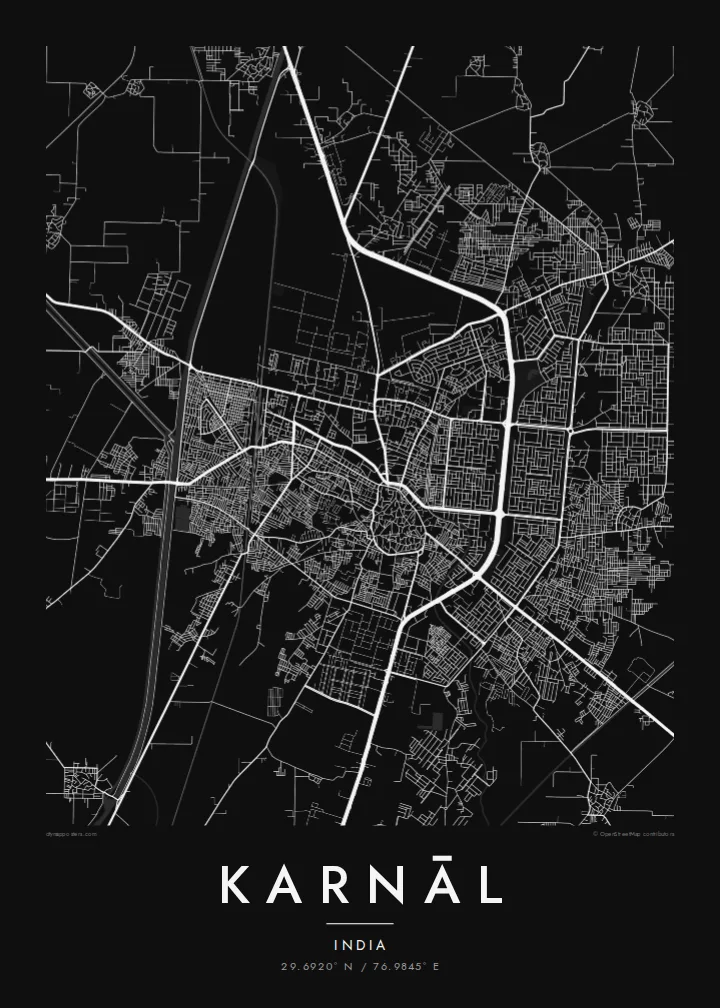
The historic road, now a national highway, runs straight past the city. It is the longest, boldest line on the map, and many newer districts are arranged along it.
Fakatino mape mukamuka · India
29.6920° N / 76.9845° E
A historic town on the old Grand Trunk Road, with canals and farmland surrounding a compact and irregular centre.



Taha e taone, lima e onoonoaga
Tapaki e taha puhala ke kitia ai ki luga he puipui. Kua tatai e totogi he tau puhala oti — pete he lolomi, poloka, po ke faila HD.
 Tau pikselo mooli · faila lolomi 24 × 36″
Maama mitaki ke lolomi
Ko e 100% e fahi mooli mai he faila lolomi. Ko e tau poster oti — pete kua lolomi, poloka, po ke utu hifo — kua taute ke he ha mautolu a tau tokoluga (server) ke he 300 DPI, hokotia ke he 7,200 × 10,800 piksela, ke maeke ai e tau ala ikiiki tote ke maaliali fakamitaki he lolomi 24 × 36″.
He Pā


Ko e mape
Karnāl lies on the plains of northern Haryana, on the national highway that follows the old Grand Trunk Road between Delhi and Chandigarh. That road draws a straight line past the city, and much of the modern growth has attached itself along it. The old town, in contrast, forms a tight knot of narrow, curving streets, while newer planned sectors spread around it in regular blocks.
Water shapes the surrounding map. The Western Yamuna Canal runs close to the city, its straight channels and branches reaching into a landscape of wheat and rice fields that ranks among the most productive in India. Karna Lake, a small reservoir beside the highway, adds one of the few irregular shapes to a landscape of otherwise flat and measured lines.
Local tradition links the city to Karna, the warrior of the Mahabharata, and its name is often traced to him. Karnāl is also home to the National Dairy Research Institute and was the birthplace of the astronaut Kalpana Chawla. A Karnāl map poster sets the old town, the highway and the canal network in clean lines against the open plain.
The historic road, now a national highway, runs straight past the city. It is the longest, boldest line on the map, and many newer districts are arranged along it.
The oldest part of Karnāl is a compact cluster of narrow, winding lanes. Its irregular pattern contrasts clearly with the planned sectors and wider roads built around it.
The canal and its branches run through the surrounding farmland in long, straight channels, giving the outer parts of the map a regular pattern of water and fields.
Taute ke ha hau
Lafi e aho, taha higoa po ke taha kupu haau, hiki e fakatino, lahi po ke tuaga.
Ko e kitiaaga nakai totogi kua tote e maaliali mo e fakamailoga vai. Ko e tau lolomi mo e tau faila HD kua taute ke he 300 DPI, hokotia ke he 7,200 × 10,800 px, nakai fai fakamailoga vai.
Ko e ha Karnāl
A Karnāl print is a thoughtful gift for families from the city, for researchers who have spent time at its institutes and for anyone who has travelled the old highway. The pairing of a dense core and open fields makes a calm, uncluttered image.
Add a family name, a wedding date or a greeting in Hindi to the title, and tailor the subtitle and coordinates. Choose Classic black & white, Noir, Paper, Blueprint or Sand. HD files at $9 include six sizes, from A3 to 24×36 inches, as PNG and PDF.
Talaage e poster Karnāl| Lahi he lolomi | Maama | Tau faila |
|---|---|---|
| 30 × 40 cm11.8 × 15.7″ | 3,543 × 4,724 px | PNG · PDF |
| 29.7 × 42 cm (A3)11.7 × 16.5″ | 3,508 × 4,961 px | PNG · PDF |
| 42 × 59.4 cm (A2)16.5 × 23.4″ | 4,961 × 7,016 px | PNG · PDF |
| 45.7 × 61 cm18 × 24″ | 5,400 × 7,200 px | PNG · PDF |
| 50 × 70 cm19.7 × 27.6″ | 5,906 × 8,268 px | PNG · PDF |
| 61 × 91.4 cm24 × 36″ | 7,200 × 10,800 px | PNG · PDF |
Ke fakatatai, ko e fakatino noa kua 900 px e laulahi, fai fakamailoga mo e mo e tau mata komipiuta ni. Ko e tau faila HD kua ato hoko ke he 8× e maama ke he tau faahi takitaha mo e lolomi mitaki he lahi katoa he fakatino.
Fifili e taha puhala i luga he kupega, ti fifili e Poster Lolomi — e lahi mo e, kaeke ke manako ai koe, taha poloka — po ke Tau Faila HD Fakaeletonika. Ko e fakaotiaga totogi ko e taha gahua ni, ti ko e kupega he hau a talaaga ka fakafou fakahaga i mua he fakaotiaga e totogi.
Kua lolomi ai ke he pepa mitaki 200 gsm matte he taha he tau lahi ono, mai he 30 × 40 cm ke hoko ke he 24 × 36″. Kamata e tau poster lolomi mai he $39, kua putoia ai e utaaga.
E. Fifili e poloka akau malolō ke he lanu uli, tea, akau oki mooli, po ke akau pouli. Kua fakalataha mo e sioga malolō nakai malepe ti kua mautali ke tautau. Kamata e tau poster poloka mai he $99, kua putoia ai e utaaga.
Nakai totogi e fakafano ke he motu 60+. Ko e fakatino taha kua lolomi he fenoga lolomi ha mautolu kua tata mo e tau motu 30+, kua hoko mai he tau aho gahua 3–7. Maeke ia koe ke kikite e tuaga mo e fakamuitua he lalo he Haku Tau Fakatonu. Ke he falu motu kua 2–5 e tau tapu, ti ka nakai fakafano a mautolu ki ai, to fakaha he api tupe ia ki mua he totogi.
Fakafano mai e taha ata ki a mautolu he loto he 14 e tau aho tali mai he hokoaga, ti to lolomi foki e mautolu nakai totogi po ke liu atu e totogi ki a koe.
E. He editor i luga he kupega nei, hikihiki e matakupu, e matakupu lalo mo e laini coordinates ke he taha mena kua manako a koe ki ai, ti fifili e puhala mo e lahi. Ko e tau talaaga lolomi, poloka mo e fakaeletonika oti kua fakaaoga tonu e hau a fakatino.
Ma e $9 ka moua e koe e tau faila PNG 300 DPI mo e PDF kua mautali ke lolomi he tau lahi ono oti, nakai fai fakamailoga vai, ke lolomi i fe mena. Nakai maopoopo agaia? Utu hifo fakamua e kitiaaga nakai totogi ne fai fakamailoga vai.
Tata mai
