Tama River
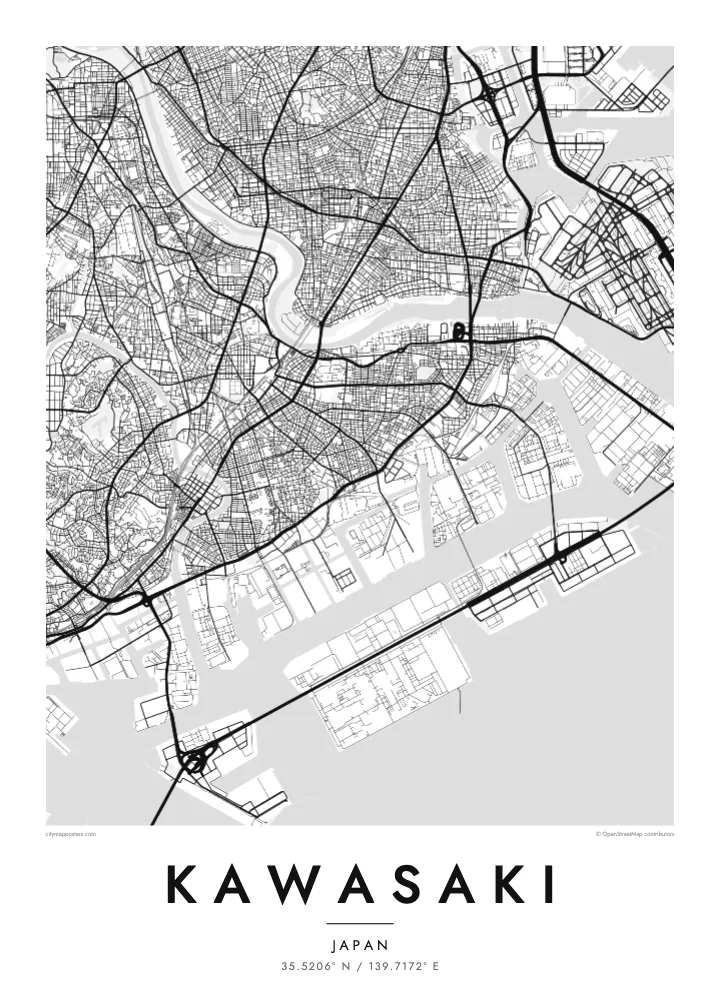
The wide river forming the northern boundary with Tokyo. Its long, gently curving course and the many bridges across it give the poster a strong diagonal edge.
Fakatino mape mukamuka · Japan
35.5206° N / 139.7172° E
A long, narrow city running from Tokyo Bay's industrial landfill up the Tama River to wooded hills.
Taha e taone, lima e onoonoaga
Tapaki e taha puhala ke kitia ai ki luga he puipui. Kua tatai e totogi he tau puhala oti — pete he lolomi, poloka, po ke faila HD.
 Tau pikselo mooli · faila lolomi 24 × 36″
Maama mitaki ke lolomi
Ko e 100% e fahi mooli mai he faila lolomi. Ko e tau poster oti — pete kua lolomi, poloka, po ke utu hifo — kua taute ke he ha mautolu a tau tokoluga (server) ke he 300 DPI, hokotia ke he 7,200 × 10,800 piksela, ke maeke ai e tau ala ikiiki tote ke maaliali fakamitaki he lolomi 24 × 36″.
He Pā


Ko e mape
Kawasaki is shaped like a ribbon. It runs northwest in a long band along the southern bank of the Tama River, which separates it from Tokyo, while Yokohama borders it to the south. At the bay end, rectangular landfill islands, docks and canals make a hard-edged pattern of heavy industry; inland, the street network softens into residential neighbourhoods and eventually into the Tama Hills.
The city is divided into seven wards, each occupying a slice of that band. Near the coast, Kawasaki Daishi, a large Buddhist temple, draws millions of visitors at New Year. Farther upstream, Musashi-Kosugi has become a cluster of high-rise towers around a busy rail junction, one of many places where train lines cross the river toward central Tokyo.
A Kawasaki map poster shows a city that is rarely seen as a single shape. From the geometric reclaimed land of the waterfront to the curving roads of the hills, its whole length is framed by the broad line of the Tama River, making for a composition that feels both industrial and surprisingly green.
The wide river forming the northern boundary with Tokyo. Its long, gently curving course and the many bridges across it give the poster a strong diagonal edge.
Rectangular artificial islands and docks along Tokyo Bay, part of the Keihin industrial zone. Their straight edges and canals form the most geometric section of the map.
The hilly northwest of the city, where roads follow valleys and ridges. Here the pattern turns loose and organic, a clear contrast to the waterfront.
Taute ke ha hau
Lafi e aho, taha higoa po ke taha kupu haau, hiki e fakatino, lahi po ke tuaga.
Ko e kitiaaga nakai totogi kua tote e maaliali mo e fakamailoga vai. Ko e tau lolomi mo e tau faila HD kua taute ke he 300 DPI, hokotia ke he 7,200 × 10,800 px, nakai fai fakamailoga vai.
Ko e ha Kawasaki
Kawasaki is home to many people who commute into Tokyo or Yokohama but think of this city as their own. A poster of its full length, from bay to hills, shows how a single ward fits into the whole, and makes a thoughtful gift for a new home or a move away.
Set your own title, add a subtitle and a date, and choose one of five styles, from Classic black & white to Blueprint. The HD files cost $9 and include 300 DPI PNGs and print-ready PDFs, so a local print shop can produce an A2 or A3 copy without fuss.
Talaage e poster Kawasaki| Lahi he lolomi | Maama | Tau faila |
|---|---|---|
| 30 × 40 cm11.8 × 15.7″ | 3,543 × 4,724 px | PNG · PDF |
| 29.7 × 42 cm (A3)11.7 × 16.5″ | 3,508 × 4,961 px | PNG · PDF |
| 42 × 59.4 cm (A2)16.5 × 23.4″ | 4,961 × 7,016 px | PNG · PDF |
| 45.7 × 61 cm18 × 24″ | 5,400 × 7,200 px | PNG · PDF |
| 50 × 70 cm19.7 × 27.6″ | 5,906 × 8,268 px | PNG · PDF |
| 61 × 91.4 cm24 × 36″ | 7,200 × 10,800 px | PNG · PDF |
Ke fakatatai, ko e fakatino noa kua 900 px e laulahi, fai fakamailoga mo e mo e tau mata komipiuta ni. Ko e tau faila HD kua ato hoko ke he 8× e maama ke he tau faahi takitaha mo e lolomi mitaki he lahi katoa he fakatino.
Fifili e taha puhala i luga he kupega, ti fifili e Poster Lolomi — e lahi mo e, kaeke ke manako ai koe, taha poloka — po ke Tau Faila HD Fakaeletonika. Ko e fakaotiaga totogi ko e taha gahua ni, ti ko e kupega he hau a talaaga ka fakafou fakahaga i mua he fakaotiaga e totogi.
Kua lolomi ai ke he pepa mitaki 200 gsm matte he taha he tau lahi ono, mai he 30 × 40 cm ke hoko ke he 24 × 36″. Kamata e tau poster lolomi mai he $39, kua putoia ai e utaaga.
E. Fifili e poloka akau malolō ke he lanu uli, tea, akau oki mooli, po ke akau pouli. Kua fakalataha mo e sioga malolō nakai malepe ti kua mautali ke tautau. Kamata e tau poster poloka mai he $99, kua putoia ai e utaaga.
Nakai totogi e fakafano ke he motu 60+. Ko e fakatino taha kua lolomi he fenoga lolomi ha mautolu kua tata mo e tau motu 30+, kua hoko mai he tau aho gahua 3–7. Maeke ia koe ke kikite e tuaga mo e fakamuitua he lalo he Haku Tau Fakatonu. Ke he falu motu kua 2–5 e tau tapu, ti ka nakai fakafano a mautolu ki ai, to fakaha he api tupe ia ki mua he totogi.
Fakafano mai e taha ata ki a mautolu he loto he 14 e tau aho tali mai he hokoaga, ti to lolomi foki e mautolu nakai totogi po ke liu atu e totogi ki a koe.
E. He editor i luga he kupega nei, hikihiki e matakupu, e matakupu lalo mo e laini coordinates ke he taha mena kua manako a koe ki ai, ti fifili e puhala mo e lahi. Ko e tau talaaga lolomi, poloka mo e fakaeletonika oti kua fakaaoga tonu e hau a fakatino.
Ma e $9 ka moua e koe e tau faila PNG 300 DPI mo e PDF kua mautali ke lolomi he tau lahi ono oti, nakai fai fakamailoga vai, ke lolomi i fe mena. Nakai maopoopo agaia? Utu hifo fakamua e kitiaaga nakai totogi ne fai fakamailoga vai.
Tata mai
