Contour-following roads
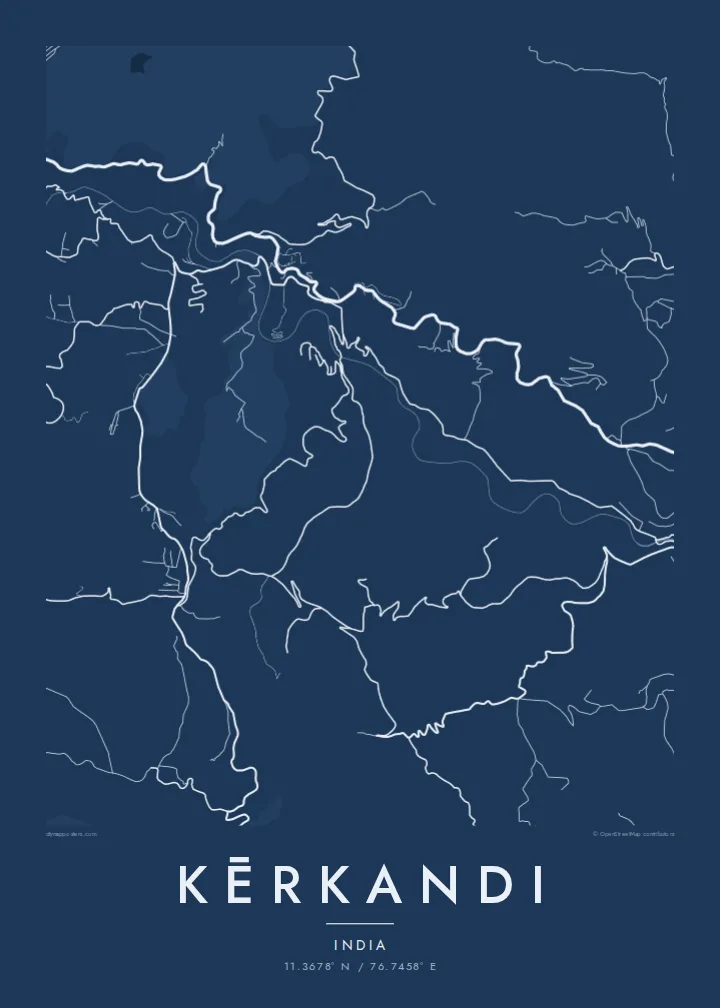
Roads trace the slopes in long curves and hairpins instead of straight runs. These flowing lines give the whole composition a sense of movement across the frame.
Fakatino mape mukamuka · India
11.3678° N / 76.7458° E
A hill settlement in the Nilgiris, where roads loop along the contours and small clusters of houses follow the ridges.



Taha e taone, lima e onoonoaga
Tapaki e taha puhala ke kitia ai ki luga he puipui. Kua tatai e totogi he tau puhala oti — pete he lolomi, poloka, po ke faila HD.
 Tau pikselo mooli · faila lolomi 24 × 36″
Maama mitaki ke lolomi
Ko e 100% e fahi mooli mai he faila lolomi. Ko e tau poster oti — pete kua lolomi, poloka, po ke utu hifo — kua taute ke he ha mautolu a tau tokoluga (server) ke he 300 DPI, hokotia ke he 7,200 × 10,800 piksela, ke maeke ai e tau ala ikiiki tote ke maaliali fakamitaki he lolomi 24 × 36″.
He Pā


Ko e mape
Kērkandi is a town in Tamil Nadu in the Nilgiri hills, a few kilometres from Ooty. At this altitude the map looks nothing like the plains towns further east. There is no grid. Roads curl around slopes, switch back on steep ground and link small clusters of homes spread across ridges and shallow valleys.
The terrain shapes almost everything in the drawing. Lanes follow the contour lines and footpaths cut between them. The open ground between settlements shows up as blank space, standing for farmland and wooded slopes. In black and white the result is a loose, organic web, very different from the straight lines of lowland cities.
Little published information exists about the town itself, and that suits a quiet poster. A Kērkandi map poster is less about landmarks and more about the shape of a hill community. It shows how people have built on whatever level ground the slopes allow, and how the roads tie those pieces together across the landscape.
Roads trace the slopes in long curves and hairpins instead of straight runs. These flowing lines give the whole composition a sense of movement across the frame.
Houses gather in small groups along ridges and gentler ground. On the map they appear as scattered pockets of fine street detail separated by open hillside.
The town lies in the Nilgiri uplands near Ooty, a region of high hills whose broken, folded terrain decides the course of every line in the local road network.
Taute ke ha hau
Lafi e aho, taha higoa po ke taha kupu haau, hiki e fakatino, lahi po ke tuaga.
Ko e kitiaaga nakai totogi kua tote e maaliali mo e fakamailoga vai. Ko e tau lolomi mo e tau faila HD kua taute ke he 300 DPI, hokotia ke he 7,200 × 10,800 px, nakai fai fakamailoga vai.
Ko e ha Kērkandi
For anyone with roots in the Nilgiris, or who remembers the hill roads above Ooty, this map recalls a very particular landscape. Its winding lines make an interesting, almost abstract composition that is calm enough for a bedroom or a workspace, and it looks good at larger sizes.
You can change the title, subtitle and coordinates line to suit the occasion and pick Classic black & white, Noir, Paper, Blueprint or Sand. Try the free watermarked preview first, then choose the $9 digital files or a printed matte poster with an optional wooden frame.
Talaage e poster Kērkandi| Lahi he lolomi | Maama | Tau faila |
|---|---|---|
| 30 × 40 cm11.8 × 15.7″ | 3,543 × 4,724 px | PNG · PDF |
| 29.7 × 42 cm (A3)11.7 × 16.5″ | 3,508 × 4,961 px | PNG · PDF |
| 42 × 59.4 cm (A2)16.5 × 23.4″ | 4,961 × 7,016 px | PNG · PDF |
| 45.7 × 61 cm18 × 24″ | 5,400 × 7,200 px | PNG · PDF |
| 50 × 70 cm19.7 × 27.6″ | 5,906 × 8,268 px | PNG · PDF |
| 61 × 91.4 cm24 × 36″ | 7,200 × 10,800 px | PNG · PDF |
Ke fakatatai, ko e fakatino noa kua 900 px e laulahi, fai fakamailoga mo e mo e tau mata komipiuta ni. Ko e tau faila HD kua ato hoko ke he 8× e maama ke he tau faahi takitaha mo e lolomi mitaki he lahi katoa he fakatino.
Fifili e taha puhala i luga he kupega, ti fifili e Poster Lolomi — e lahi mo e, kaeke ke manako ai koe, taha poloka — po ke Tau Faila HD Fakaeletonika. Ko e fakaotiaga totogi ko e taha gahua ni, ti ko e kupega he hau a talaaga ka fakafou fakahaga i mua he fakaotiaga e totogi.
Kua lolomi ai ke he pepa mitaki 200 gsm matte he taha he tau lahi ono, mai he 30 × 40 cm ke hoko ke he 24 × 36″. Kamata e tau poster lolomi mai he $39, kua putoia ai e utaaga.
E. Fifili e poloka akau malolō ke he lanu uli, tea, akau oki mooli, po ke akau pouli. Kua fakalataha mo e sioga malolō nakai malepe ti kua mautali ke tautau. Kamata e tau poster poloka mai he $99, kua putoia ai e utaaga.
Nakai totogi e fakafano ke he motu 60+. Ko e fakatino taha kua lolomi he fenoga lolomi ha mautolu kua tata mo e tau motu 30+, kua hoko mai he tau aho gahua 3–7. Maeke ia koe ke kikite e tuaga mo e fakamuitua he lalo he Haku Tau Fakatonu. Ke he falu motu kua 2–5 e tau tapu, ti ka nakai fakafano a mautolu ki ai, to fakaha he api tupe ia ki mua he totogi.
Fakafano mai e taha ata ki a mautolu he loto he 14 e tau aho tali mai he hokoaga, ti to lolomi foki e mautolu nakai totogi po ke liu atu e totogi ki a koe.
E. He editor i luga he kupega nei, hikihiki e matakupu, e matakupu lalo mo e laini coordinates ke he taha mena kua manako a koe ki ai, ti fifili e puhala mo e lahi. Ko e tau talaaga lolomi, poloka mo e fakaeletonika oti kua fakaaoga tonu e hau a fakatino.
Ma e $9 ka moua e koe e tau faila PNG 300 DPI mo e PDF kua mautali ke lolomi he tau lahi ono oti, nakai fai fakamailoga vai, ke lolomi i fe mena. Nakai maopoopo agaia? Utu hifo fakamua e kitiaaga nakai totogi ne fai fakamailoga vai.
Tata mai
