Bazaar spine
The long covered bazaar runs through the historic centre as a single unbroken line, with narrow lanes and courtyards branching off it on both sides.
Fakatino mape mukamuka · Iran
30.2832° N / 57.0788° E
A desert city on a high plateau, with its long covered bazaar forming a spine through the old centre.


Taha e taone, lima e onoonoaga
Tapaki e taha puhala ke kitia ai ki luga he puipui. Kua tatai e totogi he tau puhala oti — pete he lolomi, poloka, po ke faila HD.
 Tau pikselo mooli · faila lolomi 24 × 36″
Maama mitaki ke lolomi
Ko e 100% e fahi mooli mai he faila lolomi. Ko e tau poster oti — pete kua lolomi, poloka, po ke utu hifo — kua taute ke he ha mautolu a tau tokoluga (server) ke he 300 DPI, hokotia ke he 7,200 × 10,800 piksela, ke maeke ai e tau ala ikiiki tote ke maaliali fakamitaki he lolomi 24 × 36″.
He Pā
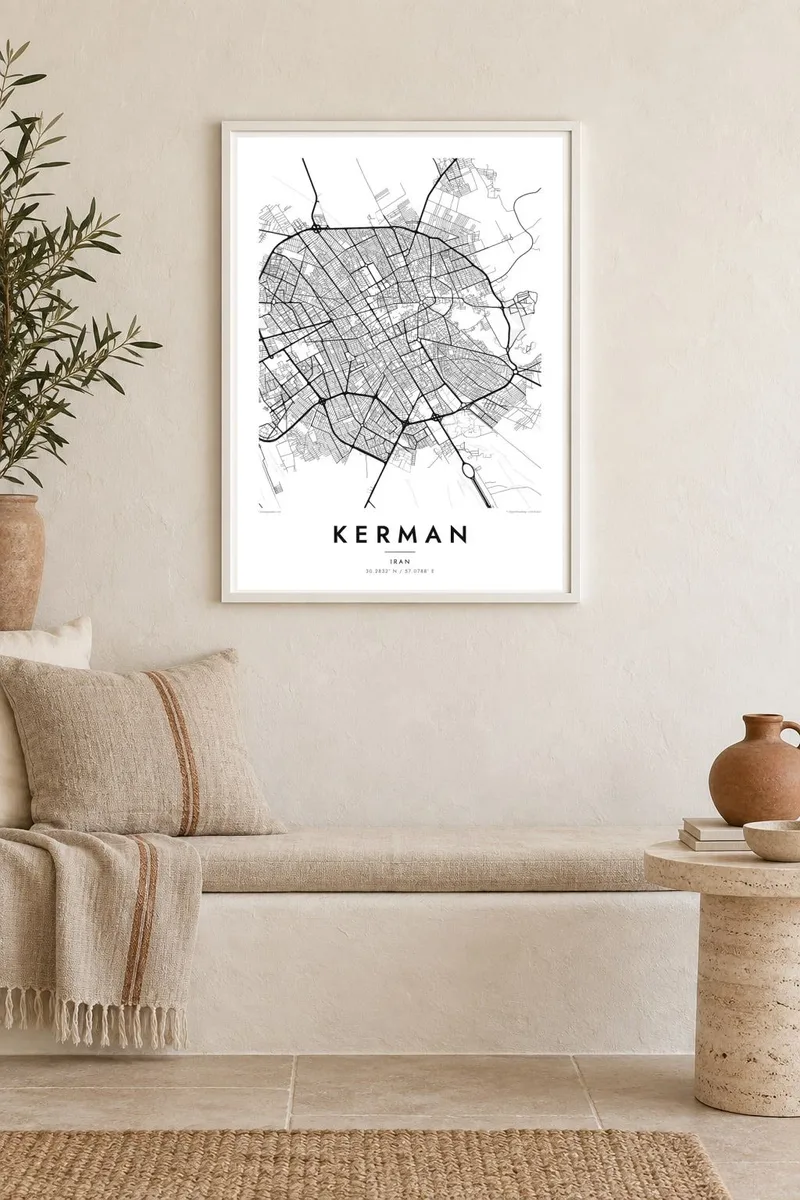
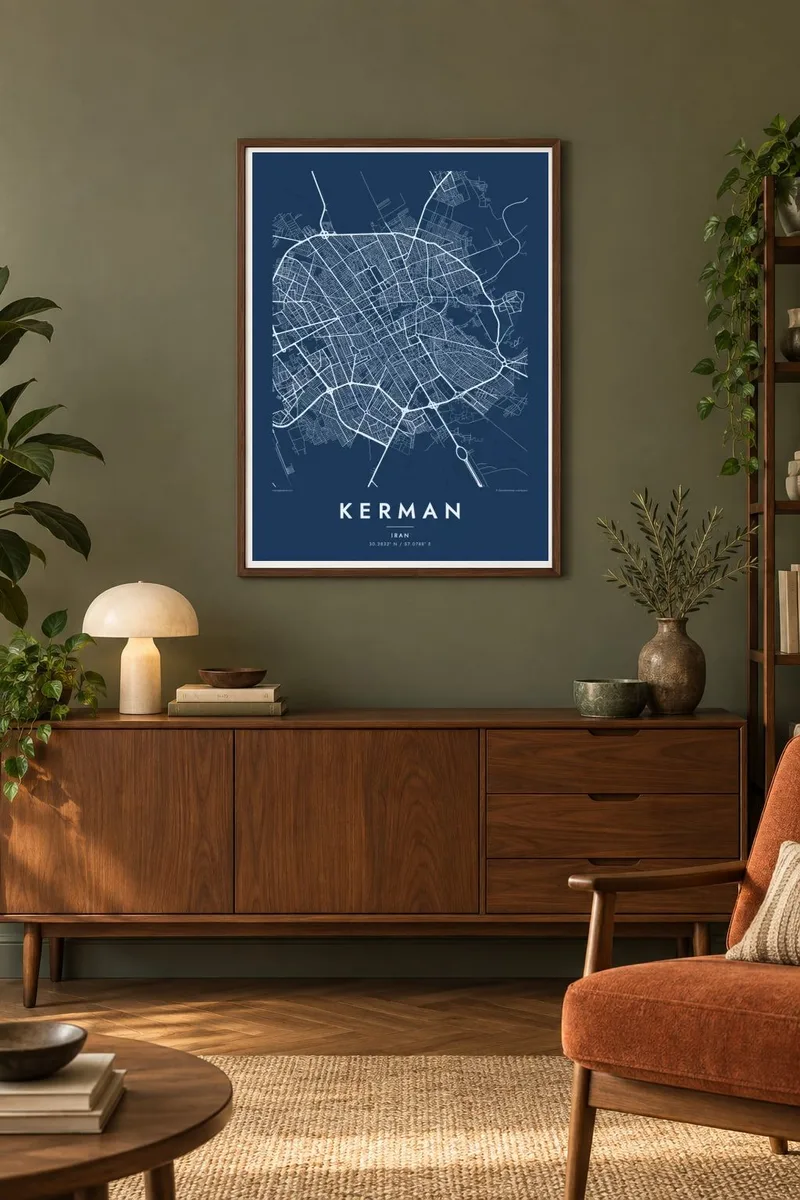
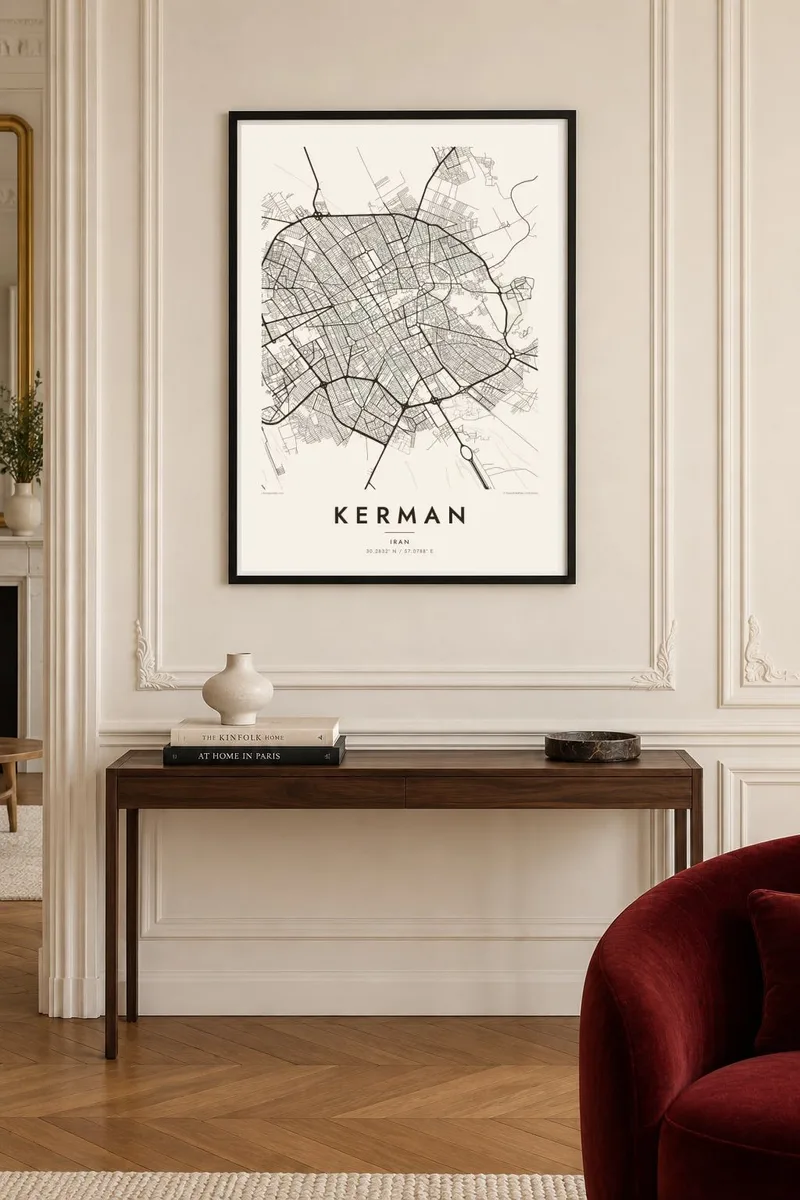
Ko e mape
Kerman sits at around 1,750 metres on a plateau in southeastern Iran, with the Lut Desert beyond the mountains to the east. On a map the city spreads across open, arid ground in a broad and fairly regular pattern of avenues and blocks. Its edges are set not by rivers or coasts but by the dry landscape and the ridges that frame it.
The historic core is built around the bazaar, one of the longest in Iran, a covered route running roughly east to west through the old city. Along it lies the Ganjali Khan complex, a Safavid-era group of square, bathhouse and caravanserai. On the map the bazaar appears as one unbroken thread, with finer lanes branching off on either side.
The city is known for its carpets and for the pistachio orchards of the surrounding province. A Kerman map poster reduces this desert city to its essential lines. It shows how the old bazaar spine meets the wider modern avenues, and how the built area gives way at its edges to open land, the plateau and distant mountains.
The long covered bazaar runs through the historic centre as a single unbroken line, with narrow lanes and courtyards branching off it on both sides.
A rectangular Safavid-era square along the bazaar, surrounded by a bathhouse, mosque and caravanserai, forms a clear geometric opening in the dense old streets.
At the city's edges the street pattern thins out quickly into open, arid land, leaving a strong contrast between the built area and the empty plateau.
Taute ke ha hau
Lafi e aho, taha higoa po ke taha kupu haau, hiki e fakatino, lahi po ke tuaga.
Ko e kitiaaga nakai totogi kua tote e maaliali mo e fakamailoga vai. Ko e tau lolomi mo e tau faila HD kua taute ke he 300 DPI, hokotia ke he 7,200 × 10,800 px, nakai fai fakamailoga vai.
Ko e ha Kerman
Kerman is a city of long histories and quiet courtyards. For people from the region it carries memories of carpets, pistachios and desert light, and a map poster keeps its outline close, even far from the plateau.
Personalise the title, subtitle and coordinates line with a family name or a year that matters. Choose from Classic black & white, Noir, Paper, Blueprint or Sand, the last especially fitting for a desert city. It comes as a $9 download or a printed poster.
Talaage e poster Kerman| Lahi he lolomi | Maama | Tau faila |
|---|---|---|
| 30 × 40 cm11.8 × 15.7″ | 3,543 × 4,724 px | PNG · PDF |
| 29.7 × 42 cm (A3)11.7 × 16.5″ | 3,508 × 4,961 px | PNG · PDF |
| 42 × 59.4 cm (A2)16.5 × 23.4″ | 4,961 × 7,016 px | PNG · PDF |
| 45.7 × 61 cm18 × 24″ | 5,400 × 7,200 px | PNG · PDF |
| 50 × 70 cm19.7 × 27.6″ | 5,906 × 8,268 px | PNG · PDF |
| 61 × 91.4 cm24 × 36″ | 7,200 × 10,800 px | PNG · PDF |
Ke fakatatai, ko e fakatino noa kua 900 px e laulahi, fai fakamailoga mo e mo e tau mata komipiuta ni. Ko e tau faila HD kua ato hoko ke he 8× e maama ke he tau faahi takitaha mo e lolomi mitaki he lahi katoa he fakatino.
Fifili e taha puhala i luga he kupega, ti fifili e Poster Lolomi — e lahi mo e, kaeke ke manako ai koe, taha poloka — po ke Tau Faila HD Fakaeletonika. Ko e fakaotiaga totogi ko e taha gahua ni, ti ko e kupega he hau a talaaga ka fakafou fakahaga i mua he fakaotiaga e totogi.
Kua lolomi ai ke he pepa mitaki 200 gsm matte he taha he tau lahi ono, mai he 30 × 40 cm ke hoko ke he 24 × 36″. Kamata e tau poster lolomi mai he $39, kua putoia ai e utaaga.
E. Fifili e poloka akau malolō ke he lanu uli, tea, akau oki mooli, po ke akau pouli. Kua fakalataha mo e sioga malolō nakai malepe ti kua mautali ke tautau. Kamata e tau poster poloka mai he $99, kua putoia ai e utaaga.
Nakai totogi e fakafano ke he motu 60+. Ko e fakatino taha kua lolomi he fenoga lolomi ha mautolu kua tata mo e tau motu 30+, kua hoko mai he tau aho gahua 3–7. Maeke ia koe ke kikite e tuaga mo e fakamuitua he lalo he Haku Tau Fakatonu. Ke he falu motu kua 2–5 e tau tapu, ti ka nakai fakafano a mautolu ki ai, to fakaha he api tupe ia ki mua he totogi.
Fakafano mai e taha ata ki a mautolu he loto he 14 e tau aho tali mai he hokoaga, ti to lolomi foki e mautolu nakai totogi po ke liu atu e totogi ki a koe.
E. He editor i luga he kupega nei, hikihiki e matakupu, e matakupu lalo mo e laini coordinates ke he taha mena kua manako a koe ki ai, ti fifili e puhala mo e lahi. Ko e tau talaaga lolomi, poloka mo e fakaeletonika oti kua fakaaoga tonu e hau a fakatino.
Ma e $9 ka moua e koe e tau faila PNG 300 DPI mo e PDF kua mautali ke lolomi he tau lahi ono oti, nakai fai fakamailoga vai, ke lolomi i fe mena. Nakai maopoopo agaia? Utu hifo fakamua e kitiaaga nakai totogi ne fai fakamailoga vai.
