Two banks, one city
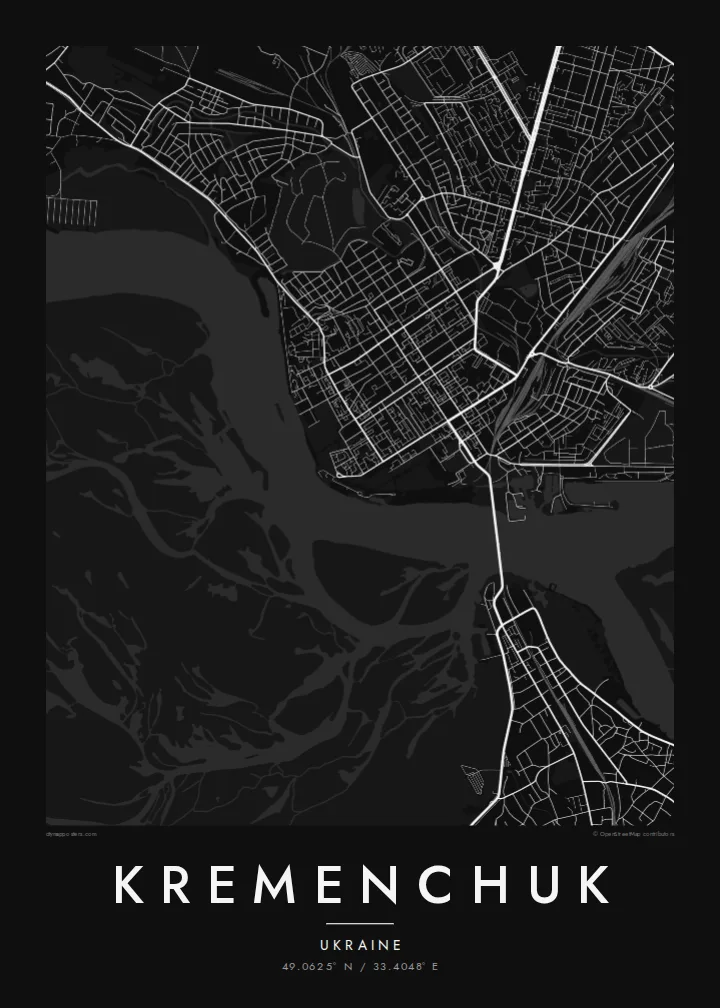
Central Kremenchuk and the Kriukiv district face each other across the Dnieper. On the poster the river runs through the middle of the city, with a different street pattern on each side.
Fakatino mape mukamuka · Ukraine
49.0625° N / 33.4048° E
A wide bend of the Dnieper divides two banks, joined by long bridges below a great reservoir dam



Taha e taone, lima e onoonoaga
Tapaki e taha puhala ke kitia ai ki luga he puipui. Kua tatai e totogi he tau puhala oti — pete he lolomi, poloka, po ke faila HD.
 Tau pikselo mooli · faila lolomi 24 × 36″
Maama mitaki ke lolomi
Ko e 100% e fahi mooli mai he faila lolomi. Ko e tau poster oti — pete kua lolomi, poloka, po ke utu hifo — kua taute ke he ha mautolu a tau tokoluga (server) ke he 300 DPI, hokotia ke he 7,200 × 10,800 piksela, ke maeke ai e tau ala ikiiki tote ke maaliali fakamitaki he lolomi 24 × 36″.
He Pā


Ko e mape
Kremenchuk sits on the Dnieper, and the river dominates any map of the city. The main districts lie on the left bank, laid out in a mostly regular street grid that reaches back from the waterfront. Across the broad channel, the Kriukiv district occupies the right bank. Sandy islands and backwaters in the river between them break up the open water into a pattern of shapes.
Upstream, the Kremenchuk Reservoir, one of the largest on the Dnieper, is held back by a hydroelectric dam. Downstream, the river widens and scatters around its islands. Kremenchuk is also one of Ukraine's major industrial centres. Its truck works, oil refinery and rail yards appear as large blocks and track fans on the city's outskirts.
A Kremenchuk map poster makes the most of this riverside setting. The water forms a bold diagonal band, the bridges stitch the two halves together, and the tight grid of the left-bank centre contrasts with the looser pattern across the river. The result is a strong, balanced composition, even in simple black and white.
Central Kremenchuk and the Kriukiv district face each other across the Dnieper. On the poster the river runs through the middle of the city, with a different street pattern on each side.
Long road and rail crossings span the wide Dnieper. They are the only links between the two banks, and they cut crisp lines across the large open area of water.
Factory grounds, the refinery and wide rail yards occupy big parcels at the edge of the city. Their coarse texture sets them apart from the finer residential grid.
Taute ke ha hau
Lafi e aho, taha higoa po ke taha kupu haau, hiki e fakatino, lahi po ke tuaga.
Ko e kitiaaga nakai totogi kua tote e maaliali mo e fakamailoga vai. Ko e tau lolomi mo e tau faila HD kua taute ke he 300 DPI, hokotia ke he 7,200 × 10,800 px, nakai fai fakamailoga vai.
Ko e ha Kremenchuk
Kremenchuk is a city defined by its river and its work, and many families have their roots on one bank or the other. A map poster keeps the shape of home on the wall, especially for those who now live far from the Dnieper.
You can set your own title and subtitle, perhaps a street name or a year, and keep or adjust the coordinates line. Five styles are available, from Classic black & white to Blueprint.
Talaage e poster Kremenchuk| Lahi he lolomi | Maama | Tau faila |
|---|---|---|
| 30 × 40 cm11.8 × 15.7″ | 3,543 × 4,724 px | PNG · PDF |
| 29.7 × 42 cm (A3)11.7 × 16.5″ | 3,508 × 4,961 px | PNG · PDF |
| 42 × 59.4 cm (A2)16.5 × 23.4″ | 4,961 × 7,016 px | PNG · PDF |
| 45.7 × 61 cm18 × 24″ | 5,400 × 7,200 px | PNG · PDF |
| 50 × 70 cm19.7 × 27.6″ | 5,906 × 8,268 px | PNG · PDF |
| 61 × 91.4 cm24 × 36″ | 7,200 × 10,800 px | PNG · PDF |
Ke fakatatai, ko e fakatino noa kua 900 px e laulahi, fai fakamailoga mo e mo e tau mata komipiuta ni. Ko e tau faila HD kua ato hoko ke he 8× e maama ke he tau faahi takitaha mo e lolomi mitaki he lahi katoa he fakatino.
Fifili e taha puhala i luga he kupega, ti fifili e Poster Lolomi — e lahi mo e, kaeke ke manako ai koe, taha poloka — po ke Tau Faila HD Fakaeletonika. Ko e fakaotiaga totogi ko e taha gahua ni, ti ko e kupega he hau a talaaga ka fakafou fakahaga i mua he fakaotiaga e totogi.
Kua lolomi ai ke he pepa mitaki 200 gsm matte he taha he tau lahi ono, mai he 30 × 40 cm ke hoko ke he 24 × 36″. Kamata e tau poster lolomi mai he $39, kua putoia ai e utaaga.
E. Fifili e poloka akau malolō ke he lanu uli, tea, akau oki mooli, po ke akau pouli. Kua fakalataha mo e sioga malolō nakai malepe ti kua mautali ke tautau. Kamata e tau poster poloka mai he $99, kua putoia ai e utaaga.
Nakai totogi e fakafano ke he motu 60+. Ko e fakatino taha kua lolomi he fenoga lolomi ha mautolu kua tata mo e tau motu 30+, kua hoko mai he tau aho gahua 3–7. Maeke ia koe ke kikite e tuaga mo e fakamuitua he lalo he Haku Tau Fakatonu. Ke he falu motu kua 2–5 e tau tapu, ti ka nakai fakafano a mautolu ki ai, to fakaha he api tupe ia ki mua he totogi.
Fakafano mai e taha ata ki a mautolu he loto he 14 e tau aho tali mai he hokoaga, ti to lolomi foki e mautolu nakai totogi po ke liu atu e totogi ki a koe.
E. He editor i luga he kupega nei, hikihiki e matakupu, e matakupu lalo mo e laini coordinates ke he taha mena kua manako a koe ki ai, ti fifili e puhala mo e lahi. Ko e tau talaaga lolomi, poloka mo e fakaeletonika oti kua fakaaoga tonu e hau a fakatino.
Ma e $9 ka moua e koe e tau faila PNG 300 DPI mo e PDF kua mautali ke lolomi he tau lahi ono oti, nakai fai fakamailoga vai, ke lolomi i fe mena. Nakai maopoopo agaia? Utu hifo fakamua e kitiaaga nakai totogi ne fai fakamailoga vai.
Tata mai
