Plaza-centred grid
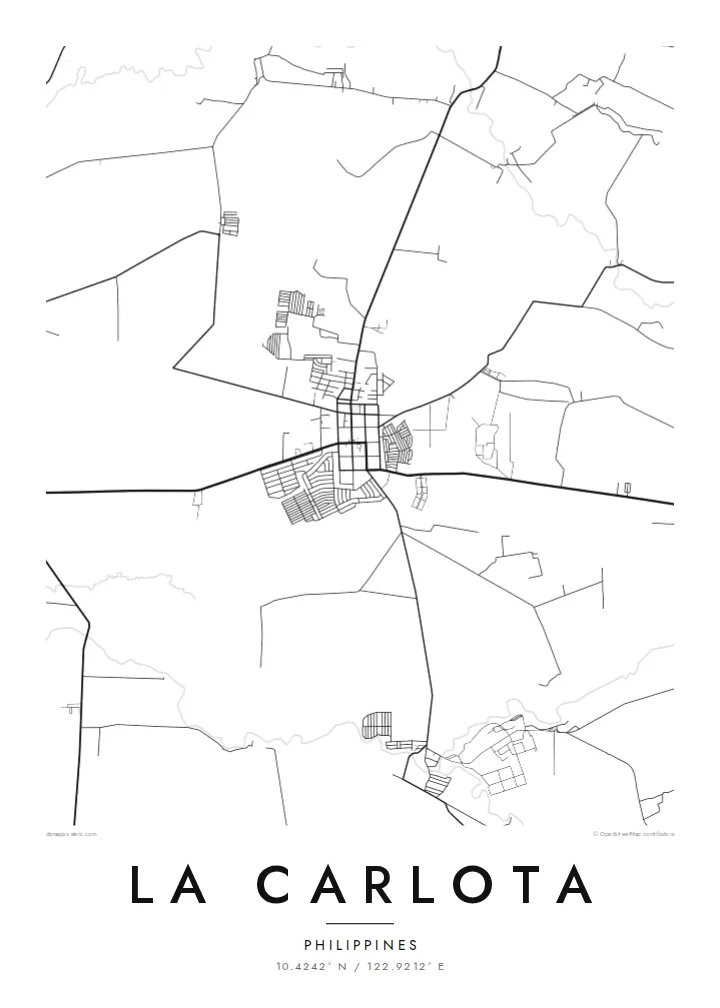
The core follows the Spanish-era pattern common to Philippine towns, with blocks arranged around a central plaza and church, easy to read even at the smaller print sizes.
Fakatino mape mukamuka · Philippines
10.4242° N / 122.9212° E
A small sugar city on the Negros plain, its grid set among cane fields that rise gently toward Kanlaon
Taha e taone, lima e onoonoaga
Tapaki e taha puhala ke kitia ai ki luga he puipui. Kua tatai e totogi he tau puhala oti — pete he lolomi, poloka, po ke faila HD.
 Tau pikselo mooli · faila lolomi 24 × 36″
Maama mitaki ke lolomi
Ko e 100% e fahi mooli mai he faila lolomi. Ko e tau poster oti — pete kua lolomi, poloka, po ke utu hifo — kua taute ke he ha mautolu a tau tokoluga (server) ke he 300 DPI, hokotia ke he 7,200 × 10,800 piksela, ke maeke ai e tau ala ikiiki tote ke maaliali fakamitaki he lolomi 24 × 36″.
He Pā


Ko e mape
La Carlota lies in the interior of Negros Occidental, south of Bacolod, on the fertile lowland that spreads from the coast toward the slopes of Mount Kanlaon. From above, the poblacion forms a modest, fairly regular grid, with the town plaza and church near its middle and residential streets extending outward in tidy blocks before giving way to agricultural land on every side.
Sugar shapes both the economy and the map. The city grew around a large sugar mill, and cane fields surround it in all directions, divided by straight farm roads and irrigation lines. On a poster these fields read as broad pale planes crossed by long thin tracks, which makes the denser centre stand out with unusual clarity.
To the east the ground begins its long rise toward Kanlaon, the active volcano that is the highest peak on Negros and in the Visayas. A La Carlota map poster captures the town at the meeting point of plain and slope, a compact settlement framed by the patient, ruled geometry of plantation land and the first curves of the mountain roads.
The core follows the Spanish-era pattern common to Philippine towns, with blocks arranged around a central plaza and church, easy to read even at the smaller print sizes.
Long straight farm roads divide the surrounding sugar lands into large parcels, creating a calm, ruled texture around the edges of the composition.
Roads on the eastern side start to bend and thin as the terrain rises toward the volcano, hinting at the mountain without drawing it outright.
Taute ke ha hau
Lafi e aho, taha higoa po ke taha kupu haau, hiki e fakatino, lahi po ke tuaga.
Ko e kitiaaga nakai totogi kua tote e maaliali mo e fakamailoga vai. Ko e tau lolomi mo e tau faila HD kua taute ke he 300 DPI, hokotia ke he 7,200 × 10,800 px, nakai fai fakamailoga vai.
Ko e ha La Carlota
For families with roots in Negros sugar country, La Carlota is often home in a very literal sense, a place of harvest seasons and the town fiesta. A clean map says that quietly, without needing a photograph to explain it.
Add a personal title and subtitle, a year or a family name, and adjust the coordinates line. Choose Classic black & white, Noir, Paper, Blueprint or Sand, check the free watermarked preview, then buy the HD files or a matte printed poster.
Talaage e poster La Carlota| Lahi he lolomi | Maama | Tau faila |
|---|---|---|
| 30 × 40 cm11.8 × 15.7″ | 3,543 × 4,724 px | PNG · PDF |
| 29.7 × 42 cm (A3)11.7 × 16.5″ | 3,508 × 4,961 px | PNG · PDF |
| 42 × 59.4 cm (A2)16.5 × 23.4″ | 4,961 × 7,016 px | PNG · PDF |
| 45.7 × 61 cm18 × 24″ | 5,400 × 7,200 px | PNG · PDF |
| 50 × 70 cm19.7 × 27.6″ | 5,906 × 8,268 px | PNG · PDF |
| 61 × 91.4 cm24 × 36″ | 7,200 × 10,800 px | PNG · PDF |
Ke fakatatai, ko e fakatino noa kua 900 px e laulahi, fai fakamailoga mo e mo e tau mata komipiuta ni. Ko e tau faila HD kua ato hoko ke he 8× e maama ke he tau faahi takitaha mo e lolomi mitaki he lahi katoa he fakatino.
Fifili e taha puhala i luga he kupega, ti fifili e Poster Lolomi — e lahi mo e, kaeke ke manako ai koe, taha poloka — po ke Tau Faila HD Fakaeletonika. Ko e fakaotiaga totogi ko e taha gahua ni, ti ko e kupega he hau a talaaga ka fakafou fakahaga i mua he fakaotiaga e totogi.
Kua lolomi ai ke he pepa mitaki 200 gsm matte he taha he tau lahi ono, mai he 30 × 40 cm ke hoko ke he 24 × 36″. Kamata e tau poster lolomi mai he $39, kua putoia ai e utaaga.
E. Fifili e poloka akau malolō ke he lanu uli, tea, akau oki mooli, po ke akau pouli. Kua fakalataha mo e sioga malolō nakai malepe ti kua mautali ke tautau. Kamata e tau poster poloka mai he $99, kua putoia ai e utaaga.
Nakai totogi e fakafano ke he motu 60+. Ko e fakatino taha kua lolomi he fenoga lolomi ha mautolu kua tata mo e tau motu 30+, kua hoko mai he tau aho gahua 3–7. Maeke ia koe ke kikite e tuaga mo e fakamuitua he lalo he Haku Tau Fakatonu. Ke he falu motu kua 2–5 e tau tapu, ti ka nakai fakafano a mautolu ki ai, to fakaha he api tupe ia ki mua he totogi.
Fakafano mai e taha ata ki a mautolu he loto he 14 e tau aho tali mai he hokoaga, ti to lolomi foki e mautolu nakai totogi po ke liu atu e totogi ki a koe.
E. He editor i luga he kupega nei, hikihiki e matakupu, e matakupu lalo mo e laini coordinates ke he taha mena kua manako a koe ki ai, ti fifili e puhala mo e lahi. Ko e tau talaaga lolomi, poloka mo e fakaeletonika oti kua fakaaoga tonu e hau a fakatino.
Ma e $9 ka moua e koe e tau faila PNG 300 DPI mo e PDF kua mautali ke lolomi he tau lahi ono oti, nakai fai fakamailoga vai, ke lolomi i fe mena. Nakai maopoopo agaia? Utu hifo fakamua e kitiaaga nakai totogi ne fai fakamailoga vai.
Tata mai
