Rebuilt town centre
A cluster of small squares and short streets designed from the 1990s forms the heart of the town, visibly denser and more regular than the areas around it.
Fakatino mape mukamuka · France
48.7889° N / 2.2708° E
A hillside suburb southwest of Paris, known for its rebuilt town centre, garden city and wooded park
Taha e taone, lima e onoonoaga
Tapaki e taha puhala ke kitia ai ki luga he puipui. Kua tatai e totogi he tau puhala oti — pete he lolomi, poloka, po ke faila HD.
 Tau pikselo mooli · faila lolomi 24 × 36″
Maama mitaki ke lolomi
Ko e 100% e fahi mooli mai he faila lolomi. Ko e tau poster oti — pete kua lolomi, poloka, po ke utu hifo — kua taute ke he ha mautolu a tau tokoluga (server) ke he 300 DPI, hokotia ke he 7,200 × 10,800 piksela, ke maeke ai e tau ala ikiiki tote ke maaliali fakamitaki he lolomi 24 × 36″.
He Pā


Ko e mape
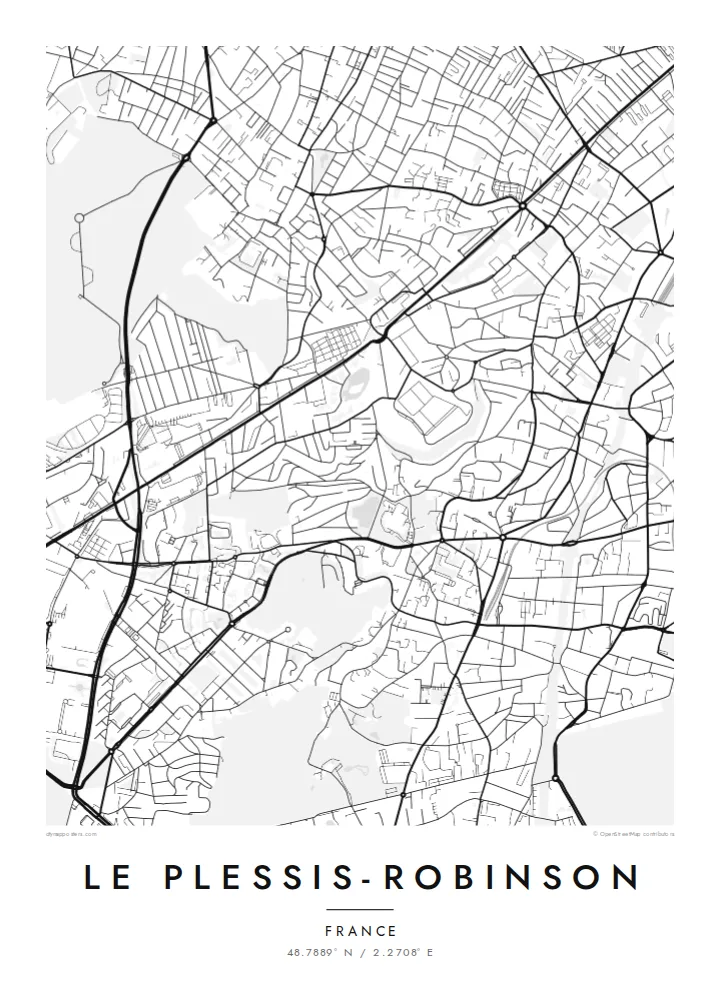
Le Plessis-Robinson lies on a plateau and slope southwest of Paris, in the Hauts-de-Seine department. On a map it sits between larger suburbs, with forest and parkland on its southern edge. The street pattern is unusually varied for a suburb: curving roads on the slopes, tight clusters of new blocks in the centre and areas of low houses laid out in the early twentieth century.
In the 1920s and 1930s the town built one of the region's notable cités-jardins, a garden city of housing arranged around shared green spaces. Much of it was later rebuilt, and from the 1990s the town centre was redesigned in a traditional style with squares and small streets. That renewal is visible from above as a compact, carefully ordered cluster of blocks.
The name Robinson comes from nineteenth-century open-air restaurants where diners were served in tree houses, inspired by stories of castaways. A Le Plessis-Robinson map poster shows the result of those layers, with parks, a pond and green corridors breaking up the streets and the woodland pressing in from the south.
A cluster of small squares and short streets designed from the 1990s forms the heart of the town, visibly denser and more regular than the areas around it.
Housing arranged around shared green spaces, first built in the interwar years, creates curving streets and open courtyards on the poster.
Green space, including a park with a pond and forest to the south, fills much of the map and frames the residential streets.
Taute ke ha hau
Lafi e aho, taha higoa po ke taha kupu haau, hiki e fakatino, lahi po ke tuaga.
Ko e kitiaaga nakai totogi kua tote e maaliali mo e fakamailoga vai. Ko e tau lolomi mo e tau faila HD kua taute ke he 300 DPI, hokotia ke he 7,200 × 10,800 px, nakai fai fakamailoga vai.
Ko e ha Le Plessis-Robinson
People who live in Le Plessis-Robinson often speak of it as a village within the Paris region. A map of it suits a first family home, a wedding held nearby or a gift for someone who has moved away from the Hauts-de-Seine.
You can personalise the title, subtitle and coordinates line, and choose Classic black and white, Noir, Paper, Blueprint or Sand. Blueprint emphasises the orderly new centre, while Paper softens the parkland and garden city streets.
Talaage e poster Le Plessis-Robinson| Lahi he lolomi | Maama | Tau faila |
|---|---|---|
| 30 × 40 cm11.8 × 15.7″ | 3,543 × 4,724 px | PNG · PDF |
| 29.7 × 42 cm (A3)11.7 × 16.5″ | 3,508 × 4,961 px | PNG · PDF |
| 42 × 59.4 cm (A2)16.5 × 23.4″ | 4,961 × 7,016 px | PNG · PDF |
| 45.7 × 61 cm18 × 24″ | 5,400 × 7,200 px | PNG · PDF |
| 50 × 70 cm19.7 × 27.6″ | 5,906 × 8,268 px | PNG · PDF |
| 61 × 91.4 cm24 × 36″ | 7,200 × 10,800 px | PNG · PDF |
Ke fakatatai, ko e fakatino noa kua 900 px e laulahi, fai fakamailoga mo e mo e tau mata komipiuta ni. Ko e tau faila HD kua ato hoko ke he 8× e maama ke he tau faahi takitaha mo e lolomi mitaki he lahi katoa he fakatino.
Fifili e taha puhala i luga he kupega, ti fifili e Poster Lolomi — e lahi mo e, kaeke ke manako ai koe, taha poloka — po ke Tau Faila HD Fakaeletonika. Ko e fakaotiaga totogi ko e taha gahua ni, ti ko e kupega he hau a talaaga ka fakafou fakahaga i mua he fakaotiaga e totogi.
Kua lolomi ai ke he pepa mitaki 200 gsm matte he taha he tau lahi ono, mai he 30 × 40 cm ke hoko ke he 24 × 36″. Kamata e tau poster lolomi mai he $39, kua putoia ai e utaaga.
E. Fifili e poloka akau malolō ke he lanu uli, tea, akau oki mooli, po ke akau pouli. Kua fakalataha mo e sioga malolō nakai malepe ti kua mautali ke tautau. Kamata e tau poster poloka mai he $99, kua putoia ai e utaaga.
Nakai totogi e fakafano ke he motu 60+. Ko e fakatino taha kua lolomi he fenoga lolomi ha mautolu kua tata mo e tau motu 30+, kua hoko mai he tau aho gahua 3–7. Maeke ia koe ke kikite e tuaga mo e fakamuitua he lalo he Haku Tau Fakatonu. Ke he falu motu kua 2–5 e tau tapu, ti ka nakai fakafano a mautolu ki ai, to fakaha he api tupe ia ki mua he totogi.
Fakafano mai e taha ata ki a mautolu he loto he 14 e tau aho tali mai he hokoaga, ti to lolomi foki e mautolu nakai totogi po ke liu atu e totogi ki a koe.
E. He editor i luga he kupega nei, hikihiki e matakupu, e matakupu lalo mo e laini coordinates ke he taha mena kua manako a koe ki ai, ti fifili e puhala mo e lahi. Ko e tau talaaga lolomi, poloka mo e fakaeletonika oti kua fakaaoga tonu e hau a fakatino.
Ma e $9 ka moua e koe e tau faila PNG 300 DPI mo e PDF kua mautali ke lolomi he tau lahi ono oti, nakai fai fakamailoga vai, ke lolomi i fe mena. Nakai maopoopo agaia? Utu hifo fakamua e kitiaaga nakai totogi ne fai fakamailoga vai.
Tata mai
