The Main riverbank
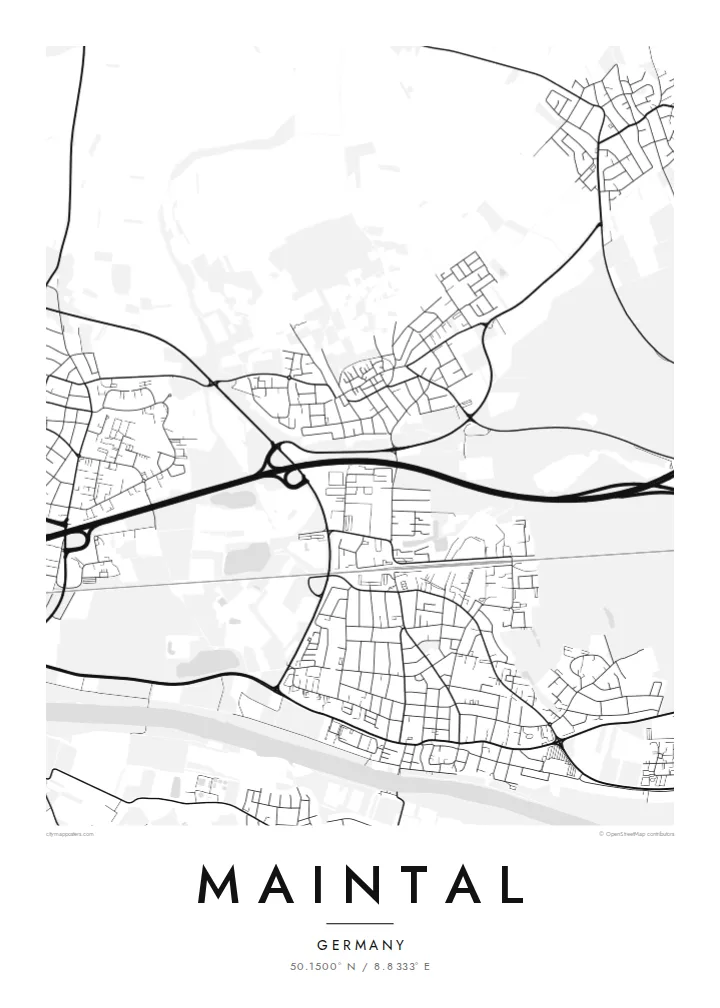
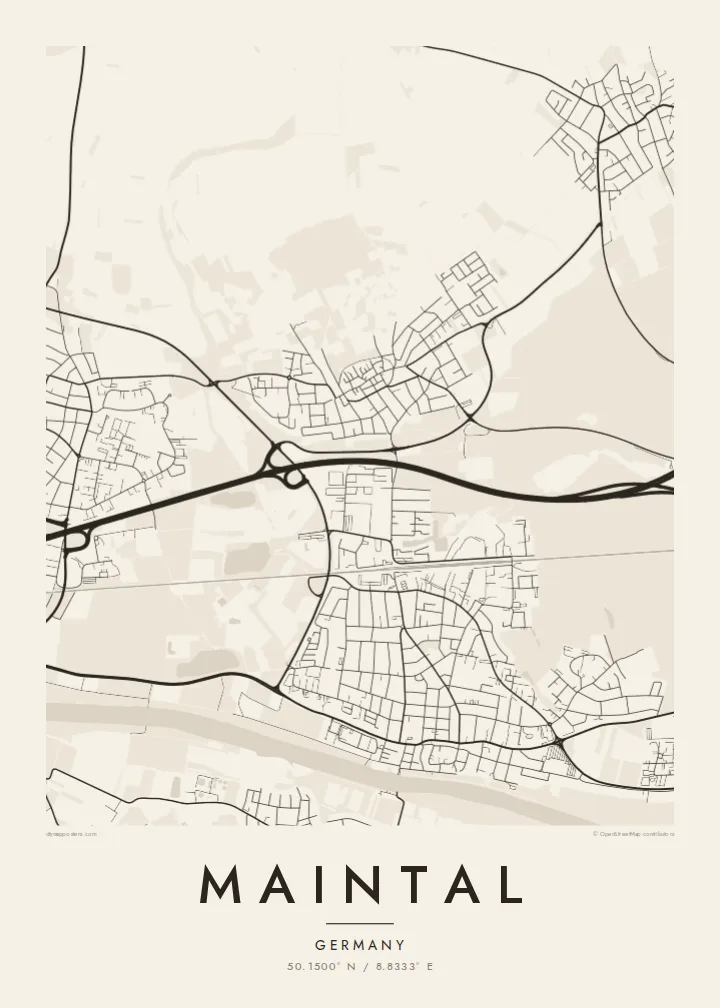
The river runs along the southern edge as a broad, calm band, giving the composition a firm base and showing how Dörnigheim's streets were drawn towards the water.
Fakatino mape mukamuka · Germany
50.1500° N / 8.8333° E
Four former villages stitched together on the north bank of the Main, between Frankfurt's eastern edge and Hanau



Taha e taone, lima e onoonoaga
Tapaki e taha puhala ke kitia ai ki luga he puipui. Kua tatai e totogi he tau puhala oti — pete he lolomi, poloka, po ke faila HD.
 Tau pikselo mooli · faila lolomi 24 × 36″
Maama mitaki ke lolomi
Ko e 100% e fahi mooli mai he faila lolomi. Ko e tau poster oti — pete kua lolomi, poloka, po ke utu hifo — kua taute ke he ha mautolu a tau tokoluga (server) ke he 300 DPI, hokotia ke he 7,200 × 10,800 piksela, ke maeke ai e tau ala ikiiki tote ke maaliali fakamitaki he lolomi 24 × 36″.
He Pā


Ko e mape
Maintal is a young town with old parts. It was formed in 1974, when Dörnigheim, Bischofsheim, Hochstadt and Wachenbuchen were merged into a single municipality in the Main-Kinzig district of Hesse. On a map the four cores are still easy to find, each with its own knot of older streets, joined by later housing, roads and rail.
The river Main forms the southern boundary, and Dörnigheim lies closest to it, with its streets running down towards the bank. Bischofsheim sits nearest to Frankfurt, while Hochstadt and Wachenbuchen are set further north, where the settlement pattern loosens into orchards and fields. The railway and the motorway cut east to west, tying the town into the Rhine-Main region.
Hochstadt is known for its preserved medieval wall and gate and for its apple-wine tradition, a reminder that this was a landscape of meadow orchards before it became commuter country. A Maintal map poster shows how those separate villages grew into one place without entirely losing their outlines, which is exactly what makes the drawing interesting.
The river runs along the southern edge as a broad, calm band, giving the composition a firm base and showing how Dörnigheim's streets were drawn towards the water.
Inside its surviving medieval wall, Hochstadt forms a small, tight cluster of lanes that stands out clearly against the more regular housing estates around it.
Look closely and the map shows four distinct points of density, each an original village, linked by roads and newer neighbourhoods that filled the gaps after the 1974 merger.
Taute ke ha hau
Lafi e aho, taha higoa po ke taha kupu haau, hiki e fakatino, lahi po ke tuaga.
Ko e kitiaaga nakai totogi kua tote e maaliali mo e fakamailoga vai. Ko e tau lolomi mo e tau faila HD kua taute ke he 300 DPI, hokotia ke he 7,200 × 10,800 px, nakai fai fakamailoga vai.
Ko e ha Maintal
Maintal suits people who know it from one particular part of town, whether they grew up in Bischofsheim or moved to Dörnigheim for the commute. The poster keeps all four districts on one sheet, which feels right for a town defined by joining.
Personalise the title, subtitle and coordinates line, perhaps naming your district or the year you moved in, and pick one of five styles: Classic black & white, Noir, Paper, Blueprint or Sand. Files cost $9, or order a print on matte paper with an optional wooden frame.
Talaage e poster Maintal| Lahi he lolomi | Maama | Tau faila |
|---|---|---|
| 30 × 40 cm11.8 × 15.7″ | 3,543 × 4,724 px | PNG · PDF |
| 29.7 × 42 cm (A3)11.7 × 16.5″ | 3,508 × 4,961 px | PNG · PDF |
| 42 × 59.4 cm (A2)16.5 × 23.4″ | 4,961 × 7,016 px | PNG · PDF |
| 45.7 × 61 cm18 × 24″ | 5,400 × 7,200 px | PNG · PDF |
| 50 × 70 cm19.7 × 27.6″ | 5,906 × 8,268 px | PNG · PDF |
| 61 × 91.4 cm24 × 36″ | 7,200 × 10,800 px | PNG · PDF |
Ke fakatatai, ko e fakatino noa kua 900 px e laulahi, fai fakamailoga mo e mo e tau mata komipiuta ni. Ko e tau faila HD kua ato hoko ke he 8× e maama ke he tau faahi takitaha mo e lolomi mitaki he lahi katoa he fakatino.
Fifili e taha puhala i luga he kupega, ti fifili e Poster Lolomi — e lahi mo e, kaeke ke manako ai koe, taha poloka — po ke Tau Faila HD Fakaeletonika. Ko e fakaotiaga totogi ko e taha gahua ni, ti ko e kupega he hau a talaaga ka fakafou fakahaga i mua he fakaotiaga e totogi.
Kua lolomi ai ke he pepa mitaki 200 gsm matte he taha he tau lahi ono, mai he 30 × 40 cm ke hoko ke he 24 × 36″. Kamata e tau poster lolomi mai he $39, kua putoia ai e utaaga.
E. Fifili e poloka akau malolō ke he lanu uli, tea, akau oki mooli, po ke akau pouli. Kua fakalataha mo e sioga malolō nakai malepe ti kua mautali ke tautau. Kamata e tau poster poloka mai he $99, kua putoia ai e utaaga.
Nakai totogi e fakafano ke he motu 60+. Ko e fakatino taha kua lolomi he fenoga lolomi ha mautolu kua tata mo e tau motu 30+, kua hoko mai he tau aho gahua 3–7. Maeke ia koe ke kikite e tuaga mo e fakamuitua he lalo he Haku Tau Fakatonu. Ke he falu motu kua 2–5 e tau tapu, ti ka nakai fakafano a mautolu ki ai, to fakaha he api tupe ia ki mua he totogi.
Fakafano mai e taha ata ki a mautolu he loto he 14 e tau aho tali mai he hokoaga, ti to lolomi foki e mautolu nakai totogi po ke liu atu e totogi ki a koe.
E. He editor i luga he kupega nei, hikihiki e matakupu, e matakupu lalo mo e laini coordinates ke he taha mena kua manako a koe ki ai, ti fifili e puhala mo e lahi. Ko e tau talaaga lolomi, poloka mo e fakaeletonika oti kua fakaaoga tonu e hau a fakatino.
Ma e $9 ka moua e koe e tau faila PNG 300 DPI mo e PDF kua mautali ke lolomi he tau lahi ono oti, nakai fai fakamailoga vai, ke lolomi i fe mena. Nakai maopoopo agaia? Utu hifo fakamua e kitiaaga nakai totogi ne fai fakamailoga vai.
