The Marne bank
The river runs along the edge of the town with quays and footpaths. It shapes the northern and eastern boundary on the map, close to its confluence with the Seine.
Fakatino mape mukamuka · France
48.8117° N / 2.4394° E
A dense inner suburb southeast of Paris, pressed against a bend of the Marne, with a fort and a historic veterinary campus.



Taha e taone, lima e onoonoaga
Tapaki e taha puhala ke kitia ai ki luga he puipui. Kua tatai e totogi he tau puhala oti — pete he lolomi, poloka, po ke faila HD.
 Tau pikselo mooli · faila lolomi 24 × 36″
Maama mitaki ke lolomi
Ko e 100% e fahi mooli mai he faila lolomi. Ko e tau poster oti — pete kua lolomi, poloka, po ke utu hifo — kua taute ke he ha mautolu a tau tokoluga (server) ke he 300 DPI, hokotia ke he 7,200 × 10,800 piksela, ke maeke ai e tau ala ikiiki tote ke maaliali fakamitaki he lolomi 24 × 36″.
He Pā


Ko e mape
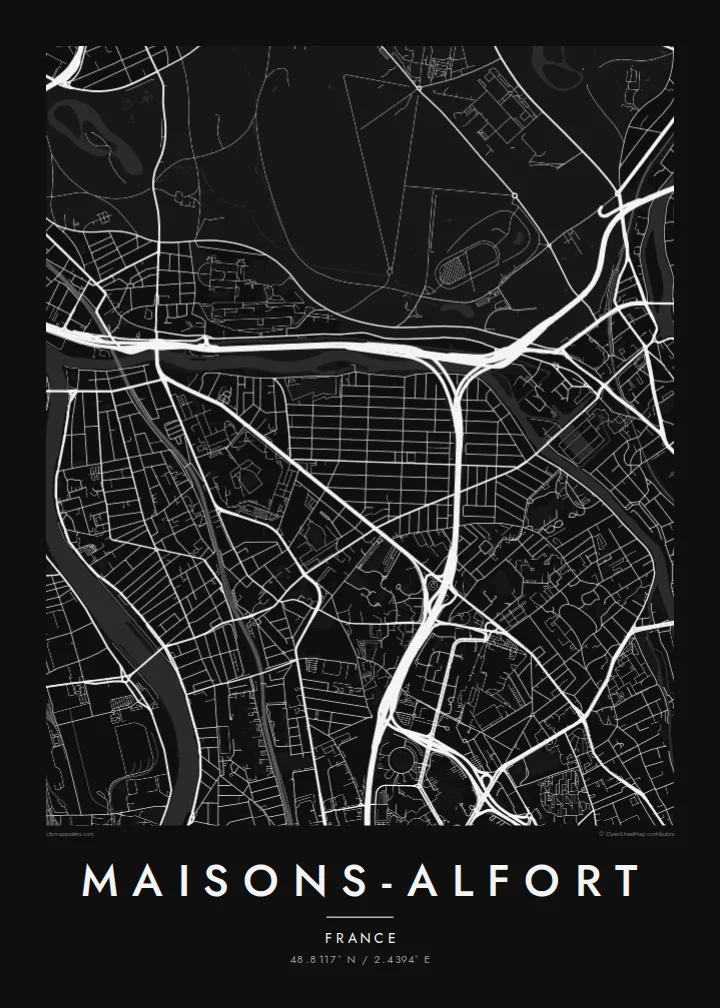
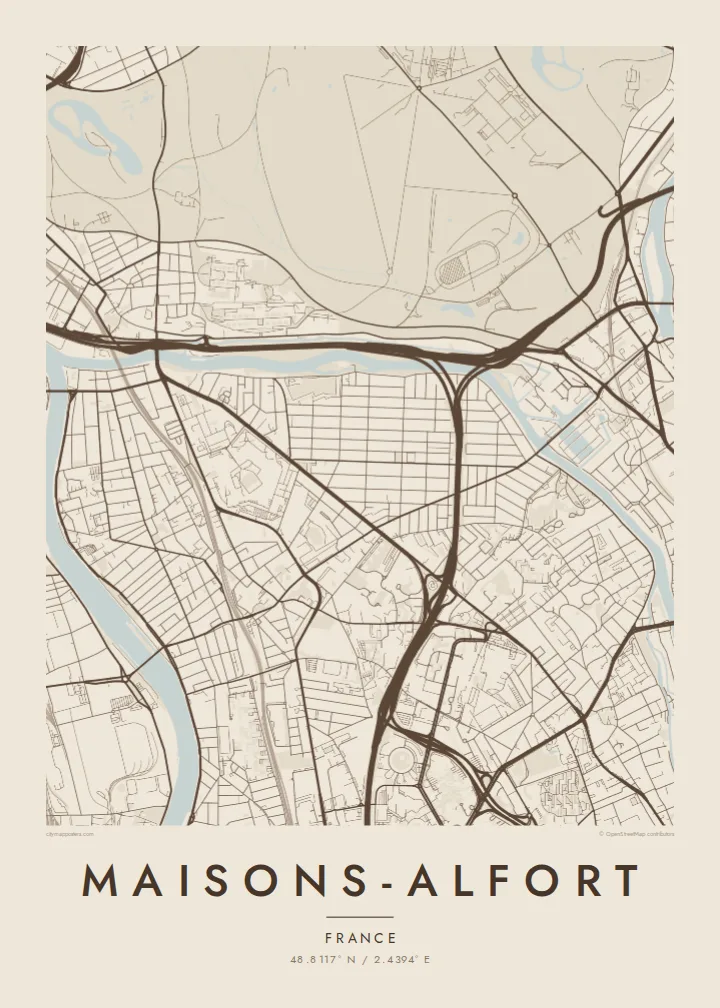
Maisons-Alfort sits just beyond the southeastern edge of Paris, in the Val-de-Marne department. From above it looks like a close weave of residential streets, avenues and small blocks. The Marne curves along its northern and eastern side, close to where the river meets the Seine. There is no single centre. The town reads as a string of neighbourhoods tied together by long roads that lead back towards the capital.
Two large shapes stand out from the finer grain of streets. One is the old Fort de Charenton, a bastioned outline left from the ring of forts built to defend Paris in the nineteenth century. The other is the campus of the Alfort veterinary school. It was founded in 1765 and is one of the oldest veterinary schools in the world. Its grounds form a calm, open block in the middle of the built-up area.
A Maisons-Alfort map poster captures the typical first-ring suburb of Paris: quays along the river, metro stations placed along a main axis, and a mix of apartment blocks and low houses. Printed in black and white, the fine street pattern becomes an even texture. The river and the fort are the only strong breaks in it, and they give the composition its structure.
The river runs along the edge of the town with quays and footpaths. It shapes the northern and eastern boundary on the map, close to its confluence with the Seine.
Part of the nineteenth-century defensive ring around Paris, the fort still shows its angular bastioned plan. It is one of the clearest geometric shapes in the district.
Founded in 1765, the school occupies a large campus near the northwest of the town. Its buildings and courtyards interrupt the surrounding residential grid.
Taute ke ha hau
Lafi e aho, taha higoa po ke taha kupu haau, hiki e fakatino, lahi po ke tuaga.
Ko e kitiaaga nakai totogi kua tote e maaliali mo e fakamailoga vai. Ko e tau lolomi mo e tau faila HD kua taute ke he 300 DPI, hokotia ke he 7,200 × 10,800 px, nakai fai fakamailoga vai.
Ko e ha Maisons-Alfort
For people who studied at Alfort, grew up near the Marne or commute into Paris from here, this map shows a place that is often overlooked but deeply familiar. It records the ordinary streets that make up daily life just outside the capital.
You can change the title, subtitle and coordinates line to mark a street, a graduation year or a move. The poster comes in five styles: Classic black and white, Noir, Paper, Blueprint and Sand.
Talaage e poster Maisons-Alfort| Lahi he lolomi | Maama | Tau faila |
|---|---|---|
| 30 × 40 cm11.8 × 15.7″ | 3,543 × 4,724 px | PNG · PDF |
| 29.7 × 42 cm (A3)11.7 × 16.5″ | 3,508 × 4,961 px | PNG · PDF |
| 42 × 59.4 cm (A2)16.5 × 23.4″ | 4,961 × 7,016 px | PNG · PDF |
| 45.7 × 61 cm18 × 24″ | 5,400 × 7,200 px | PNG · PDF |
| 50 × 70 cm19.7 × 27.6″ | 5,906 × 8,268 px | PNG · PDF |
| 61 × 91.4 cm24 × 36″ | 7,200 × 10,800 px | PNG · PDF |
Ke fakatatai, ko e fakatino noa kua 900 px e laulahi, fai fakamailoga mo e mo e tau mata komipiuta ni. Ko e tau faila HD kua ato hoko ke he 8× e maama ke he tau faahi takitaha mo e lolomi mitaki he lahi katoa he fakatino.
Fifili e taha puhala i luga he kupega, ti fifili e Poster Lolomi — e lahi mo e, kaeke ke manako ai koe, taha poloka — po ke Tau Faila HD Fakaeletonika. Ko e fakaotiaga totogi ko e taha gahua ni, ti ko e kupega he hau a talaaga ka fakafou fakahaga i mua he fakaotiaga e totogi.
Kua lolomi ai ke he pepa mitaki 200 gsm matte he taha he tau lahi ono, mai he 30 × 40 cm ke hoko ke he 24 × 36″. Kamata e tau poster lolomi mai he $39, kua putoia ai e utaaga.
E. Fifili e poloka akau malolō ke he lanu uli, tea, akau oki mooli, po ke akau pouli. Kua fakalataha mo e sioga malolō nakai malepe ti kua mautali ke tautau. Kamata e tau poster poloka mai he $99, kua putoia ai e utaaga.
Nakai totogi e fakafano ke he motu 60+. Ko e fakatino taha kua lolomi he fenoga lolomi ha mautolu kua tata mo e tau motu 30+, kua hoko mai he tau aho gahua 3–7. Maeke ia koe ke kikite e tuaga mo e fakamuitua he lalo he Haku Tau Fakatonu. Ke he falu motu kua 2–5 e tau tapu, ti ka nakai fakafano a mautolu ki ai, to fakaha he api tupe ia ki mua he totogi.
Fakafano mai e taha ata ki a mautolu he loto he 14 e tau aho tali mai he hokoaga, ti to lolomi foki e mautolu nakai totogi po ke liu atu e totogi ki a koe.
E. He editor i luga he kupega nei, hikihiki e matakupu, e matakupu lalo mo e laini coordinates ke he taha mena kua manako a koe ki ai, ti fifili e puhala mo e lahi. Ko e tau talaaga lolomi, poloka mo e fakaeletonika oti kua fakaaoga tonu e hau a fakatino.
Ma e $9 ka moua e koe e tau faila PNG 300 DPI mo e PDF kua mautali ke lolomi he tau lahi ono oti, nakai fai fakamailoga vai, ke lolomi i fe mena. Nakai maopoopo agaia? Utu hifo fakamua e kitiaaga nakai totogi ne fai fakamailoga vai.
Tata mai
