Shrine at the centre
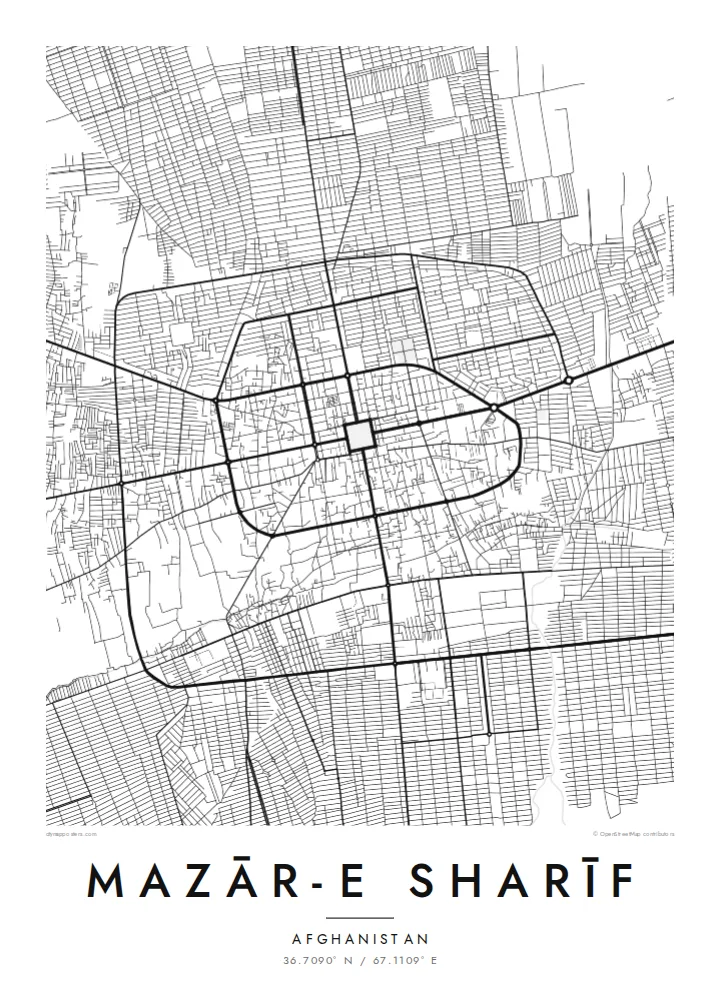
The walled grounds of the Blue Mosque form a large rectangle in the middle of the map, the point around which the city's main streets and markets are organised.
Fakatino mape mukamuka · Afghanistan
36.7090° N / 67.1109° E
A plains city in northern Afghanistan organised around a single great shrine, with open ground stretching north toward the Amu Darya.


Taha e taone, lima e onoonoaga
Tapaki e taha puhala ke kitia ai ki luga he puipui. Kua tatai e totogi he tau puhala oti — pete he lolomi, poloka, po ke faila HD.
 Tau pikselo mooli · faila lolomi 24 × 36″
Maama mitaki ke lolomi
Ko e 100% e fahi mooli mai he faila lolomi. Ko e tau poster oti — pete kua lolomi, poloka, po ke utu hifo — kua taute ke he ha mautolu a tau tokoluga (server) ke he 300 DPI, hokotia ke he 7,200 × 10,800 piksela, ke maeke ai e tau ala ikiiki tote ke maaliali fakamitaki he lolomi 24 × 36″.
He Pā


Ko e mape
Mazār-e Sharīf is the largest city in northern Afghanistan. It sits on a flat plain between the foothills of the Hindu Kush to the south and the Amu Darya to the north. Its name means the noble shrine. The city grew around the Shrine of Ali, widely known as the Blue Mosque, whose walled grounds sit at the centre of the street map.
Main avenues lead away from the shrine enclosure toward the edges of the city, and the surrounding blocks form a dense pattern of markets and low houses. Beyond them the built-up area gives way to irrigated fields and then open, dry ground. About twenty kilometres to the west lie the ruins of ancient Balkh, once one of Central Asia's great cities.
A Mazār-e Sharīf map poster reads almost like a diagram: a central enclosure, a tight block pattern around it and straight roads leaving for Balkh, Hairatan and the south. It is a strong, balanced subject, and the plain around it is so simple that the city's shape stands out clearly at any size.
The walled grounds of the Blue Mosque form a large rectangle in the middle of the map, the point around which the city's main streets and markets are organised.
Straight highways leave the city toward Balkh in the west and the Amu Darya border crossing at Hairatan in the north, drawing clean lines across open ground.
Canals and field boundaries surround the built-up area, a fine pattern of lines that gradually fades into the dry plain as the frame widens.
Taute ke ha hau
Lafi e aho, taha higoa po ke taha kupu haau, hiki e fakatino, lahi po ke tuaga.
Ko e kitiaaga nakai totogi kua tote e maaliali mo e fakamailoga vai. Ko e tau lolomi mo e tau faila HD kua taute ke he 300 DPI, hokotia ke he 7,200 × 10,800 px, nakai fai fakamailoga vai.
Ko e ha Mazār-e Sharīf
For Afghans abroad, Mazār-e Sharīf is often remembered through Nowruz at the shrine and the white pigeons in its courtyard. A map of the city is a quiet, personal way to keep that place close without relying on photographs.
Set the title, subtitle and coordinates line in your own words, perhaps a family name or a year. Choose Classic black & white, Noir, Paper, Blueprint or Sand, then download the HD files for $9 or order a printed poster on matte paper.
Talaage e poster Mazār-e Sharīf| Lahi he lolomi | Maama | Tau faila |
|---|---|---|
| 30 × 40 cm11.8 × 15.7″ | 3,543 × 4,724 px | PNG · PDF |
| 29.7 × 42 cm (A3)11.7 × 16.5″ | 3,508 × 4,961 px | PNG · PDF |
| 42 × 59.4 cm (A2)16.5 × 23.4″ | 4,961 × 7,016 px | PNG · PDF |
| 45.7 × 61 cm18 × 24″ | 5,400 × 7,200 px | PNG · PDF |
| 50 × 70 cm19.7 × 27.6″ | 5,906 × 8,268 px | PNG · PDF |
| 61 × 91.4 cm24 × 36″ | 7,200 × 10,800 px | PNG · PDF |
Ke fakatatai, ko e fakatino noa kua 900 px e laulahi, fai fakamailoga mo e mo e tau mata komipiuta ni. Ko e tau faila HD kua ato hoko ke he 8× e maama ke he tau faahi takitaha mo e lolomi mitaki he lahi katoa he fakatino.
Fifili e taha puhala i luga he kupega, ti fifili e Poster Lolomi — e lahi mo e, kaeke ke manako ai koe, taha poloka — po ke Tau Faila HD Fakaeletonika. Ko e fakaotiaga totogi ko e taha gahua ni, ti ko e kupega he hau a talaaga ka fakafou fakahaga i mua he fakaotiaga e totogi.
Kua lolomi ai ke he pepa mitaki 200 gsm matte he taha he tau lahi ono, mai he 30 × 40 cm ke hoko ke he 24 × 36″. Kamata e tau poster lolomi mai he $39, kua putoia ai e utaaga.
E. Fifili e poloka akau malolō ke he lanu uli, tea, akau oki mooli, po ke akau pouli. Kua fakalataha mo e sioga malolō nakai malepe ti kua mautali ke tautau. Kamata e tau poster poloka mai he $99, kua putoia ai e utaaga.
Nakai totogi e fakafano ke he motu 60+. Ko e fakatino taha kua lolomi he fenoga lolomi ha mautolu kua tata mo e tau motu 30+, kua hoko mai he tau aho gahua 3–7. Maeke ia koe ke kikite e tuaga mo e fakamuitua he lalo he Haku Tau Fakatonu. Ke he falu motu kua 2–5 e tau tapu, ti ka nakai fakafano a mautolu ki ai, to fakaha he api tupe ia ki mua he totogi.
Fakafano mai e taha ata ki a mautolu he loto he 14 e tau aho tali mai he hokoaga, ti to lolomi foki e mautolu nakai totogi po ke liu atu e totogi ki a koe.
E. He editor i luga he kupega nei, hikihiki e matakupu, e matakupu lalo mo e laini coordinates ke he taha mena kua manako a koe ki ai, ti fifili e puhala mo e lahi. Ko e tau talaaga lolomi, poloka mo e fakaeletonika oti kua fakaaoga tonu e hau a fakatino.
Ma e $9 ka moua e koe e tau faila PNG 300 DPI mo e PDF kua mautali ke lolomi he tau lahi ono oti, nakai fai fakamailoga vai, ke lolomi i fe mena. Nakai maopoopo agaia? Utu hifo fakamua e kitiaaga nakai totogi ne fai fakamailoga vai.
Tata mai
