Imperial ramparts
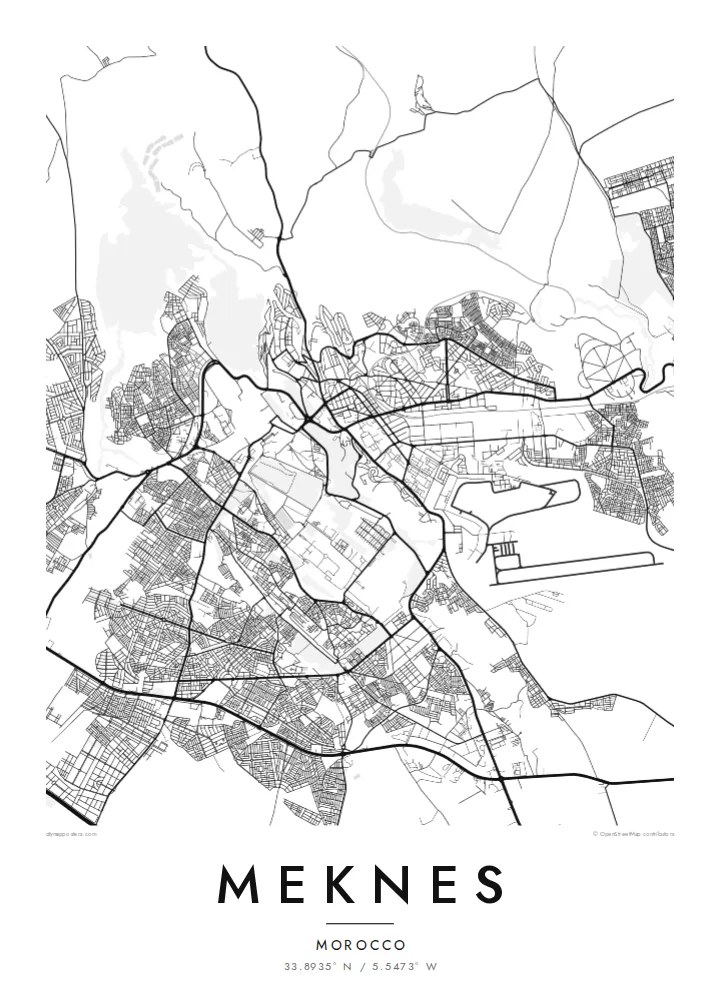
Long walls enclose the palaces, gardens and granaries of Moulay Ismail's city. They show on the print as broad bands enclosing unusually large open compounds.
Fakatino mape mukamuka · Morocco
33.8935° N / 5.5473° W
A walled imperial medina and a gridded new town on opposite sides of a green river valley



Taha e taone, lima e onoonoaga
Tapaki e taha puhala ke kitia ai ki luga he puipui. Kua tatai e totogi he tau puhala oti — pete he lolomi, poloka, po ke faila HD.
 Tau pikselo mooli · faila lolomi 24 × 36″
Maama mitaki ke lolomi
Ko e 100% e fahi mooli mai he faila lolomi. Ko e tau poster oti — pete kua lolomi, poloka, po ke utu hifo — kua taute ke he ha mautolu a tau tokoluga (server) ke he 300 DPI, hokotia ke he 7,200 × 10,800 piksela, ke maeke ai e tau ala ikiiki tote ke maaliali fakamitaki he lolomi 24 × 36″.
He Pā


Ko e mape
Meknes is a city in two parts, and the map shows why. On one side of the Oued Boufekrane valley sits the old medina and the imperial city, a maze of narrow lanes enclosed by long lines of ramparts. On the other side is the Ville Nouvelle, laid out in the twentieth century with straighter boulevards and regular blocks. Between them, the green valley runs like a seam.
The imperial city was built largely under Sultan Moulay Ismail in the late seventeenth and early eighteenth centuries, when he made Meknes his capital. Its walls, gates and granaries were built on a very large scale, and the monumental Bab Mansour gate is one of the best known in Morocco. The historic city is a UNESCO World Heritage site, and the ruins of Volubilis are not far away.
A Meknes map poster shows the contrast between the two halves in one image. The medina's dense, irregular fabric sits beside the large enclosed spaces of the imperial complex, with walls tracing long unbroken lines. Across the valley, the modern town's clean geometry answers it. Few Moroccan cities show that division so clearly from above.
Long walls enclose the palaces, gardens and granaries of Moulay Ismail's city. They show on the print as broad bands enclosing unusually large open compounds.
North of the imperial quarter, narrow lanes and dead ends are packed tightly together. It is the most intricate part of the poster, and a very different texture from the new town.
A green river valley separates the old city from the Ville Nouvelle. On the map it is a clear open strip that divides the composition in two.
Taute ke ha hau
Lafi e aho, taha higoa po ke taha kupu haau, hiki e fakatino, lahi po ke tuaga.
Ko e kitiaaga nakai totogi kua tote e maaliali mo e fakamailoga vai. Ko e tau lolomi mo e tau faila HD kua taute ke he 300 DPI, hokotia ke he 7,200 × 10,800 px, nakai fai fakamailoga vai.
Ko e ha Meknes
Meknes is often a short stop on a Moroccan itinerary, but those who stay remember the scale of its walls and gates. A map poster keeps that memory in a form that fits a hallway or study.
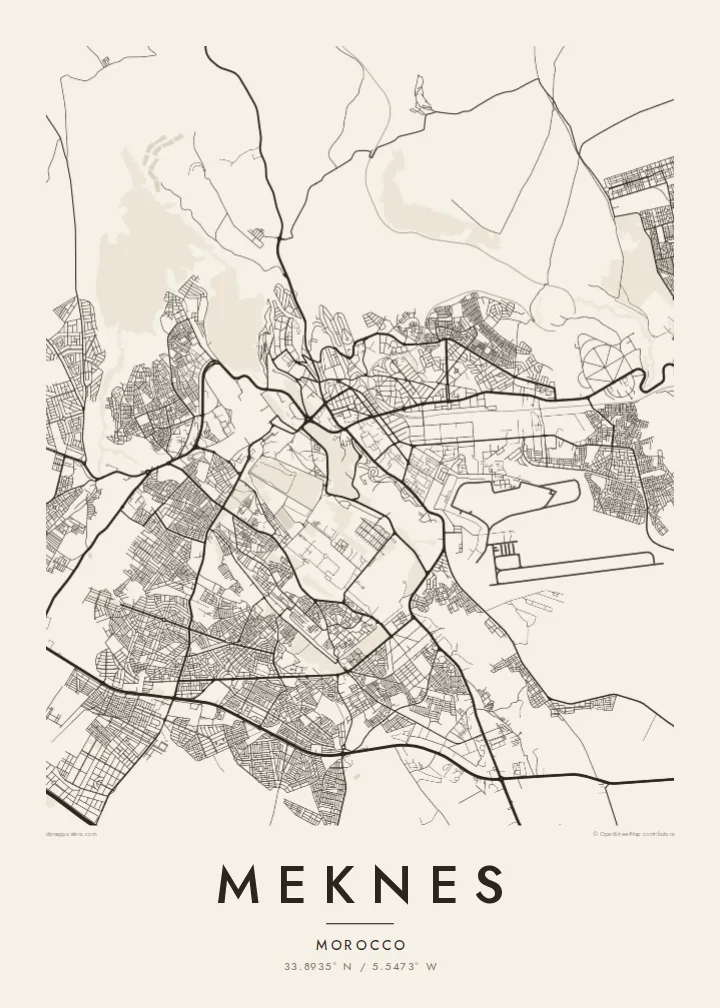
Personalise the title, subtitle and coordinates line, for example with the date of your trip, and choose one of five styles. Sand and Paper suit the earthen tones of the ramparts, while Classic black and white keeps it crisp.
Talaage e poster Meknes| Lahi he lolomi | Maama | Tau faila |
|---|---|---|
| 30 × 40 cm11.8 × 15.7″ | 3,543 × 4,724 px | PNG · PDF |
| 29.7 × 42 cm (A3)11.7 × 16.5″ | 3,508 × 4,961 px | PNG · PDF |
| 42 × 59.4 cm (A2)16.5 × 23.4″ | 4,961 × 7,016 px | PNG · PDF |
| 45.7 × 61 cm18 × 24″ | 5,400 × 7,200 px | PNG · PDF |
| 50 × 70 cm19.7 × 27.6″ | 5,906 × 8,268 px | PNG · PDF |
| 61 × 91.4 cm24 × 36″ | 7,200 × 10,800 px | PNG · PDF |
Ke fakatatai, ko e fakatino noa kua 900 px e laulahi, fai fakamailoga mo e mo e tau mata komipiuta ni. Ko e tau faila HD kua ato hoko ke he 8× e maama ke he tau faahi takitaha mo e lolomi mitaki he lahi katoa he fakatino.
Fifili e taha puhala i luga he kupega, ti fifili e Poster Lolomi — e lahi mo e, kaeke ke manako ai koe, taha poloka — po ke Tau Faila HD Fakaeletonika. Ko e fakaotiaga totogi ko e taha gahua ni, ti ko e kupega he hau a talaaga ka fakafou fakahaga i mua he fakaotiaga e totogi.
Kua lolomi ai ke he pepa mitaki 200 gsm matte he taha he tau lahi ono, mai he 30 × 40 cm ke hoko ke he 24 × 36″. Kamata e tau poster lolomi mai he $39, kua putoia ai e utaaga.
E. Fifili e poloka akau malolō ke he lanu uli, tea, akau oki mooli, po ke akau pouli. Kua fakalataha mo e sioga malolō nakai malepe ti kua mautali ke tautau. Kamata e tau poster poloka mai he $99, kua putoia ai e utaaga.
Nakai totogi e fakafano ke he motu 60+. Ko e fakatino taha kua lolomi he fenoga lolomi ha mautolu kua tata mo e tau motu 30+, kua hoko mai he tau aho gahua 3–7. Maeke ia koe ke kikite e tuaga mo e fakamuitua he lalo he Haku Tau Fakatonu. Ke he falu motu kua 2–5 e tau tapu, ti ka nakai fakafano a mautolu ki ai, to fakaha he api tupe ia ki mua he totogi.
Fakafano mai e taha ata ki a mautolu he loto he 14 e tau aho tali mai he hokoaga, ti to lolomi foki e mautolu nakai totogi po ke liu atu e totogi ki a koe.
E. He editor i luga he kupega nei, hikihiki e matakupu, e matakupu lalo mo e laini coordinates ke he taha mena kua manako a koe ki ai, ti fifili e puhala mo e lahi. Ko e tau talaaga lolomi, poloka mo e fakaeletonika oti kua fakaaoga tonu e hau a fakatino.
Ma e $9 ka moua e koe e tau faila PNG 300 DPI mo e PDF kua mautali ke lolomi he tau lahi ono oti, nakai fai fakamailoga vai, ke lolomi i fe mena. Nakai maopoopo agaia? Utu hifo fakamua e kitiaaga nakai totogi ne fai fakamailoga vai.
Tata mai
