Cuvelai floodplain
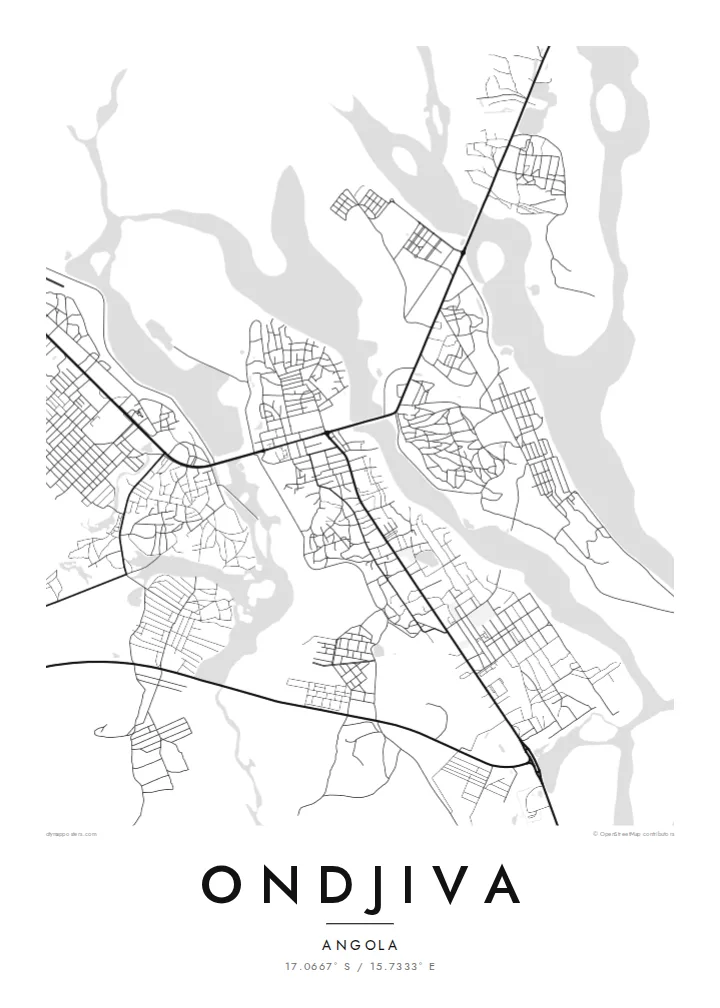
The land around the town is almost perfectly flat, crossed by shallow channels known as oshanas that fill in the rainy season and show as soft, branching lines.
Fakatino mape mukamuka · Angola
17.0667° S / 15.7333° E
A provincial capital on the flat Cuvelai plain of southern Angola, laced with seasonal channels close to Namibia.


Taha e taone, lima e onoonoaga
Tapaki e taha puhala ke kitia ai ki luga he puipui. Kua tatai e totogi he tau puhala oti — pete he lolomi, poloka, po ke faila HD.
 Tau pikselo mooli · faila lolomi 24 × 36″
Maama mitaki ke lolomi
Ko e 100% e fahi mooli mai he faila lolomi. Ko e tau poster oti — pete kua lolomi, poloka, po ke utu hifo — kua taute ke he ha mautolu a tau tokoluga (server) ke he 300 DPI, hokotia ke he 7,200 × 10,800 piksela, ke maeke ai e tau ala ikiiki tote ke maaliali fakamitaki he lolomi 24 × 36″.
He Pā


Ko e mape
Ondjiva is the capital of Cunene province in the far south of Angola, a short distance from the Namibian border. It stands on the very flat plain of the Cuvelai basin, where shallow seasonal watercourses spread across the land after the rains. On the map the town is a grid of streets and larger government plots, surrounded by open savanna, homesteads and roads leading toward the border.
Ondjiva is the main town of the Kwanyama people and an administrative and trading centre for a wide rural area of cattle herding and farming. The town was heavily damaged during the conflicts of the 1970s and 1980s and has been largely rebuilt since. New public buildings, avenues and neighbourhoods have been added around the older centre.
An Ondjiva map poster shows a town defined by flatness and space: straight avenues, open plots, the faint lines of seasonal channels and roads fanning out across the plain. In monochrome the composition is spare and graphic, a clear picture of how a southern Angolan capital sits in its wide, level landscape.
The land around the town is almost perfectly flat, crossed by shallow channels known as oshanas that fill in the rainy season and show as soft, branching lines.
Broad avenues and larger public plots mark the rebuilt centre, giving the core a more open and orderly pattern than the scattered settlement around it.
The main road south toward the Namibian border runs from the town across the plain, a straight line that ties Ondjiva to cross-border trade.
Taute ke ha hau
Lafi e aho, taha higoa po ke taha kupu haau, hiki e fakatino, lahi po ke tuaga.
Ko e kitiaaga nakai totogi kua tote e maaliali mo e fakamailoga vai. Ko e tau lolomi mo e tau faila HD kua taute ke he 300 DPI, hokotia ke he 7,200 × 10,800 px, nakai fai fakamailoga vai.
Ko e ha Ondjiva
For families from Cunene, and for people who have worked or travelled in southern Angola, a map of Ondjiva is a spare and personal image of home. Set your own title, subtitle and coordinates line, and pick Classic black & white, Noir, Paper, Blueprint or Sand.
The $9 digital download includes six print sizes, from 30×40 cm to 24×36″, each as a 300 DPI PNG and a print-ready PDF with no watermark. A free 900 px preview is available, and printed matte posters ship from print partners in more than 30 countries.
Talaage e poster Ondjiva| Lahi he lolomi | Maama | Tau faila |
|---|---|---|
| 30 × 40 cm11.8 × 15.7″ | 3,543 × 4,724 px | PNG · PDF |
| 29.7 × 42 cm (A3)11.7 × 16.5″ | 3,508 × 4,961 px | PNG · PDF |
| 42 × 59.4 cm (A2)16.5 × 23.4″ | 4,961 × 7,016 px | PNG · PDF |
| 45.7 × 61 cm18 × 24″ | 5,400 × 7,200 px | PNG · PDF |
| 50 × 70 cm19.7 × 27.6″ | 5,906 × 8,268 px | PNG · PDF |
| 61 × 91.4 cm24 × 36″ | 7,200 × 10,800 px | PNG · PDF |
Ke fakatatai, ko e fakatino noa kua 900 px e laulahi, fai fakamailoga mo e mo e tau mata komipiuta ni. Ko e tau faila HD kua ato hoko ke he 8× e maama ke he tau faahi takitaha mo e lolomi mitaki he lahi katoa he fakatino.
Fifili e taha puhala i luga he kupega, ti fifili e Poster Lolomi — e lahi mo e, kaeke ke manako ai koe, taha poloka — po ke Tau Faila HD Fakaeletonika. Ko e fakaotiaga totogi ko e taha gahua ni, ti ko e kupega he hau a talaaga ka fakafou fakahaga i mua he fakaotiaga e totogi.
Kua lolomi ai ke he pepa mitaki 200 gsm matte he taha he tau lahi ono, mai he 30 × 40 cm ke hoko ke he 24 × 36″. Kamata e tau poster lolomi mai he $39, kua putoia ai e utaaga.
E. Fifili e poloka akau malolō ke he lanu uli, tea, akau oki mooli, po ke akau pouli. Kua fakalataha mo e sioga malolō nakai malepe ti kua mautali ke tautau. Kamata e tau poster poloka mai he $99, kua putoia ai e utaaga.
Nakai totogi e fakafano ke he motu 60+. Ko e fakatino taha kua lolomi he fenoga lolomi ha mautolu kua tata mo e tau motu 30+, kua hoko mai he tau aho gahua 3–7. Maeke ia koe ke kikite e tuaga mo e fakamuitua he lalo he Haku Tau Fakatonu. Ke he falu motu kua 2–5 e tau tapu, ti ka nakai fakafano a mautolu ki ai, to fakaha he api tupe ia ki mua he totogi.
Fakafano mai e taha ata ki a mautolu he loto he 14 e tau aho tali mai he hokoaga, ti to lolomi foki e mautolu nakai totogi po ke liu atu e totogi ki a koe.
E. He editor i luga he kupega nei, hikihiki e matakupu, e matakupu lalo mo e laini coordinates ke he taha mena kua manako a koe ki ai, ti fifili e puhala mo e lahi. Ko e tau talaaga lolomi, poloka mo e fakaeletonika oti kua fakaaoga tonu e hau a fakatino.
Ma e $9 ka moua e koe e tau faila PNG 300 DPI mo e PDF kua mautali ke lolomi he tau lahi ono oti, nakai fai fakamailoga vai, ke lolomi i fe mena. Nakai maopoopo agaia? Utu hifo fakamua e kitiaaga nakai totogi ne fai fakamailoga vai.
Tata mai
