Tigris River
The Tigris runs past the city in a wide channel, and a barrage upstream diverts some of its water toward the Tharthar depression to the west.
Fakatino mape mukamuka · Iraq
34.1959° N / 43.8857° E
A city on the Tigris beside the vast grid of a ninth-century Abbasid capital, stretching along the riverbank.


Taha e taone, lima e onoonoaga
Tapaki e taha puhala ke kitia ai ki luga he puipui. Kua tatai e totogi he tau puhala oti — pete he lolomi, poloka, po ke faila HD.
 Tau pikselo mooli · faila lolomi 24 × 36″
Maama mitaki ke lolomi
Ko e 100% e fahi mooli mai he faila lolomi. Ko e tau poster oti — pete kua lolomi, poloka, po ke utu hifo — kua taute ke he ha mautolu a tau tokoluga (server) ke he 300 DPI, hokotia ke he 7,200 × 10,800 piksela, ke maeke ai e tau ala ikiiki tote ke maaliali fakamitaki he lolomi 24 × 36″.
He Pā


Ko e mape
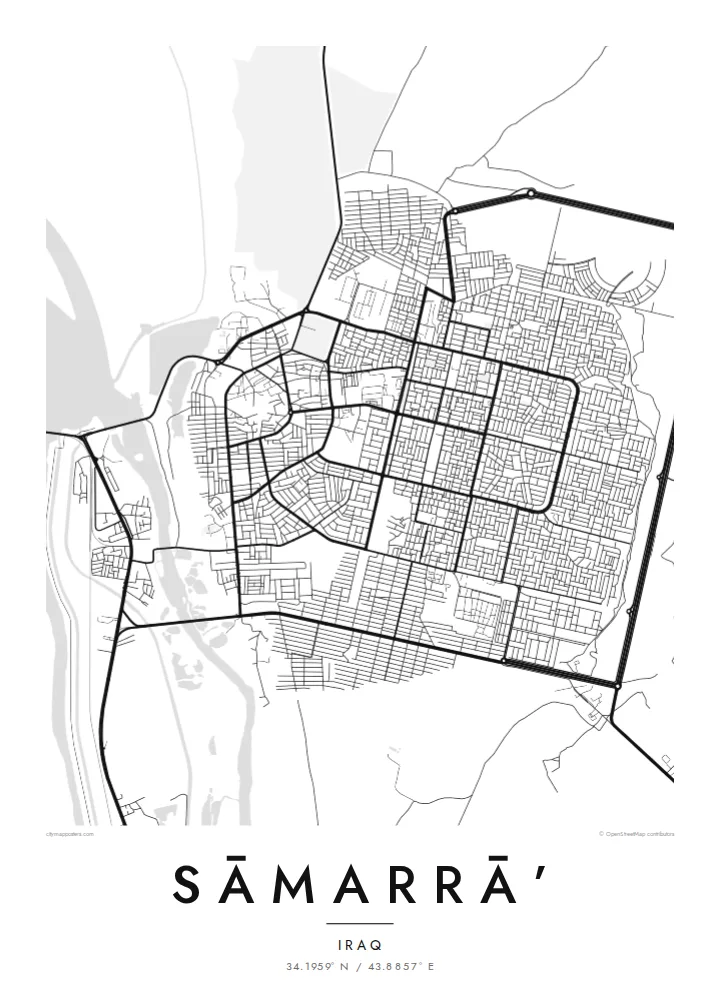
Sāmarrā’ lies on the east bank of the Tigris north of Baghdad, and on a map the river is its defining feature. The modern city gathers around an older walled core, while beyond it the traces of an immense historic capital extend for kilometres along the Tigris, visible as long straight avenues, enclosures and open ground in the desert landscape.
In the ninth century Sāmarrā’ served as the capital of the Abbasid caliphate, and its archaeological remains are a UNESCO World Heritage Site. The best-known monument is the Great Mosque with its spiral minaret, the Malwiya. The city is also home to the al-Askari Shrine, a major Shia pilgrimage site whose golden dome stands at the centre of the old town.
A Sāmarrā’ map poster shows a compact modern city beside one of the largest archaeological landscapes of the medieval world. The Tigris draws a strong, calm line through the frame, and the historic layout, though faint, gives the map depth. It is a meaningful subject for anyone interested in history, architecture or the city itself.
The Tigris runs past the city in a wide channel, and a barrage upstream diverts some of its water toward the Tharthar depression to the west.
The vast rectangular enclosure of the Great Mosque and its spiral minaret lie north of the old town, forming a large, precise shape on the map.
Remains of palaces, avenues and districts extend along the river far beyond the modern city, visible as long straight lines across open ground.
Taute ke ha hau
Lafi e aho, taha higoa po ke taha kupu haau, hiki e fakatino, lahi po ke tuaga.
Ko e kitiaaga nakai totogi kua tote e maaliali mo e fakamailoga vai. Ko e tau lolomi mo e tau faila HD kua taute ke he 300 DPI, hokotia ke he 7,200 × 10,800 px, nakai fai fakamailoga vai.
Ko e ha Sāmarrā’
Sāmarrā’ matters to pilgrims, historians and families from Salah ad Din alike. A map poster offers a respectful way to keep the city close, whether as a record of a visit or as a link to a place of personal or spiritual significance.
The title, subtitle and coordinates can be set as you like, including in the spelling you prefer. Five styles are available, Classic black & white, Noir, Paper, Blueprint and Sand, as digital HD files or a printed poster.
Talaage e poster Sāmarrā’| Lahi he lolomi | Maama | Tau faila |
|---|---|---|
| 30 × 40 cm11.8 × 15.7″ | 3,543 × 4,724 px | PNG · PDF |
| 29.7 × 42 cm (A3)11.7 × 16.5″ | 3,508 × 4,961 px | PNG · PDF |
| 42 × 59.4 cm (A2)16.5 × 23.4″ | 4,961 × 7,016 px | PNG · PDF |
| 45.7 × 61 cm18 × 24″ | 5,400 × 7,200 px | PNG · PDF |
| 50 × 70 cm19.7 × 27.6″ | 5,906 × 8,268 px | PNG · PDF |
| 61 × 91.4 cm24 × 36″ | 7,200 × 10,800 px | PNG · PDF |
Ke fakatatai, ko e fakatino noa kua 900 px e laulahi, fai fakamailoga mo e mo e tau mata komipiuta ni. Ko e tau faila HD kua ato hoko ke he 8× e maama ke he tau faahi takitaha mo e lolomi mitaki he lahi katoa he fakatino.
Fifili e taha puhala i luga he kupega, ti fifili e Poster Lolomi — e lahi mo e, kaeke ke manako ai koe, taha poloka — po ke Tau Faila HD Fakaeletonika. Ko e fakaotiaga totogi ko e taha gahua ni, ti ko e kupega he hau a talaaga ka fakafou fakahaga i mua he fakaotiaga e totogi.
Kua lolomi ai ke he pepa mitaki 200 gsm matte he taha he tau lahi ono, mai he 30 × 40 cm ke hoko ke he 24 × 36″. Kamata e tau poster lolomi mai he $39, kua putoia ai e utaaga.
E. Fifili e poloka akau malolō ke he lanu uli, tea, akau oki mooli, po ke akau pouli. Kua fakalataha mo e sioga malolō nakai malepe ti kua mautali ke tautau. Kamata e tau poster poloka mai he $99, kua putoia ai e utaaga.
Nakai totogi e fakafano ke he motu 60+. Ko e fakatino taha kua lolomi he fenoga lolomi ha mautolu kua tata mo e tau motu 30+, kua hoko mai he tau aho gahua 3–7. Maeke ia koe ke kikite e tuaga mo e fakamuitua he lalo he Haku Tau Fakatonu. Ke he falu motu kua 2–5 e tau tapu, ti ka nakai fakafano a mautolu ki ai, to fakaha he api tupe ia ki mua he totogi.
Fakafano mai e taha ata ki a mautolu he loto he 14 e tau aho tali mai he hokoaga, ti to lolomi foki e mautolu nakai totogi po ke liu atu e totogi ki a koe.
E. He editor i luga he kupega nei, hikihiki e matakupu, e matakupu lalo mo e laini coordinates ke he taha mena kua manako a koe ki ai, ti fifili e puhala mo e lahi. Ko e tau talaaga lolomi, poloka mo e fakaeletonika oti kua fakaaoga tonu e hau a fakatino.
Ma e $9 ka moua e koe e tau faila PNG 300 DPI mo e PDF kua mautali ke lolomi he tau lahi ono oti, nakai fai fakamailoga vai, ke lolomi i fe mena. Nakai maopoopo agaia? Utu hifo fakamua e kitiaaga nakai totogi ne fai fakamailoga vai.
