Valley shape
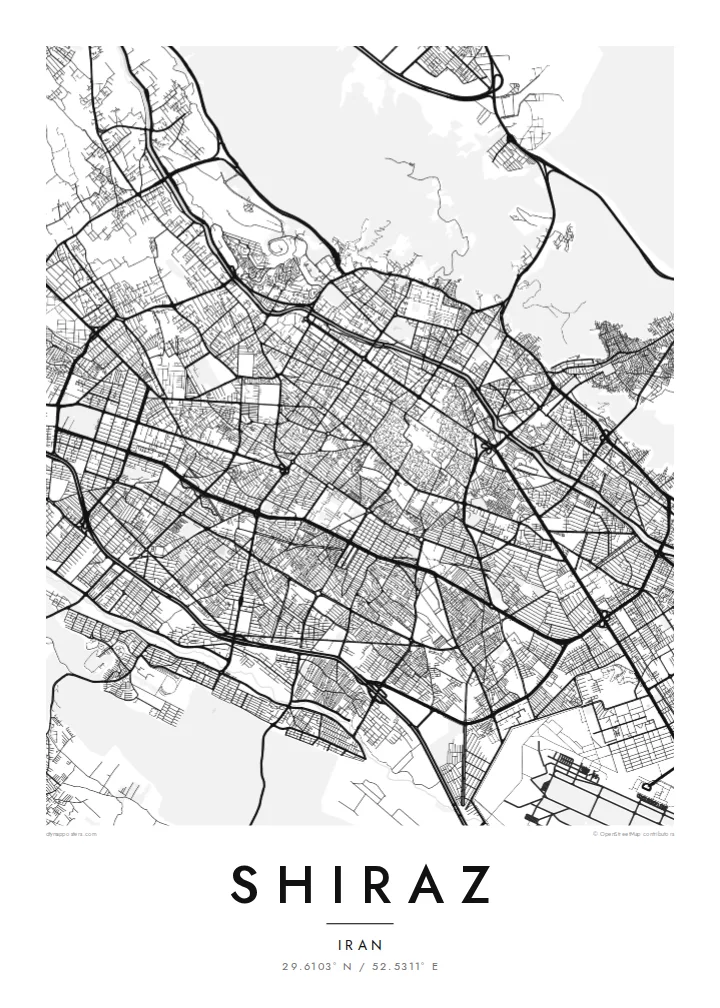
The city stretches along a long valley between mountain ridges. The slopes set a clear outer limit, giving the map a strong, elongated form.
Fakatino mape mukamuka · Iran
29.6103° N / 52.5311° E
A long valley city beneath the Zagros slopes, its streets lined with gardens between a gate and a citadel


Taha e taone, lima e onoonoaga
Tapaki e taha puhala ke kitia ai ki luga he puipui. Kua tatai e totogi he tau puhala oti — pete he lolomi, poloka, po ke faila HD.
 Tau pikselo mooli · faila lolomi 24 × 36″
Maama mitaki ke lolomi
Ko e 100% e fahi mooli mai he faila lolomi. Ko e tau poster oti — pete kua lolomi, poloka, po ke utu hifo — kua taute ke he ha mautolu a tau tokoluga (server) ke he 300 DPI, hokotia ke he 7,200 × 10,800 piksela, ke maeke ai e tau ala ikiiki tote ke maaliali fakamitaki he lolomi 24 × 36″.
He Pā


Ko e mape
Shiraz lies in a long valley in the Zagros Mountains of southern Iran, at about 1,500 metres above sea level. From above, the city stretches from northwest to southeast between mountain ridges, and its streets follow the valley. On the northern edge, the road enters through a narrow pass guarded by the Quran Gate. A seasonal riverbed runs through the city and becomes a thin line of green on the map.
In the centre, the older districts form a compact, irregular pattern around the Vakil Bazaar and the Karim Khan Citadel. Newer districts spread out in broader avenues toward the valley edges. Gardens are everywhere: Eram Garden, part of a UNESCO-listed group of Persian gardens, appears on a Shiraz map poster as a neat green rectangle among the streets.
Shiraz is often called the city of poets. Hafez and Saadi are both buried here, and their tombs are set in gardens that are visited all year. The ruins of Persepolis, the ceremonial capital of the Achaemenid Empire, lie about sixty kilometres to the northeast. For many people, Shiraz is also closely associated with gardens and roses.
The city stretches along a long valley between mountain ridges. The slopes set a clear outer limit, giving the map a strong, elongated form.
The streets around the bazaar and the citadel are tight and irregular. They look distinctly different from the broader avenues of the newer districts.
Walled gardens such as Eram appear as neat, open rectangles within the city. They are quiet pauses in the texture of the streets.
Taute ke ha hau
Lafi e aho, taha higoa po ke taha kupu haau, hiki e fakatino, lahi po ke tuaga.
Ko e kitiaaga nakai totogi kua tote e maaliali mo e fakamailoga vai. Ko e tau lolomi mo e tau faila HD kua taute ke he 300 DPI, hokotia ke he 7,200 × 10,800 px, nakai fai fakamailoga vai.
Ko e ha Shiraz
Shiraz is for anyone who has read Hafez in a garden, grew up in the valley, or keeps family ties to Fars. The long, mountain-framed shape feels calm and poetic, especially in the Paper and Sand styles.
Personalise the title, add a line of verse or a date as the subtitle, and edit the coordinates. Choose one of five styles, then download the 300 DPI files or order a matte print shipped from a nearby partner.
Talaage e poster Shiraz| Lahi he lolomi | Maama | Tau faila |
|---|---|---|
| 30 × 40 cm11.8 × 15.7″ | 3,543 × 4,724 px | PNG · PDF |
| 29.7 × 42 cm (A3)11.7 × 16.5″ | 3,508 × 4,961 px | PNG · PDF |
| 42 × 59.4 cm (A2)16.5 × 23.4″ | 4,961 × 7,016 px | PNG · PDF |
| 45.7 × 61 cm18 × 24″ | 5,400 × 7,200 px | PNG · PDF |
| 50 × 70 cm19.7 × 27.6″ | 5,906 × 8,268 px | PNG · PDF |
| 61 × 91.4 cm24 × 36″ | 7,200 × 10,800 px | PNG · PDF |
Ke fakatatai, ko e fakatino noa kua 900 px e laulahi, fai fakamailoga mo e mo e tau mata komipiuta ni. Ko e tau faila HD kua ato hoko ke he 8× e maama ke he tau faahi takitaha mo e lolomi mitaki he lahi katoa he fakatino.
Fifili e taha puhala i luga he kupega, ti fifili e Poster Lolomi — e lahi mo e, kaeke ke manako ai koe, taha poloka — po ke Tau Faila HD Fakaeletonika. Ko e fakaotiaga totogi ko e taha gahua ni, ti ko e kupega he hau a talaaga ka fakafou fakahaga i mua he fakaotiaga e totogi.
Kua lolomi ai ke he pepa mitaki 200 gsm matte he taha he tau lahi ono, mai he 30 × 40 cm ke hoko ke he 24 × 36″. Kamata e tau poster lolomi mai he $39, kua putoia ai e utaaga.
E. Fifili e poloka akau malolō ke he lanu uli, tea, akau oki mooli, po ke akau pouli. Kua fakalataha mo e sioga malolō nakai malepe ti kua mautali ke tautau. Kamata e tau poster poloka mai he $99, kua putoia ai e utaaga.
Nakai totogi e fakafano ke he motu 60+. Ko e fakatino taha kua lolomi he fenoga lolomi ha mautolu kua tata mo e tau motu 30+, kua hoko mai he tau aho gahua 3–7. Maeke ia koe ke kikite e tuaga mo e fakamuitua he lalo he Haku Tau Fakatonu. Ke he falu motu kua 2–5 e tau tapu, ti ka nakai fakafano a mautolu ki ai, to fakaha he api tupe ia ki mua he totogi.
Fakafano mai e taha ata ki a mautolu he loto he 14 e tau aho tali mai he hokoaga, ti to lolomi foki e mautolu nakai totogi po ke liu atu e totogi ki a koe.
E. He editor i luga he kupega nei, hikihiki e matakupu, e matakupu lalo mo e laini coordinates ke he taha mena kua manako a koe ki ai, ti fifili e puhala mo e lahi. Ko e tau talaaga lolomi, poloka mo e fakaeletonika oti kua fakaaoga tonu e hau a fakatino.
Ma e $9 ka moua e koe e tau faila PNG 300 DPI mo e PDF kua mautali ke lolomi he tau lahi ono oti, nakai fai fakamailoga vai, ke lolomi i fe mena. Nakai maopoopo agaia? Utu hifo fakamua e kitiaaga nakai totogi ne fai fakamailoga vai.
