Erode's eastern edge
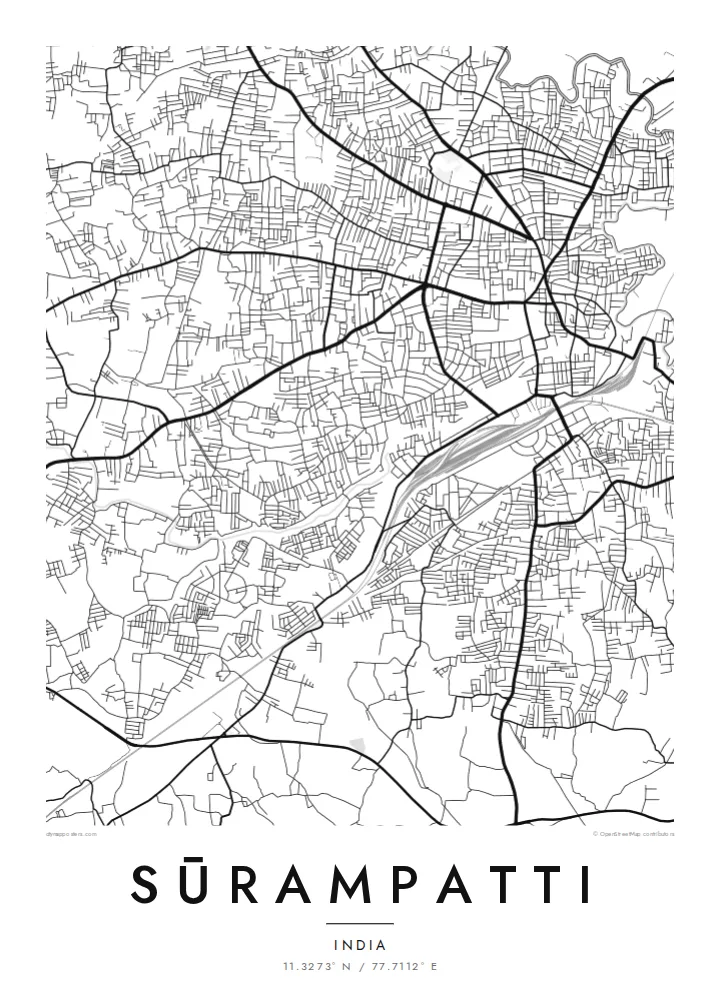
The streets of Sūrampatti merge into Erode with no visible break. The poster shows one continuous urban fabric instead of a town with clear borders.
Fakatino mape mukamuka · India
11.3273° N / 77.7112° E
A dense grid of lanes and small blocks pressed against Erode, where town streets thin out into canal-fed fields


Taha e taone, lima e onoonoaga
Tapaki e taha puhala ke kitia ai ki luga he puipui. Kua tatai e totogi he tau puhala oti — pete he lolomi, poloka, po ke faila HD.
 Tau pikselo mooli · faila lolomi 24 × 36″
Maama mitaki ke lolomi
Ko e 100% e fahi mooli mai he faila lolomi. Ko e tau poster oti — pete kua lolomi, poloka, po ke utu hifo — kua taute ke he ha mautolu a tau tokoluga (server) ke he 300 DPI, hokotia ke he 7,200 × 10,800 piksela, ke maeke ai e tau ala ikiiki tote ke maaliali fakamitaki he lolomi 24 × 36″.
He Pā


Ko e mape
Sūrampatti sits on the eastern side of Erode in western Tamil Nadu, close enough that on a map the two read as one continuous town. Tight residential lanes run between a few busier roads, and the blocks are small and irregular. There is no single centre. The street pattern just gets denser the closer it comes to Erode's core.
Erode is known across India for its textile markets and its turmeric trade, and that commercial pull shapes the neighbourhoods around it. Roads leading out of Sūrampatti point towards the city's market districts and rail links. Further out, the tight lanes give way to farmland watered from the Kaveri basin, so the edges of the map loosen into long field boundaries.
A Sūrampatti map poster shows how a small town grows into a larger one. Short lanes, a few strong arterials and a soft edge where housing meets cultivated land all come through clearly in black and white. It is a modest, honest map with a lot of fine texture, and it rewards a close look more than a passing glance.
The streets of Sūrampatti merge into Erode with no visible break. The poster shows one continuous urban fabric instead of a town with clear borders.
Narrow, closely packed lanes fill the space between the main roads and create a dense, almost woven texture that prints well at larger sizes.
Towards the outskirts the built-up grid thins into agricultural plots, and the long straight boundaries contrast with the crowded lanes nearer the centre.
Taute ke ha hau
Lafi e aho, taha higoa po ke taha kupu haau, hiki e fakatino, lahi po ke tuaga.
Ko e kitiaaga nakai totogi kua tote e maaliali mo e fakamailoga vai. Ko e tau lolomi mo e tau faila HD kua taute ke he 300 DPI, hokotia ke he 7,200 × 10,800 px, nakai fai fakamailoga vai.
Ko e ha Sūrampatti
People hang this map to keep a specific corner of Erode close: the lanes they grew up on, a family home, a first workplace in the textile trade. A local map like this usually means more to the person who knows it than a famous skyline would.
You can personalise the title, subtitle and coordinates line, adding a family name or a date, and pick from five styles: Classic black & white, Noir, Paper, Blueprint or Sand. The HD files cost $9, and printed posters with an optional wooden frame are also available.
Talaage e poster Sūrampatti| Lahi he lolomi | Maama | Tau faila |
|---|---|---|
| 30 × 40 cm11.8 × 15.7″ | 3,543 × 4,724 px | PNG · PDF |
| 29.7 × 42 cm (A3)11.7 × 16.5″ | 3,508 × 4,961 px | PNG · PDF |
| 42 × 59.4 cm (A2)16.5 × 23.4″ | 4,961 × 7,016 px | PNG · PDF |
| 45.7 × 61 cm18 × 24″ | 5,400 × 7,200 px | PNG · PDF |
| 50 × 70 cm19.7 × 27.6″ | 5,906 × 8,268 px | PNG · PDF |
| 61 × 91.4 cm24 × 36″ | 7,200 × 10,800 px | PNG · PDF |
Ke fakatatai, ko e fakatino noa kua 900 px e laulahi, fai fakamailoga mo e mo e tau mata komipiuta ni. Ko e tau faila HD kua ato hoko ke he 8× e maama ke he tau faahi takitaha mo e lolomi mitaki he lahi katoa he fakatino.
Fifili e taha puhala i luga he kupega, ti fifili e Poster Lolomi — e lahi mo e, kaeke ke manako ai koe, taha poloka — po ke Tau Faila HD Fakaeletonika. Ko e fakaotiaga totogi ko e taha gahua ni, ti ko e kupega he hau a talaaga ka fakafou fakahaga i mua he fakaotiaga e totogi.
Kua lolomi ai ke he pepa mitaki 200 gsm matte he taha he tau lahi ono, mai he 30 × 40 cm ke hoko ke he 24 × 36″. Kamata e tau poster lolomi mai he $39, kua putoia ai e utaaga.
E. Fifili e poloka akau malolō ke he lanu uli, tea, akau oki mooli, po ke akau pouli. Kua fakalataha mo e sioga malolō nakai malepe ti kua mautali ke tautau. Kamata e tau poster poloka mai he $99, kua putoia ai e utaaga.
Nakai totogi e fakafano ke he motu 60+. Ko e fakatino taha kua lolomi he fenoga lolomi ha mautolu kua tata mo e tau motu 30+, kua hoko mai he tau aho gahua 3–7. Maeke ia koe ke kikite e tuaga mo e fakamuitua he lalo he Haku Tau Fakatonu. Ke he falu motu kua 2–5 e tau tapu, ti ka nakai fakafano a mautolu ki ai, to fakaha he api tupe ia ki mua he totogi.
Fakafano mai e taha ata ki a mautolu he loto he 14 e tau aho tali mai he hokoaga, ti to lolomi foki e mautolu nakai totogi po ke liu atu e totogi ki a koe.
E. He editor i luga he kupega nei, hikihiki e matakupu, e matakupu lalo mo e laini coordinates ke he taha mena kua manako a koe ki ai, ti fifili e puhala mo e lahi. Ko e tau talaaga lolomi, poloka mo e fakaeletonika oti kua fakaaoga tonu e hau a fakatino.
Ma e $9 ka moua e koe e tau faila PNG 300 DPI mo e PDF kua mautali ke lolomi he tau lahi ono oti, nakai fai fakamailoga vai, ke lolomi i fe mena. Nakai maopoopo agaia? Utu hifo fakamua e kitiaaga nakai totogi ne fai fakamailoga vai.
Tata mai
