The great plaza
The main square is unusually large and forms a broad open rectangle at the heart of the grid. It is the focal point of the town's colonial layout.
Fakatino mape mukamuka · Mexico
18.9669° N / 97.8998° W
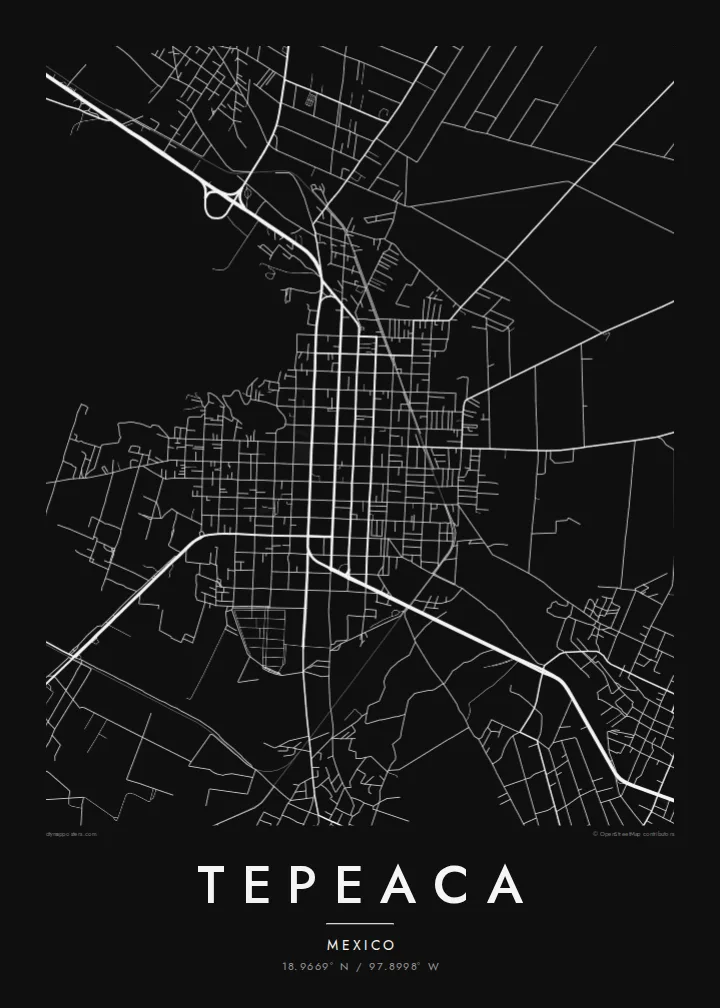
A colonial town on the Puebla plateau, built on a grid around a large plaza with an octagonal tower at its centre



Taha e taone, lima e onoonoaga
Tapaki e taha puhala ke kitia ai ki luga he puipui. Kua tatai e totogi he tau puhala oti — pete he lolomi, poloka, po ke faila HD.
 Tau pikselo mooli · faila lolomi 24 × 36″
Maama mitaki ke lolomi
Ko e 100% e fahi mooli mai he faila lolomi. Ko e tau poster oti — pete kua lolomi, poloka, po ke utu hifo — kua taute ke he ha mautolu a tau tokoluga (server) ke he 300 DPI, hokotia ke he 7,200 × 10,800 piksela, ke maeke ai e tau ala ikiiki tote ke maaliali fakamitaki he lolomi 24 × 36″.
He Pā


Ko e mape
Tepeaca is a town in the state of Puebla, in central Mexico, on the high plains east of the city of Puebla. It was one of the first Spanish foundations on the mainland. Hernán Cortés established it in 1520 as Segura de la Frontera. Its colonial layout is still clear today: a regular grid of blocks spreads out from a very large main plaza.
In the middle of the plaza stands the Rollo, an octagonal stone tower in a Moorish-influenced style. It is one of Tepeaca's best-known landmarks. Nearby is a sixteenth-century Franciscan monastery with fortress-like walls. The town is also known for its large weekly market, which draws traders and buyers from across the region.
A Tepeaca map poster shows a colonial plan at its clearest. There is a wide, open square at the centre, straight streets running outward in each direction, and farmland across the plateau beyond. With the volcanoes of central Mexico on the far horizon, it is a place with a strong sense of order and history, reflected in its map.
The main square is unusually large and forms a broad open rectangle at the heart of the grid. It is the focal point of the town's colonial layout.
An octagonal stone tower stands in the middle of the plaza. It is a distinctive colonial monument and the town's most recognised landmark.
Regular blocks extend in every direction from the plaza. It is the orderly street plan of one of the earliest Spanish towns in mainland Mexico, still intact.
Taute ke ha hau
Lafi e aho, taha higoa po ke taha kupu haau, hiki e fakatino, lahi po ke tuaga.
Ko e kitiaaga nakai totogi kua tote e maaliali mo e fakamailoga vai. Ko e tau lolomi mo e tau faila HD kua taute ke he 300 DPI, hokotia ke he 7,200 × 10,800 px, nakai fai fakamailoga vai.
Ko e ha Tepeaca
Tepeaca's clear colonial plan and its central plaza make a naturally balanced poster. It suits people who grew up here, relatives who have moved to Puebla, Mexico City or the United States, and anyone interested in Mexico's early colonial towns.
You can change the title, subtitle and coordinates line, adding a family name or a special date. Pick Classic black and white, Noir, Paper, Blueprint or Sand. Printed posters come on matte paper with an optional wooden frame, shipped from partners in more than 30 countries.
Talaage e poster Tepeaca| Lahi he lolomi | Maama | Tau faila |
|---|---|---|
| 30 × 40 cm11.8 × 15.7″ | 3,543 × 4,724 px | PNG · PDF |
| 29.7 × 42 cm (A3)11.7 × 16.5″ | 3,508 × 4,961 px | PNG · PDF |
| 42 × 59.4 cm (A2)16.5 × 23.4″ | 4,961 × 7,016 px | PNG · PDF |
| 45.7 × 61 cm18 × 24″ | 5,400 × 7,200 px | PNG · PDF |
| 50 × 70 cm19.7 × 27.6″ | 5,906 × 8,268 px | PNG · PDF |
| 61 × 91.4 cm24 × 36″ | 7,200 × 10,800 px | PNG · PDF |
Ke fakatatai, ko e fakatino noa kua 900 px e laulahi, fai fakamailoga mo e mo e tau mata komipiuta ni. Ko e tau faila HD kua ato hoko ke he 8× e maama ke he tau faahi takitaha mo e lolomi mitaki he lahi katoa he fakatino.
Fifili e taha puhala i luga he kupega, ti fifili e Poster Lolomi — e lahi mo e, kaeke ke manako ai koe, taha poloka — po ke Tau Faila HD Fakaeletonika. Ko e fakaotiaga totogi ko e taha gahua ni, ti ko e kupega he hau a talaaga ka fakafou fakahaga i mua he fakaotiaga e totogi.
Kua lolomi ai ke he pepa mitaki 200 gsm matte he taha he tau lahi ono, mai he 30 × 40 cm ke hoko ke he 24 × 36″. Kamata e tau poster lolomi mai he $39, kua putoia ai e utaaga.
E. Fifili e poloka akau malolō ke he lanu uli, tea, akau oki mooli, po ke akau pouli. Kua fakalataha mo e sioga malolō nakai malepe ti kua mautali ke tautau. Kamata e tau poster poloka mai he $99, kua putoia ai e utaaga.
Nakai totogi e fakafano ke he motu 60+. Ko e fakatino taha kua lolomi he fenoga lolomi ha mautolu kua tata mo e tau motu 30+, kua hoko mai he tau aho gahua 3–7. Maeke ia koe ke kikite e tuaga mo e fakamuitua he lalo he Haku Tau Fakatonu. Ke he falu motu kua 2–5 e tau tapu, ti ka nakai fakafano a mautolu ki ai, to fakaha he api tupe ia ki mua he totogi.
Fakafano mai e taha ata ki a mautolu he loto he 14 e tau aho tali mai he hokoaga, ti to lolomi foki e mautolu nakai totogi po ke liu atu e totogi ki a koe.
E. He editor i luga he kupega nei, hikihiki e matakupu, e matakupu lalo mo e laini coordinates ke he taha mena kua manako a koe ki ai, ti fifili e puhala mo e lahi. Ko e tau talaaga lolomi, poloka mo e fakaeletonika oti kua fakaaoga tonu e hau a fakatino.
Ma e $9 ka moua e koe e tau faila PNG 300 DPI mo e PDF kua mautali ke lolomi he tau lahi ono oti, nakai fai fakamailoga vai, ke lolomi i fe mena. Nakai maopoopo agaia? Utu hifo fakamua e kitiaaga nakai totogi ne fai fakamailoga vai.
