Ternopil Pond
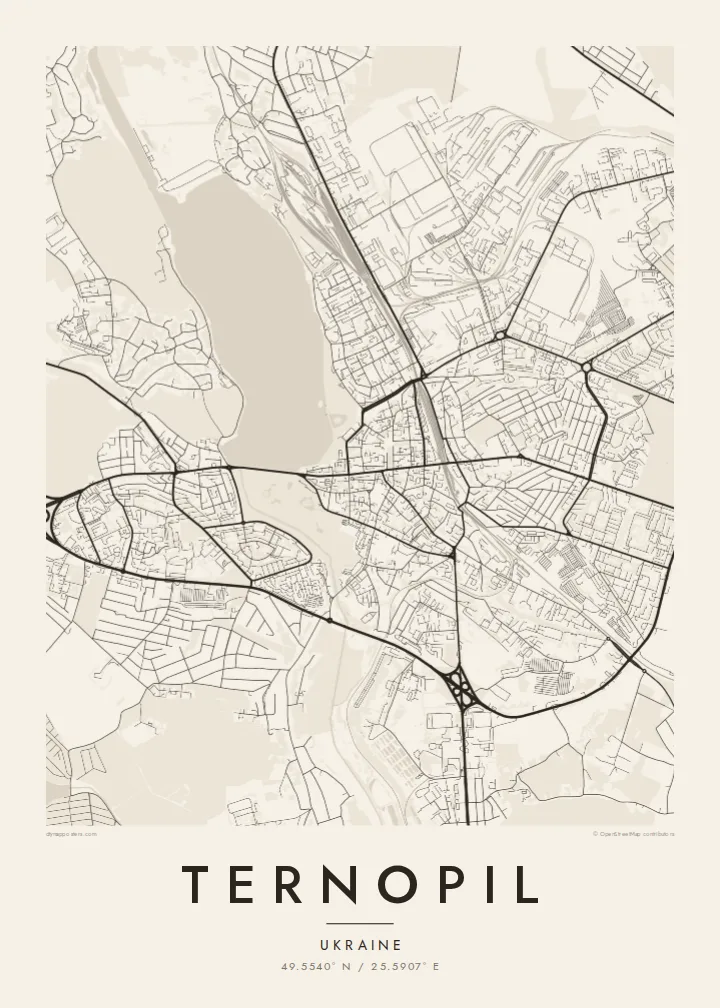
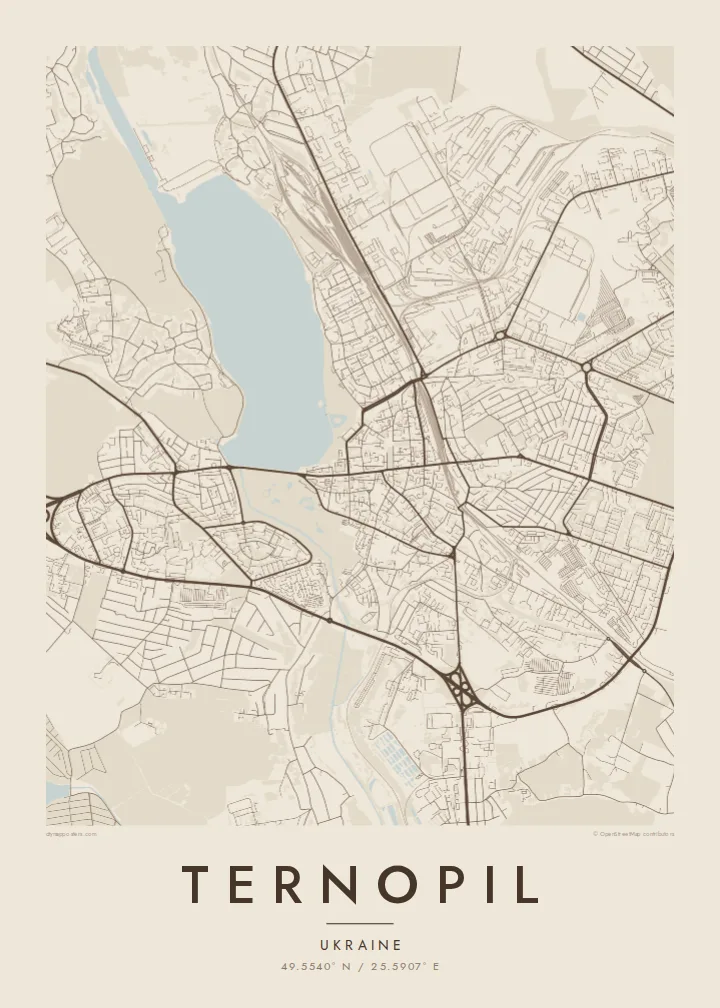
The reservoir on the Seret spreads across the western side of the centre, a large open shape framed by embankments and parks that anchors the entire poster.
Fakatino mape mukamuka · Ukraine
49.5540° N / 25.5907° E
A western Ukrainian city curled around a broad reservoir on the Seret River, its old centre along the shore.



Taha e taone, lima e onoonoaga
Tapaki e taha puhala ke kitia ai ki luga he puipui. Kua tatai e totogi he tau puhala oti — pete he lolomi, poloka, po ke faila HD.
 Tau pikselo mooli · faila lolomi 24 × 36″
Maama mitaki ke lolomi
Ko e 100% e fahi mooli mai he faila lolomi. Ko e tau poster oti — pete kua lolomi, poloka, po ke utu hifo — kua taute ke he ha mautolu a tau tokoluga (server) ke he 300 DPI, hokotia ke he 7,200 × 10,800 piksela, ke maeke ai e tau ala ikiiki tote ke maaliali fakamitaki he lolomi 24 × 36″.
He Pā


Ko e mape
Ternopil is organised around water. The Seret River was dammed centuries ago to create a large reservoir, known locally as the Ternopil Pond, which spreads along the western side of the centre. On a map it is the dominant shape, a broad pale body with parks and promenades along its eastern shore, while the old town and newer districts spread out around it on gently rolling land.
The city was founded in 1540 as a fortress by the Polish hetman Jan Amor Tarnowski, whose name it still carries, and his castle survives at the edge of the reservoir. Ternopil is now a regional capital and a university city, and its centre, rebuilt after heavy damage in the Second World War, is known for its pedestrian streets and churches.
A Ternopil map poster places the pond at the heart of the composition, with the castle and old streets on its shore, the curving parkland, the rail lines and the regular layouts of post-war districts. The contrast between open water and dense streets gives the city an unusually balanced shape, well suited to a clean black-and-white print.
The reservoir on the Seret spreads across the western side of the centre, a large open shape framed by embankments and parks that anchors the entire poster.
The sixteenth-century castle stands at the edge of the water, where the oldest part of the city meets the reservoir in a tight cluster of streets.
Beyond the centre, districts built in the second half of the twentieth century follow broader, more regular layouts, clearly different from the older blocks near the pond.
Taute ke ha hau
Lafi e aho, taha higoa po ke taha kupu haau, hiki e fakatino, lahi po ke tuaga.
Ko e kitiaaga nakai totogi kua tote e maaliali mo e fakamailoga vai. Ko e tau lolomi mo e tau faila HD kua taute ke he 300 DPI, hokotia ke he 7,200 × 10,800 px, nakai fai fakamailoga vai.
Ko e ha Ternopil
In recent years many people have left Ternopil as students, workers and families, and a map of the city holds a lot of home in one image. The pond at its centre makes the design instantly recognisable to anyone who knows it.
Write the title in Ukrainian or English, add a date or district to the subtitle, and choose one of five styles. HD files include 300 DPI PNG and print-ready PDF versions in six sizes, and printed posters come on matte paper with an optional frame.
Talaage e poster Ternopil| Lahi he lolomi | Maama | Tau faila |
|---|---|---|
| 30 × 40 cm11.8 × 15.7″ | 3,543 × 4,724 px | PNG · PDF |
| 29.7 × 42 cm (A3)11.7 × 16.5″ | 3,508 × 4,961 px | PNG · PDF |
| 42 × 59.4 cm (A2)16.5 × 23.4″ | 4,961 × 7,016 px | PNG · PDF |
| 45.7 × 61 cm18 × 24″ | 5,400 × 7,200 px | PNG · PDF |
| 50 × 70 cm19.7 × 27.6″ | 5,906 × 8,268 px | PNG · PDF |
| 61 × 91.4 cm24 × 36″ | 7,200 × 10,800 px | PNG · PDF |
Ke fakatatai, ko e fakatino noa kua 900 px e laulahi, fai fakamailoga mo e mo e tau mata komipiuta ni. Ko e tau faila HD kua ato hoko ke he 8× e maama ke he tau faahi takitaha mo e lolomi mitaki he lahi katoa he fakatino.
Fifili e taha puhala i luga he kupega, ti fifili e Poster Lolomi — e lahi mo e, kaeke ke manako ai koe, taha poloka — po ke Tau Faila HD Fakaeletonika. Ko e fakaotiaga totogi ko e taha gahua ni, ti ko e kupega he hau a talaaga ka fakafou fakahaga i mua he fakaotiaga e totogi.
Kua lolomi ai ke he pepa mitaki 200 gsm matte he taha he tau lahi ono, mai he 30 × 40 cm ke hoko ke he 24 × 36″. Kamata e tau poster lolomi mai he $39, kua putoia ai e utaaga.
E. Fifili e poloka akau malolō ke he lanu uli, tea, akau oki mooli, po ke akau pouli. Kua fakalataha mo e sioga malolō nakai malepe ti kua mautali ke tautau. Kamata e tau poster poloka mai he $99, kua putoia ai e utaaga.
Nakai totogi e fakafano ke he motu 60+. Ko e fakatino taha kua lolomi he fenoga lolomi ha mautolu kua tata mo e tau motu 30+, kua hoko mai he tau aho gahua 3–7. Maeke ia koe ke kikite e tuaga mo e fakamuitua he lalo he Haku Tau Fakatonu. Ke he falu motu kua 2–5 e tau tapu, ti ka nakai fakafano a mautolu ki ai, to fakaha he api tupe ia ki mua he totogi.
Fakafano mai e taha ata ki a mautolu he loto he 14 e tau aho tali mai he hokoaga, ti to lolomi foki e mautolu nakai totogi po ke liu atu e totogi ki a koe.
E. He editor i luga he kupega nei, hikihiki e matakupu, e matakupu lalo mo e laini coordinates ke he taha mena kua manako a koe ki ai, ti fifili e puhala mo e lahi. Ko e tau talaaga lolomi, poloka mo e fakaeletonika oti kua fakaaoga tonu e hau a fakatino.
Ma e $9 ka moua e koe e tau faila PNG 300 DPI mo e PDF kua mautali ke lolomi he tau lahi ono oti, nakai fai fakamailoga vai, ke lolomi i fe mena. Nakai maopoopo agaia? Utu hifo fakamua e kitiaaga nakai totogi ne fai fakamailoga vai.
Tata mai
