Compact town centre
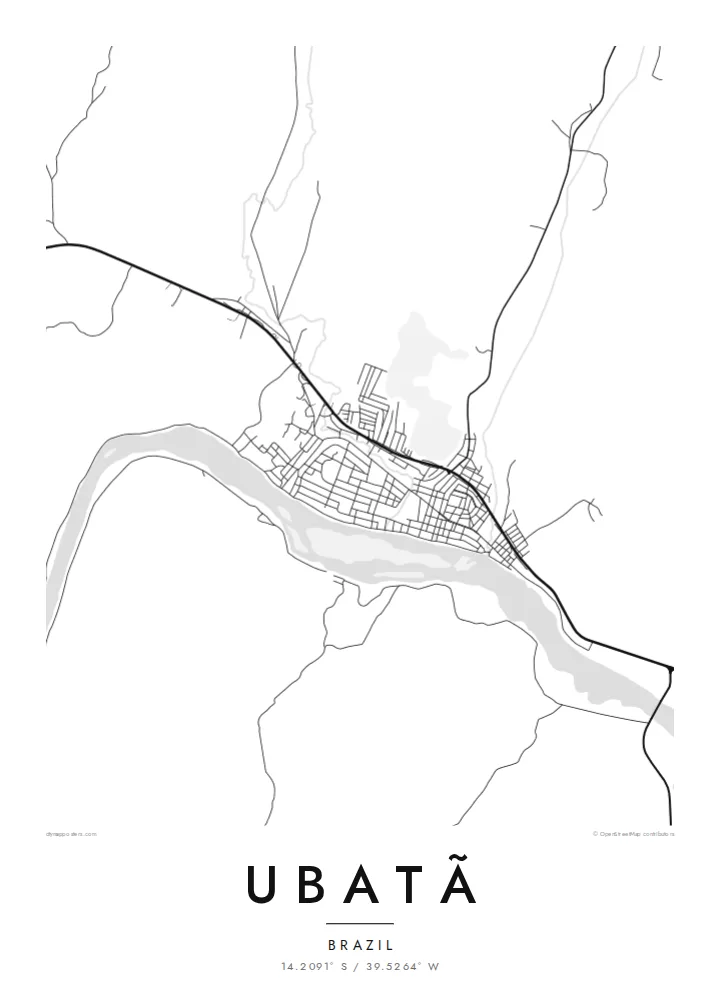
The urban core is small and easy to read. Its streets gather into a tight cluster that shows up clearly on the page, framed by open land on every side instead of sprawling suburbs.
Fakatino mape mukamuka · Brazil
14.2091° S / 39.5264° W
A compact inland town in southern Bahia, with a small grid of streets following the slopes of green, rolling cacao country.


Taha e taone, lima e onoonoaga
Tapaki e taha puhala ke kitia ai ki luga he puipui. Kua tatai e totogi he tau puhala oti — pete he lolomi, poloka, po ke faila HD.
 Tau pikselo mooli · faila lolomi 24 × 36″
Maama mitaki ke lolomi
Ko e 100% e fahi mooli mai he faila lolomi. Ko e tau poster oti — pete kua lolomi, poloka, po ke utu hifo — kua taute ke he ha mautolu a tau tokoluga (server) ke he 300 DPI, hokotia ke he 7,200 × 10,800 piksela, ke maeke ai e tau ala ikiiki tote ke maaliali fakamitaki he lolomi 24 × 36″.
He Pā


Ko e mape
Ubatã sits in the interior of southern Bahia, west of the Atlantic coast, in hilly country long known for growing cacao. From above, the town is a small cluster of streets. It stretches out where the ground allows and thins quickly into farmland and wooded hillsides. On a map, the edge between built streets and open land is sharp, and that edge gives the town its outline.
The centre is a modest network of short blocks and connecting roads. It is regular in places and bends in others, where streets follow the lie of the land instead of a strict grid. Roads leave town toward neighbouring municipalities in the region. Beyond them, the map is mostly quiet space: field boundaries, tracks and the soft curves of watercourses running through the valleys.
A Ubatã map poster keeps all of this in black and white. The dense lines of the town centre stand against the wide empty paper of the countryside around it. That contrast suits a small place well. The poster shows how a town of about twenty-seven thousand people fits into its landscape, and it keeps the plain geometry of streets that residents know by heart.
The urban core is small and easy to read. Its streets gather into a tight cluster that shows up clearly on the page, framed by open land on every side instead of sprawling suburbs.
Ubatã belongs to southern Bahia's traditional cacao region. Around the town, the map opens into rural land and wooded slopes that give the poster generous negative space.
Regional roads lead out of town and wind across the undulating terrain. Their curving lines add movement to the composition and link the settlement to the wider interior of Bahia.
Taute ke ha hau
Lafi e aho, taha higoa po ke taha kupu haau, hiki e fakatino, lahi po ke tuaga.
Ko e kitiaaga nakai totogi kua tote e maaliali mo e fakamailoga vai. Ko e tau lolomi mo e tau faila HD kua taute ke he 300 DPI, hokotia ke he 7,200 × 10,800 px, nakai fai fakamailoga vai.
Ko e ha Ubatã
For people who grew up in Ubatã or have family roots there, the street plan is a personal record of routes to school, to the market and to relatives' homes. A clean map of a small town can feel more intimate than a view of any large city.
You can personalise the poster with your own title, subtitle and coordinates line, for example a family name or a meaningful date. Choose from five styles: Classic black & white, Noir, Paper, Blueprint or Sand. Download HD files for $9, or order a matte print with an optional wooden frame.
Talaage e poster Ubatã| Lahi he lolomi | Maama | Tau faila |
|---|---|---|
| 30 × 40 cm11.8 × 15.7″ | 3,543 × 4,724 px | PNG · PDF |
| 29.7 × 42 cm (A3)11.7 × 16.5″ | 3,508 × 4,961 px | PNG · PDF |
| 42 × 59.4 cm (A2)16.5 × 23.4″ | 4,961 × 7,016 px | PNG · PDF |
| 45.7 × 61 cm18 × 24″ | 5,400 × 7,200 px | PNG · PDF |
| 50 × 70 cm19.7 × 27.6″ | 5,906 × 8,268 px | PNG · PDF |
| 61 × 91.4 cm24 × 36″ | 7,200 × 10,800 px | PNG · PDF |
Ke fakatatai, ko e fakatino noa kua 900 px e laulahi, fai fakamailoga mo e mo e tau mata komipiuta ni. Ko e tau faila HD kua ato hoko ke he 8× e maama ke he tau faahi takitaha mo e lolomi mitaki he lahi katoa he fakatino.
Fifili e taha puhala i luga he kupega, ti fifili e Poster Lolomi — e lahi mo e, kaeke ke manako ai koe, taha poloka — po ke Tau Faila HD Fakaeletonika. Ko e fakaotiaga totogi ko e taha gahua ni, ti ko e kupega he hau a talaaga ka fakafou fakahaga i mua he fakaotiaga e totogi.
Kua lolomi ai ke he pepa mitaki 200 gsm matte he taha he tau lahi ono, mai he 30 × 40 cm ke hoko ke he 24 × 36″. Kamata e tau poster lolomi mai he $39, kua putoia ai e utaaga.
E. Fifili e poloka akau malolō ke he lanu uli, tea, akau oki mooli, po ke akau pouli. Kua fakalataha mo e sioga malolō nakai malepe ti kua mautali ke tautau. Kamata e tau poster poloka mai he $99, kua putoia ai e utaaga.
Nakai totogi e fakafano ke he motu 60+. Ko e fakatino taha kua lolomi he fenoga lolomi ha mautolu kua tata mo e tau motu 30+, kua hoko mai he tau aho gahua 3–7. Maeke ia koe ke kikite e tuaga mo e fakamuitua he lalo he Haku Tau Fakatonu. Ke he falu motu kua 2–5 e tau tapu, ti ka nakai fakafano a mautolu ki ai, to fakaha he api tupe ia ki mua he totogi.
Fakafano mai e taha ata ki a mautolu he loto he 14 e tau aho tali mai he hokoaga, ti to lolomi foki e mautolu nakai totogi po ke liu atu e totogi ki a koe.
E. He editor i luga he kupega nei, hikihiki e matakupu, e matakupu lalo mo e laini coordinates ke he taha mena kua manako a koe ki ai, ti fifili e puhala mo e lahi. Ko e tau talaaga lolomi, poloka mo e fakaeletonika oti kua fakaaoga tonu e hau a fakatino.
Ma e $9 ka moua e koe e tau faila PNG 300 DPI mo e PDF kua mautali ke lolomi he tau lahi ono oti, nakai fai fakamailoga vai, ke lolomi i fe mena. Nakai maopoopo agaia? Utu hifo fakamua e kitiaaga nakai totogi ne fai fakamailoga vai.
Tata mai
