The merchant street
The preserved old quarter runs as a single, slightly curving street along the hillside, with short lanes dropping off it. On paper it reads as a fine, tight thread above the valley floor.
Fakatino mape mukamuka · Japan
33.5499° N / 132.6471° E
A narrow river valley in the Ehime hills, with an old merchant street running along the slope above the town centre




Taha e taone, lima e onoonoaga
Tapaki e taha puhala ke kitia ai ki luga he puipui. Kua tatai e totogi he tau puhala oti — pete he lolomi, poloka, po ke faila HD.
 Tau pikselo mooli · faila lolomi 24 × 36″
Maama mitaki ke lolomi
Ko e 100% e fahi mooli mai he faila lolomi. Ko e tau poster oti — pete kua lolomi, poloka, po ke utu hifo — kua taute ke he ha mautolu a tau tokoluga (server) ke he 300 DPI, hokotia ke he 7,200 × 10,800 piksela, ke maeke ai e tau ala ikiiki tote ke maaliali fakamitaki he lolomi 24 × 36″.
He Pā


Ko e mape
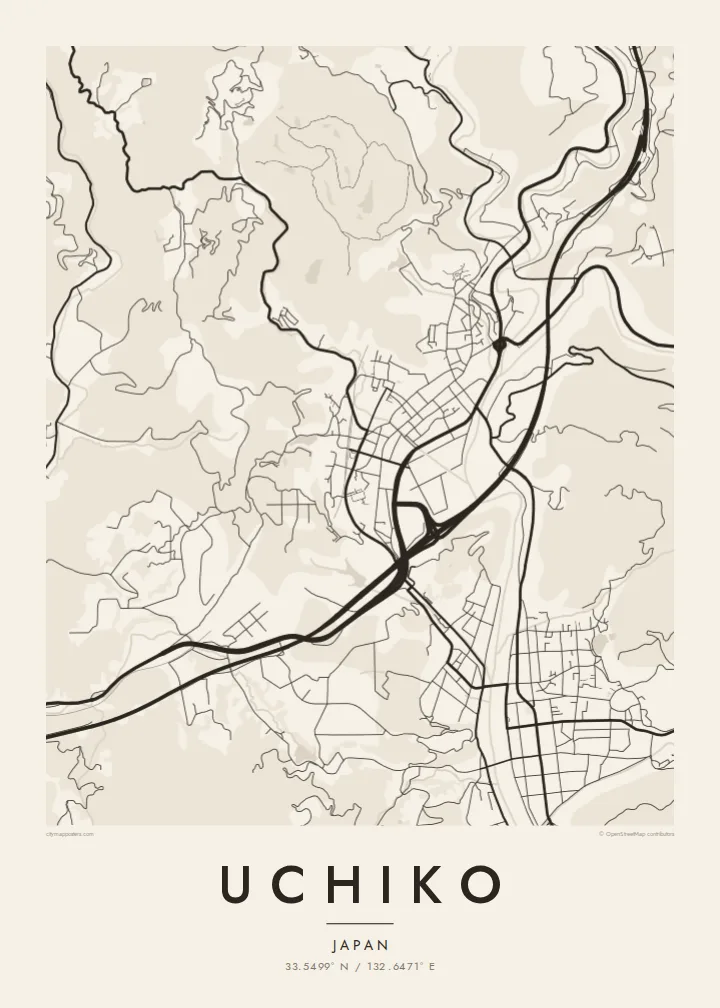
Uchiko sits in a valley in the interior of Ehime, where the hills close in and the town follows the river rather than a planned grid. From above, the built-up area is a long, uneven ribbon: roads keep to the valley floor, side lanes climb a short way into the slopes, and the land beyond turns quickly into forested ridges and small terraced fields.
The town is best known for its preserved merchant quarter, where houses from the Edo and Meiji periods line a gently rising street. Much of that prosperity came from making Japanese wax, once an important local industry. Uchiko-za, a wooden kabuki theatre opened in 1916 and later restored, is still used for performances and is one of the town's best-known buildings.
On a Uchiko map poster the historic street shows as a thin line pressed against the hillside, while the newer roads and the railway follow the easier ground below. The contrast between the dense old lanes and the empty ridges around them gives the print a quiet, layered look, closer to a valley cross-section than to the usual city plan.
The preserved old quarter runs as a single, slightly curving street along the hillside, with short lanes dropping off it. On paper it reads as a fine, tight thread above the valley floor.
The river and the main roads share the flat ground, running side by side through the town. Most of the modern street pattern gathers along this corridor, leaving the slopes on either side almost blank.
Beyond the last houses the hills rise steeply, and the map thins to scattered roads and field edges. That surrounding emptiness frames the town and makes its narrow outline easy to read.
Taute ke ha hau
Lafi e aho, taha higoa po ke taha kupu haau, hiki e fakatino, lahi po ke tuaga.
Ko e kitiaaga nakai totogi kua tote e maaliali mo e fakamailoga vai. Ko e tau lolomi mo e tau faila HD kua taute ke he 300 DPI, hokotia ke he 7,200 × 10,800 px, nakai fai fakamailoga vai.
Ko e ha Uchiko
Uchiko suits people who remember it as a slow walk up an old street, or who trace family back to the Ehime interior. The valley shape is unusual enough to be recognisable even without a label, and it sits well in a calm room.
The title, subtitle and coordinates line can be changed to add a name, a date or a short note. Choose from Classic black & white, Noir, Paper, Blueprint or Sand; Paper and Sand suit the town's wooden streets especially well.
Talaage e poster Uchiko| Lahi he lolomi | Maama | Tau faila |
|---|---|---|
| 30 × 40 cm11.8 × 15.7″ | 3,543 × 4,724 px | PNG · PDF |
| 29.7 × 42 cm (A3)11.7 × 16.5″ | 3,508 × 4,961 px | PNG · PDF |
| 42 × 59.4 cm (A2)16.5 × 23.4″ | 4,961 × 7,016 px | PNG · PDF |
| 45.7 × 61 cm18 × 24″ | 5,400 × 7,200 px | PNG · PDF |
| 50 × 70 cm19.7 × 27.6″ | 5,906 × 8,268 px | PNG · PDF |
| 61 × 91.4 cm24 × 36″ | 7,200 × 10,800 px | PNG · PDF |
Ke fakatatai, ko e fakatino noa kua 900 px e laulahi, fai fakamailoga mo e mo e tau mata komipiuta ni. Ko e tau faila HD kua ato hoko ke he 8× e maama ke he tau faahi takitaha mo e lolomi mitaki he lahi katoa he fakatino.
Fifili e taha puhala i luga he kupega, ti fifili e Poster Lolomi — e lahi mo e, kaeke ke manako ai koe, taha poloka — po ke Tau Faila HD Fakaeletonika. Ko e fakaotiaga totogi ko e taha gahua ni, ti ko e kupega he hau a talaaga ka fakafou fakahaga i mua he fakaotiaga e totogi.
Kua lolomi ai ke he pepa mitaki 200 gsm matte he taha he tau lahi ono, mai he 30 × 40 cm ke hoko ke he 24 × 36″. Kamata e tau poster lolomi mai he $39, kua putoia ai e utaaga.
E. Fifili e poloka akau malolō ke he lanu uli, tea, akau oki mooli, po ke akau pouli. Kua fakalataha mo e sioga malolō nakai malepe ti kua mautali ke tautau. Kamata e tau poster poloka mai he $99, kua putoia ai e utaaga.
Nakai totogi e fakafano ke he motu 60+. Ko e fakatino taha kua lolomi he fenoga lolomi ha mautolu kua tata mo e tau motu 30+, kua hoko mai he tau aho gahua 3–7. Maeke ia koe ke kikite e tuaga mo e fakamuitua he lalo he Haku Tau Fakatonu. Ke he falu motu kua 2–5 e tau tapu, ti ka nakai fakafano a mautolu ki ai, to fakaha he api tupe ia ki mua he totogi.
Fakafano mai e taha ata ki a mautolu he loto he 14 e tau aho tali mai he hokoaga, ti to lolomi foki e mautolu nakai totogi po ke liu atu e totogi ki a koe.
E. He editor i luga he kupega nei, hikihiki e matakupu, e matakupu lalo mo e laini coordinates ke he taha mena kua manako a koe ki ai, ti fifili e puhala mo e lahi. Ko e tau talaaga lolomi, poloka mo e fakaeletonika oti kua fakaaoga tonu e hau a fakatino.
Ma e $9 ka moua e koe e tau faila PNG 300 DPI mo e PDF kua mautali ke lolomi he tau lahi ono oti, nakai fai fakamailoga vai, ke lolomi i fe mena. Nakai maopoopo agaia? Utu hifo fakamua e kitiaaga nakai totogi ne fai fakamailoga vai.
Tata mai
