Independence Avenue
The city's main street runs north–south through the centre, a clear spine from which the rest of the downtown grid takes its orientation.
Fakatino mape mukamuka · Namibia
22.5594° S / 17.0832° E
A highland capital held in a valley between low mountain ranges, its streets fanning out from a compact centre.


Taha e taone, lima e onoonoaga
Tapaki e taha puhala ke kitia ai ki luga he puipui. Kua tatai e totogi he tau puhala oti — pete he lolomi, poloka, po ke faila HD.
 Tau pikselo mooli · faila lolomi 24 × 36″
Maama mitaki ke lolomi
Ko e 100% e fahi mooli mai he faila lolomi. Ko e tau poster oti — pete kua lolomi, poloka, po ke utu hifo — kua taute ke he ha mautolu a tau tokoluga (server) ke he 300 DPI, hokotia ke he 7,200 × 10,800 piksela, ke maeke ai e tau ala ikiiki tote ke maaliali fakamitaki he lolomi 24 × 36″.
He Pā


Ko e mape
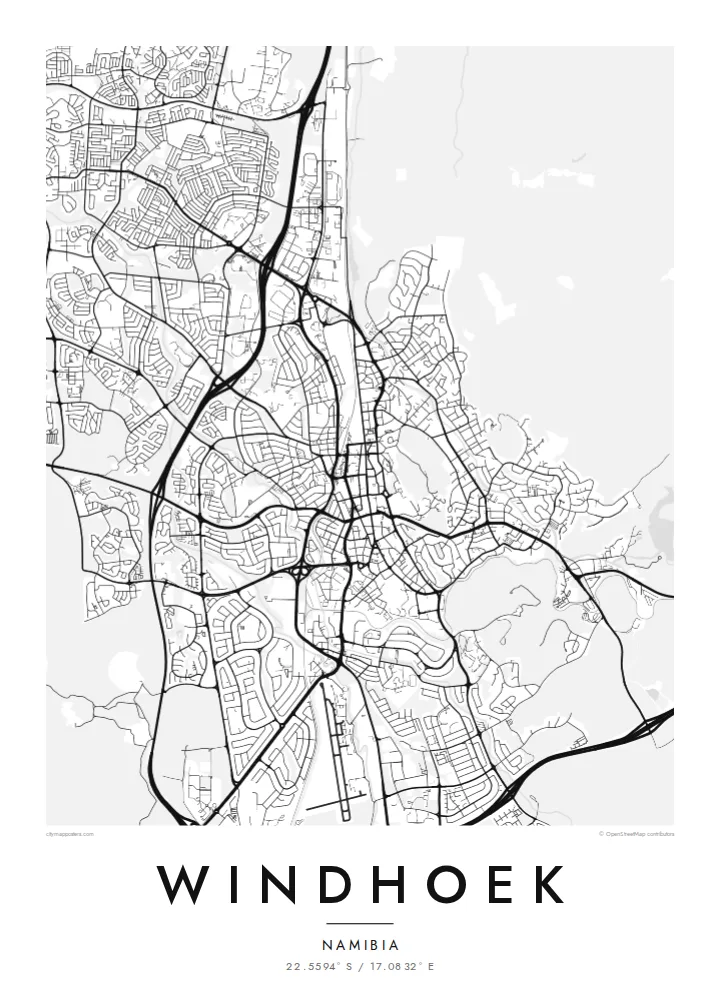
Windhoek, the capital of Namibia, lies in a valley on the central plateau at roughly 1,650 metres above sea level. Low ranges enclose it, with the Eros Mountains to the north and the Auas Mountains to the south, and the city stretches between them along a north–south axis. The map shows a compact centre, curving suburban streets climbing the hills, and dry riverbeds crossing the valley.
Independence Avenue runs through the heart of the city, and on a rise just to the east stand the Christuskirche, a German colonial church from the early twentieth century, and the Tintenpalast, seat of the national parliament. To the northwest lies Katutura, a large district established during apartheid, whose tighter street pattern contrasts with the looser suburbs on the eastern hills.
Hot springs in the valley once gave the site its Nama name, Ai-Gams, and their water drew early settlement. Today Windhoek is known for its mix of German and Namibian heritage and its role as the starting point for journeys into the desert. A Windhoek map poster captures a capital shaped by a valley, a handful of hills and the wide, open land beyond.
The city's main street runs north–south through the centre, a clear spine from which the rest of the downtown grid takes its orientation.
The Eros and Auas mountains frame the valley, and the edges of the poster show where suburban streets stop and open hillside begins.
In the northwest, the dense grid of Katutura forms a distinct district on the map, a visible trace of the city's twentieth-century history.
Taute ke ha hau
Lafi e aho, taha higoa po ke taha kupu haau, hiki e fakatino, lahi po ke tuaga.
Ko e kitiaaga nakai totogi kua tote e maaliali mo e fakamailoga vai. Ko e tau lolomi mo e tau faila HD kua taute ke he 300 DPI, hokotia ke he 7,200 × 10,800 px, nakai fai fakamailoga vai.
Ko e ha Windhoek
Windhoek is home to Namibians from every region and a starting point for journeys across the country. A map of it suits those who live here, those who grew up here and travellers who remember the city as the beginning of the road into the desert.
Add a title, subtitle and coordinates line, perhaps a home address or the date of a first trip. Choose Classic black & white, Noir, Paper, Blueprint or Sand, and download 300 DPI files or order a matte print from a partner in one of more than 30 countries.
Talaage e poster Windhoek| Lahi he lolomi | Maama | Tau faila |
|---|---|---|
| 30 × 40 cm11.8 × 15.7″ | 3,543 × 4,724 px | PNG · PDF |
| 29.7 × 42 cm (A3)11.7 × 16.5″ | 3,508 × 4,961 px | PNG · PDF |
| 42 × 59.4 cm (A2)16.5 × 23.4″ | 4,961 × 7,016 px | PNG · PDF |
| 45.7 × 61 cm18 × 24″ | 5,400 × 7,200 px | PNG · PDF |
| 50 × 70 cm19.7 × 27.6″ | 5,906 × 8,268 px | PNG · PDF |
| 61 × 91.4 cm24 × 36″ | 7,200 × 10,800 px | PNG · PDF |
Ke fakatatai, ko e fakatino noa kua 900 px e laulahi, fai fakamailoga mo e mo e tau mata komipiuta ni. Ko e tau faila HD kua ato hoko ke he 8× e maama ke he tau faahi takitaha mo e lolomi mitaki he lahi katoa he fakatino.
Fifili e taha puhala i luga he kupega, ti fifili e Poster Lolomi — e lahi mo e, kaeke ke manako ai koe, taha poloka — po ke Tau Faila HD Fakaeletonika. Ko e fakaotiaga totogi ko e taha gahua ni, ti ko e kupega he hau a talaaga ka fakafou fakahaga i mua he fakaotiaga e totogi.
Kua lolomi ai ke he pepa mitaki 200 gsm matte he taha he tau lahi ono, mai he 30 × 40 cm ke hoko ke he 24 × 36″. Kamata e tau poster lolomi mai he $39, kua putoia ai e utaaga.
E. Fifili e poloka akau malolō ke he lanu uli, tea, akau oki mooli, po ke akau pouli. Kua fakalataha mo e sioga malolō nakai malepe ti kua mautali ke tautau. Kamata e tau poster poloka mai he $99, kua putoia ai e utaaga.
Nakai totogi e fakafano ke he motu 60+. Ko e fakatino taha kua lolomi he fenoga lolomi ha mautolu kua tata mo e tau motu 30+, kua hoko mai he tau aho gahua 3–7. Maeke ia koe ke kikite e tuaga mo e fakamuitua he lalo he Haku Tau Fakatonu. Ke he falu motu kua 2–5 e tau tapu, ti ka nakai fakafano a mautolu ki ai, to fakaha he api tupe ia ki mua he totogi.
Fakafano mai e taha ata ki a mautolu he loto he 14 e tau aho tali mai he hokoaga, ti to lolomi foki e mautolu nakai totogi po ke liu atu e totogi ki a koe.
E. He editor i luga he kupega nei, hikihiki e matakupu, e matakupu lalo mo e laini coordinates ke he taha mena kua manako a koe ki ai, ti fifili e puhala mo e lahi. Ko e tau talaaga lolomi, poloka mo e fakaeletonika oti kua fakaaoga tonu e hau a fakatino.
Ma e $9 ka moua e koe e tau faila PNG 300 DPI mo e PDF kua mautali ke lolomi he tau lahi ono oti, nakai fai fakamailoga vai, ke lolomi i fe mena. Nakai maopoopo agaia? Utu hifo fakamua e kitiaaga nakai totogi ne fai fakamailoga vai.
