The Ming city wall
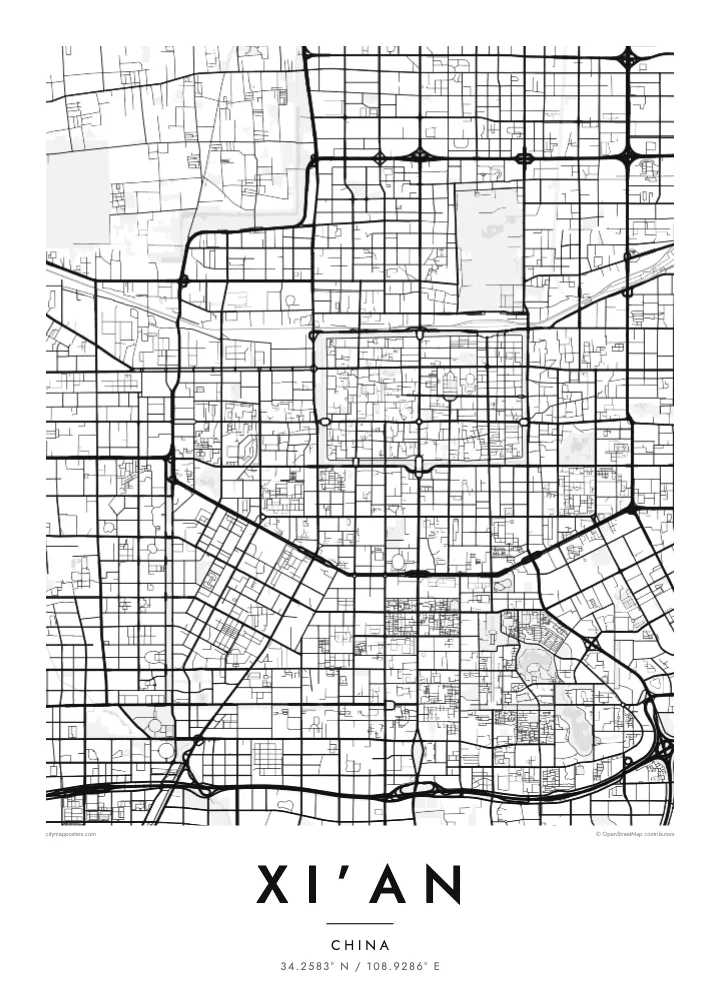
A continuous rectangle of wall and moat encloses the old town. It is one of the most complete ancient city walls in China and gives the poster a ready-made frame.
Fakatino mape mukamuka · China
34.2583° N / 108.9286° E
A rectangular walled city with four straight avenues meeting at the Bell Tower, set on a wide river plain



Taha e taone, lima e onoonoaga
Tapaki e taha puhala ke kitia ai ki luga he puipui. Kua tatai e totogi he tau puhala oti — pete he lolomi, poloka, po ke faila HD.
 Tau pikselo mooli · faila lolomi 24 × 36″
Maama mitaki ke lolomi
Ko e 100% e fahi mooli mai he faila lolomi. Ko e tau poster oti — pete kua lolomi, poloka, po ke utu hifo — kua taute ke he ha mautolu a tau tokoluga (server) ke he 300 DPI, hokotia ke he 7,200 × 10,800 piksela, ke maeke ai e tau ala ikiiki tote ke maaliali fakamitaki he lolomi 24 × 36″.
He Pā


Ko e mape
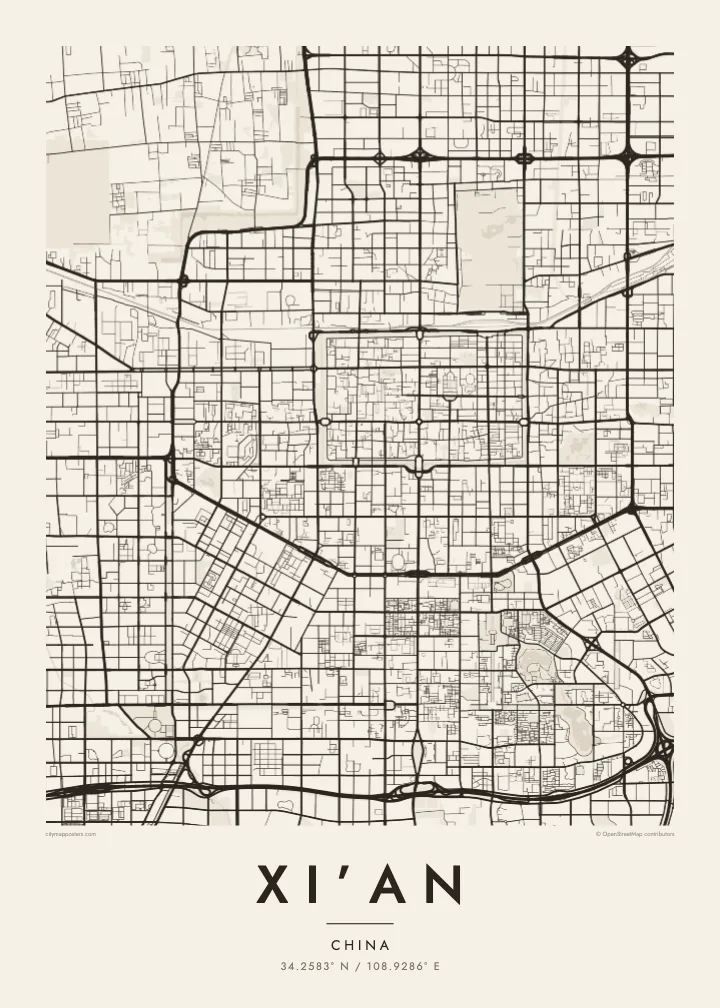
Xi’an has one of the clearest plans of any large city. At its heart is a rectangle defined by the Ming dynasty city wall, about 13.7 kilometres long and surrounded by a moat. Four main streets run from the Bell Tower at the centre to the four gates in the wall, dividing the old town into quarters. Outside, newer districts extend the same orthogonal logic in every direction.
That grid reflects a much older layout. Tang dynasty Chang’an, which covered much of the present city, was laid out as a strict chessboard of walled wards and avenues. South of the walls, the Big Wild Goose Pagoda stands at the end of a long straight road, while the Wei River flows to the north and the ridges of the Qinling Mountains line the southern horizon.
Xi’an served as the capital of many Chinese dynasties and was the eastern starting point of the Silk Road. The Terracotta Army, discovered in 1974, lies east of the city in Lintong, near the mausoleum of the first Qin emperor. A Xi’an map poster frames the walled core that still orients the city today.
A continuous rectangle of wall and moat encloses the old town. It is one of the most complete ancient city walls in China and gives the poster a ready-made frame.
East, West, North and South Streets meet at the Bell Tower near the middle of the walled city, forming a cross that divides the old town into four quarters.
South of the walls, the Tang dynasty pagoda sits inside a temple complex with long plazas and parks, marking the end of a straight avenue that leads south from the old city.
Taute ke ha hau
Lafi e aho, taha higoa po ke taha kupu haau, hiki e fakatino, lahi po ke tuaga.
Ko e kitiaaga nakai totogi kua tote e maaliali mo e fakamailoga vai. Ko e tau lolomi mo e tau faila HD kua taute ke he 300 DPI, hokotia ke he 7,200 × 10,800 px, nakai fai fakamailoga vai.
Ko e ha Xi’an
Xi’an appeals to travellers who walked or cycled the wall, students of Chinese history and anyone who likes a city with a clear, almost diagrammatic plan. The walled rectangle gives the poster a strong focal point without needing any explanation.
Personalise the title and subtitle with a name, a trip or a date, and edit the coordinates line to mark a spot inside the walls. Choose from Classic black & white, Noir, Paper, Blueprint and Sand, as HD files in six print sizes or a printed poster.
Talaage e poster Xi’an| Lahi he lolomi | Maama | Tau faila |
|---|---|---|
| 30 × 40 cm11.8 × 15.7″ | 3,543 × 4,724 px | PNG · PDF |
| 29.7 × 42 cm (A3)11.7 × 16.5″ | 3,508 × 4,961 px | PNG · PDF |
| 42 × 59.4 cm (A2)16.5 × 23.4″ | 4,961 × 7,016 px | PNG · PDF |
| 45.7 × 61 cm18 × 24″ | 5,400 × 7,200 px | PNG · PDF |
| 50 × 70 cm19.7 × 27.6″ | 5,906 × 8,268 px | PNG · PDF |
| 61 × 91.4 cm24 × 36″ | 7,200 × 10,800 px | PNG · PDF |
Ke fakatatai, ko e fakatino noa kua 900 px e laulahi, fai fakamailoga mo e mo e tau mata komipiuta ni. Ko e tau faila HD kua ato hoko ke he 8× e maama ke he tau faahi takitaha mo e lolomi mitaki he lahi katoa he fakatino.
Fifili e taha puhala i luga he kupega, ti fifili e Poster Lolomi — e lahi mo e, kaeke ke manako ai koe, taha poloka — po ke Tau Faila HD Fakaeletonika. Ko e fakaotiaga totogi ko e taha gahua ni, ti ko e kupega he hau a talaaga ka fakafou fakahaga i mua he fakaotiaga e totogi.
Kua lolomi ai ke he pepa mitaki 200 gsm matte he taha he tau lahi ono, mai he 30 × 40 cm ke hoko ke he 24 × 36″. Kamata e tau poster lolomi mai he $39, kua putoia ai e utaaga.
E. Fifili e poloka akau malolō ke he lanu uli, tea, akau oki mooli, po ke akau pouli. Kua fakalataha mo e sioga malolō nakai malepe ti kua mautali ke tautau. Kamata e tau poster poloka mai he $99, kua putoia ai e utaaga.
Nakai totogi e fakafano ke he motu 60+. Ko e fakatino taha kua lolomi he fenoga lolomi ha mautolu kua tata mo e tau motu 30+, kua hoko mai he tau aho gahua 3–7. Maeke ia koe ke kikite e tuaga mo e fakamuitua he lalo he Haku Tau Fakatonu. Ke he falu motu kua 2–5 e tau tapu, ti ka nakai fakafano a mautolu ki ai, to fakaha he api tupe ia ki mua he totogi.
Fakafano mai e taha ata ki a mautolu he loto he 14 e tau aho tali mai he hokoaga, ti to lolomi foki e mautolu nakai totogi po ke liu atu e totogi ki a koe.
E. He editor i luga he kupega nei, hikihiki e matakupu, e matakupu lalo mo e laini coordinates ke he taha mena kua manako a koe ki ai, ti fifili e puhala mo e lahi. Ko e tau talaaga lolomi, poloka mo e fakaeletonika oti kua fakaaoga tonu e hau a fakatino.
Ma e $9 ka moua e koe e tau faila PNG 300 DPI mo e PDF kua mautali ke lolomi he tau lahi ono oti, nakai fai fakamailoga vai, ke lolomi i fe mena. Nakai maopoopo agaia? Utu hifo fakamua e kitiaaga nakai totogi ne fai fakamailoga vai.
Tata mai
