Market centre
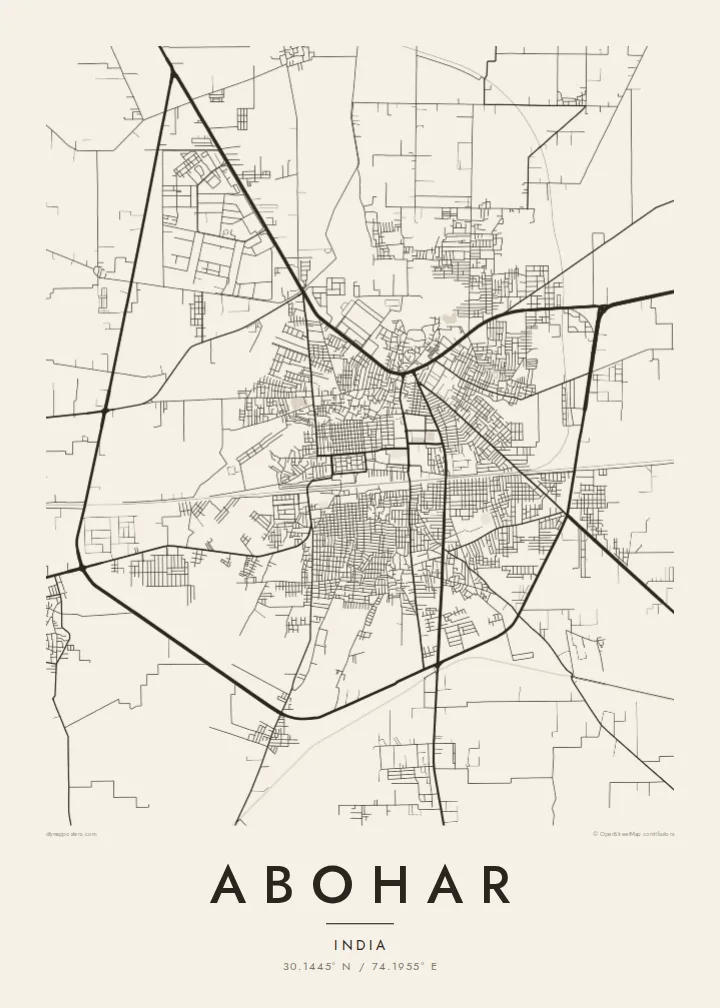
The town's commercial streets form a compact, dense core. On the poster it is the most detailed area, surrounded by more open residential blocks.
Posta faʻafanua faigofie · India
30.1445° N / 74.1955° E
A market town in south-western Punjab, set among canals, citrus orchards and flat farmland near the Rajasthan border.




Tasi le aai, lagona e lima
Tapi se sitaili e vaai ai i luga o le puipui. E tutusa uma le tau o sitaili — pe lolomiina, faapipiiina, pe avea ma faila HD.
 Pika Moni · Faila Lolomi 24 × 36″
Manino mo le lolomi
O se vaega atoa (100%) lenei mai le faila lolomi moni. O posita uma — pe lolomiina, faapipiiina pe download mai — e faia i luga o a matou server i le 300 DPI, e oo atu i le 7,200 × 10,800 pika, ina ia manino pea auala laiti i luga o se lolomiga 24 × 36″.
I luga o le puipui


Le faʻafanua
Abohar lies in the Fazilka district of south-western Punjab, close to the border with Rajasthan. The land around it is flat and intensively farmed. On a map the town is a compact centre of market streets and residential blocks, crossed by a railway and surrounded by farmland divided into regular fields by roads and irrigation canals.
The area is known for its kinnow orchards, a citrus fruit grown widely across this part of Punjab, and for cotton cultivation. Nearby, the Abohar Wildlife Sanctuary is unusual in that it covers the lands of Bishnoi villages, where a strong tradition of protecting animals has allowed blackbuck and other wildlife to thrive among the fields.
An Abohar map poster shows a town closely tied to the land around it. The dense streets of the centre stand out against the wide, open farmland, and the straight lines of canals and field roads cross the frame in a steady grid. It is a simple, balanced composition that reflects the agricultural life of the region.
The town's commercial streets form a compact, dense core. On the poster it is the most detailed area, surrounded by more open residential blocks.
A railway passes through the town and links it to the wider region. It crosses the poster as a firm, straight line through the street pattern.
Irrigation canals and field roads divide the farmland into a regular pattern. They extend to the edges of the frame and frame the town with the order of the surrounding land.
Fai mo oe
Faʻaopoopo se aso, se igoa po o sau lava upu, sui le sitaili, lapoʻa po o le itu.
O le preview e leai se totogi e maualalo le resolution ma iai se watermark. O lolomi ma faila HD e faia i le 300 DPI, e oo atu i le 7,200 × 10,800 px, e aunoa ma se watermark.
Aisea Abohar
Many families from Abohar and the surrounding villages now live in other parts of India, in Canada, the UK or Australia. A map of the hometown is a personal way to stay connected to it, and a meaningful gift across generations.
You can personalise the title, subtitle and coordinates line, in English or Punjabi, and choose from five styles: Classic black & white, Noir, Paper, Blueprint or Sand. The digital HD files cost $9, and printed posters ship from partners in more than 30 countries.
Faatau le posita Abohar| Lapoʻa lolomi | Manino | Faila |
|---|---|---|
| 30 × 40 cm (11.8 × 15.7″) | 3,543 × 4,724 px | PNG · PDF |
| 29.7 × 42 cm (A3, 11.7 × 16.5″) | 3,508 × 4,961 px | PNG · PDF |
| 42 × 59.4 cm (A2, 16.5 × 23.4″) | 4,961 × 7,016 px | PNG · PDF |
| 45.7 × 61 cm (18 × 24″) | 5,400 × 7,200 px | PNG · PDF |
| 50 × 70 cm (19.7 × 27.6″) | 5,906 × 8,268 px | PNG · PDF |
| 61 × 91.4 cm (24 × 36″) | 7,200 × 10,800 px | PNG · PDF |
Ae faʻatusatusa, o le faʻataʻitaʻiga e leai se totogi e 900 px le lautele, e iai le faʻailoga vai ma e mo mata. O faila HD e oʻo atu i le 8× le manino i itu taʻitasi ma e lolomi manino i le lapoʻa atoa o le posta.
Filifili se sitaili i le pito i luga o le itulau, ona filifili lea o le Posita Lolomi — se lapopoa ma, afai e te fiafia, se faavaa — po o Faila HD Numera. E na o le tasi laasaga o le Checkout, ma o le a fesuia'i lou itulau o oka i le taimi lava e mae'a ai le totogi.
E lolomiina i luga o pepa matte maualuga le tulaga e 200 gsm, i se tasi o lapopoa e ono, mai le 30 × 40 cm i le 24 × 36″. E amata le tau o posita lolomi mai le $39, aofia ai le auina atu.
Ioe. Filifili se faavaa laau malosi i le lanu uliuli, sina, oak masani, po o le laau pogisa. E aofia ai se tioata e le gau ma ua saunia e tautau i luga. E amata le tau o posita faavaa mai le $99, aofia ai le auina atu.
E leai se totogi mo le uta i le lalolagi atoa. O poster ta'itasi e lolomi e le paaga lolomi e latalata mai i matou i atunuu e 30+, ma e masani ona taunuu i aso faigaluega e 3–7. E mafai ona e mulimuli i le tulaga ma le tracking i le "Aʻu Oka". O nisi atunuu e 2–5 vaiaso, ma i atunuu matou te lei tuuina atu ai, e taʻu atu e le saite iā te oe ae e te leʻi totogiina.
Auina mai se ata i totonu o le 14 aso talu ona taunuu, ma o le a matou toe lolomiina e leai se totogi po o le toe faafoi atu lau tupe.
Ioe. I totonu o le editor i lenei itulau, suia le ulutala, le ulutala laititi ma le laina o coordinates i soo se mea e te fiafia i ai, ma filifili se sitaili ma le lapopoa. O oka lolomi, faavaa ma numera e faaaoga uma lava lau mamanu.
Mo le $9 e te maua ai faila PNG 300 DPI ma PDF ua saunia mo le lolomi i lapopoa uma e ono, e aunoa ma se watermark, e mafai ona lolomi i soo se mea. Le mautinoa lava? Download muamua se preview e leai se totogi ma le watermark.
