The Karun River
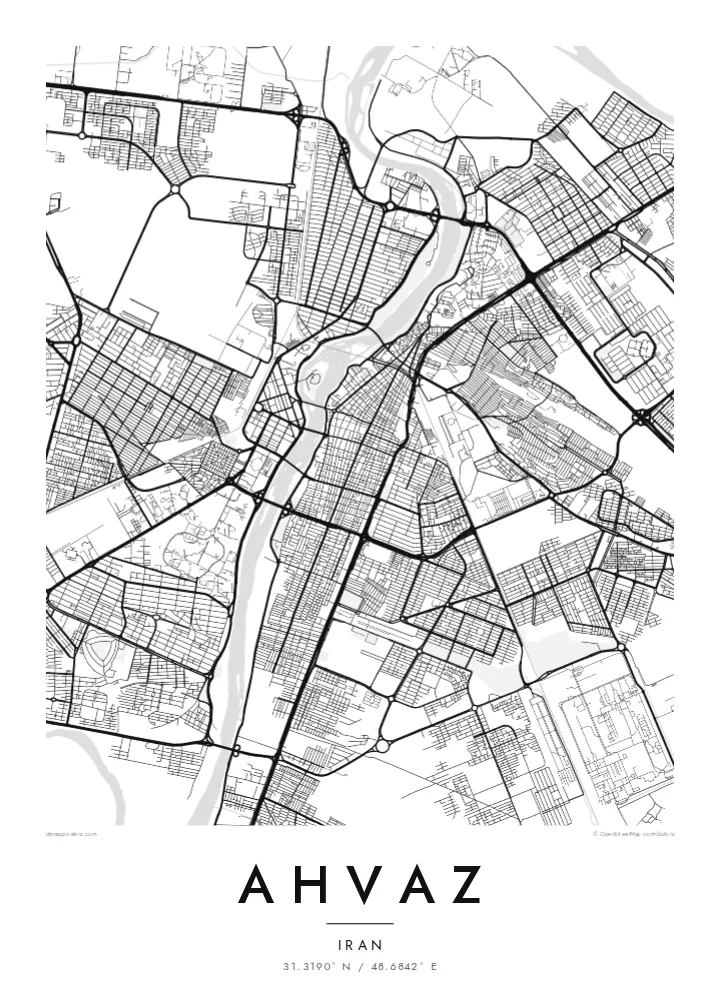
Iran's largest river curves through the middle of the map, a broad ribbon of empty space that gives the print its main shape and balance.
Posta faʻafanua faigofie · Iran
31.3190° N / 48.6842° E
A city divided by the broad Karun River, its two banks stitched together by a long sequence of bridges.


Tasi le aai, lagona e lima
Tapi se sitaili e vaai ai i luga o le puipui. E tutusa uma le tau o sitaili — pe lolomiina, faapipiiina, pe avea ma faila HD.
 Pika Moni · Faila Lolomi 24 × 36″
Manino mo le lolomi
O se vaega atoa (100%) lenei mai le faila lolomi moni. O posita uma — pe lolomiina, faapipiiina pe download mai — e faia i luga o a matou server i le 300 DPI, e oo atu i le 7,200 × 10,800 pika, ina ia manino pea auala laiti i luga o se lolomiga 24 × 36″.
I luga o le puipui


Le faʻafanua
Ahvaz is the capital of Khuzestan province in south-western Iran, built on the flat, hot plain near the head of the Persian Gulf. The Karun, the country's largest river by volume, winds straight through the city, splitting it into eastern and western halves. From above, the river's gentle curves set the direction of the streets and the rhythm of the whole urban plan.
Because of this, Ahvaz is often called the city of bridges. Several crossings span the Karun within the urban area, the best known being the White Bridge, a steel suspension bridge completed in the 1930s that has become a symbol of the city. The region is also the centre of Iran's oil industry, which drove much of the city's growth in the twentieth century.
An Ahvaz map poster shows the Karun as a wide band of open space cutting through dense blocks, with each bridge drawn as a fine line from bank to bank. Riverside parks, long boulevards and the regular grid of newer districts complete a composition that feels both structured and calm.
Iran's largest river curves through the middle of the map, a broad ribbon of empty space that gives the print its main shape and balance.
The city's best-known crossing, a suspension bridge from the 1930s, links the two banks near the centre and is a familiar image for anyone from Ahvaz.
Green strips and promenades line parts of both banks, softening the edges of the river and marking where the city opens toward the water.
Fai mo oe
Faʻaopoopo se aso, se igoa po o sau lava upu, sui le sitaili, lapoʻa po o le itu.
O le preview e leai se totogi e maualalo le resolution ma iai se watermark. O lolomi ma faila HD e faia i le 300 DPI, e oo atu i le 7,200 × 10,800 px, e aunoa ma se watermark.
Aisea Ahvaz
For families from Khuzestan, the river and its bridges are the heart of the city, and a map that places them at the centre carries real meaning. The design suits a living room or a quiet corner and makes a considered gift.
Add a personal title, subtitle and coordinates line, and pick Classic black & white, Noir, Paper, Blueprint or Sand. The digital version includes six print sizes, from A3 to 24×36″, each as a 300 DPI PNG and print-ready PDF.
Faatau le posita Ahvaz| Lapoʻa lolomi | Manino | Faila |
|---|---|---|
| 30 × 40 cm11.8 × 15.7″ | 3,543 × 4,724 px | PNG · PDF |
| 29.7 × 42 cm (A3)11.7 × 16.5″ | 3,508 × 4,961 px | PNG · PDF |
| 42 × 59.4 cm (A2)16.5 × 23.4″ | 4,961 × 7,016 px | PNG · PDF |
| 45.7 × 61 cm18 × 24″ | 5,400 × 7,200 px | PNG · PDF |
| 50 × 70 cm19.7 × 27.6″ | 5,906 × 8,268 px | PNG · PDF |
| 61 × 91.4 cm24 × 36″ | 7,200 × 10,800 px | PNG · PDF |
Ae faʻatusatusa, o le faʻataʻitaʻiga e leai se totogi e 900 px le lautele, e iai le faʻailoga vai ma e mo mata. O faila HD e oʻo atu i le 8× le manino i itu taʻitasi ma e lolomi manino i le lapoʻa atoa o le posta.
Filifili se sitaili i le pito i luga o le itulau, ona filifili lea o le Posita Lolomi — se lapopoa ma, afai e te fiafia, se faavaa — po o Faila HD Numera. E na o le tasi laasaga o le Checkout, ma o le a fesuia'i lou itulau o oka i le taimi lava e mae'a ai le totogi.
E lolomiina i luga o pepa matte maualuga le tulaga e 200 gsm, i se tasi o lapopoa e ono, mai le 30 × 40 cm i le 24 × 36″. E amata le tau o posita lolomi mai le $39, aofia ai le auina atu.
Ioe. Filifili se faavaa laau malosi i le lanu uliuli, sina, oak masani, po o le laau pogisa. E aofia ai se tioata e le gau ma ua saunia e tautau i luga. E amata le tau o posita faavaa mai le $99, aofia ai le auina atu.
E leai se totogi o le auina atu i atunuu e 60+. O pepa ata taʻitasi e lolomiina e le tasi o matou paaga lolomi e latalata mai i atunuu e 30+, ma e masani ona taunuu i le 3–7 aso faigaluega. E mafai ona e mulimulitaia le tulaga ma le sailiga i lalo o My Orders. O nisi atunuu e 2–5 vaiaso, ma i nofoaga e lei matou auina atu iai, e taʻu atu e le saite ia te oe a o lei totogi.
Auina mai se ata i totonu o le 14 aso talu ona taunuu, ma o le a matou toe lolomiina e leai se totogi po o le toe faafoi atu lau tupe.
Ioe. I totonu o le editor i lenei itulau, suia le ulutala, le ulutala laititi ma le laina o coordinates i soo se mea e te fiafia i ai, ma filifili se sitaili ma le lapopoa. O oka lolomi, faavaa ma numera e faaaoga uma lava lau mamanu.
Mo le $9 e te maua ai faila PNG 300 DPI ma PDF ua saunia mo le lolomi i lapopoa uma e ono, e aunoa ma se watermark, e mafai ona lolomi i soo se mea. Le mautinoa lava? Download muamua se preview e leai se totogi ma le watermark.
