Shatt al-Arab
The broad waterway formed by the Tigris and Euphrates runs along the city's eastern edge, a wide, steady line that anchors the entire composition.
Posta faʻafanua faigofie · Iraq
30.5085° N / 47.7804° E
A river port along the Shatt al-Arab, threaded by old canals and edged by wide groves of date palms



Tasi le aai, lagona e lima
Tapi se sitaili e vaai ai i luga o le puipui. E tutusa uma le tau o sitaili — pe lolomiina, faapipiiina, pe avea ma faila HD.
 Pika Moni · Faila Lolomi 24 × 36″
Manino mo le lolomi
O se vaega atoa (100%) lenei mai le faila lolomi moni. O posita uma — pe lolomiina, faapipiiina pe download mai — e faia i luga o a matou server i le 300 DPI, e oo atu i le 7,200 × 10,800 pika, ina ia manino pea auala laiti i luga o se lolomiga 24 × 36″.
I luga o le puipui


Le faʻafanua
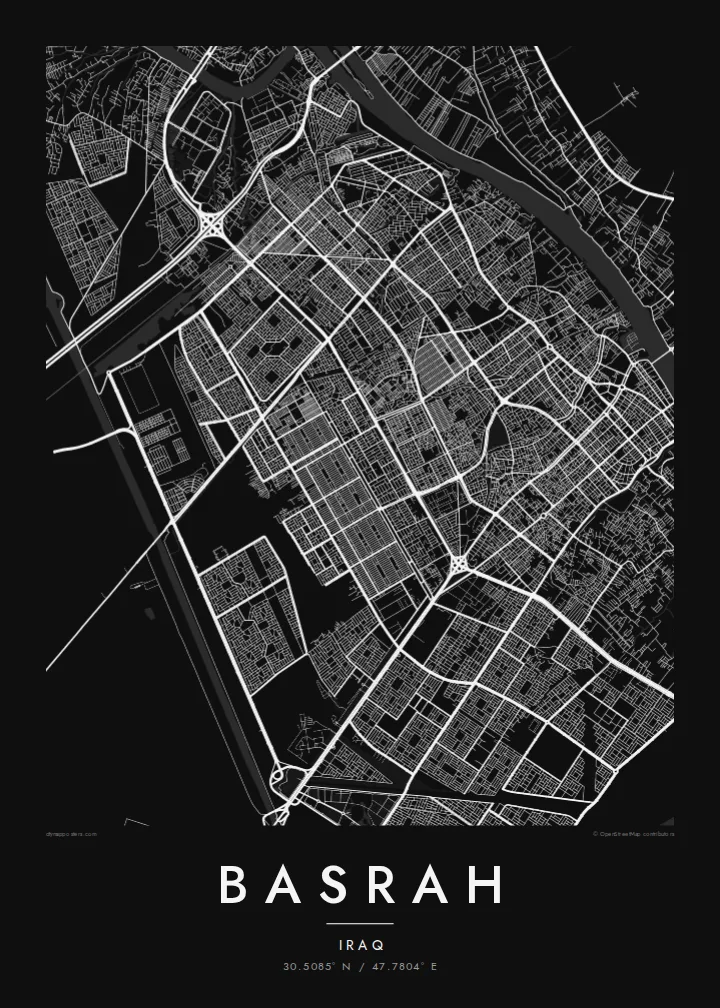
Basrah lies on the Shatt al-Arab, the waterway formed where the Tigris and the Euphrates join upstream at Qurna. On the map, the river runs along the eastern side of the city toward the Gulf, and a network of canals branches off it through the urban area, which once earned Basrah the nickname the Venice of the East. Palm groves line the banks beyond the city.
Founded in 636 as a garrison town, Basrah became one of the great cities of the early Islamic world, known for its scholars and particularly for the school of Arabic grammar that developed here. It is also associated with the tales of Sinbad the Sailor, who set out on his voyages from its port, according to the stories.
A Basrah map poster traces the Shatt al-Arab, the canals and the pattern of streets between them, with the corniche following the river through the centre. Today Basrah is Iraq's main port city and a centre of its oil industry, but on the map it remains what it has always been: a city shaped by rivers, water and trade.
The broad waterway formed by the Tigris and Euphrates runs along the city's eastern edge, a wide, steady line that anchors the entire composition.
Canals branch off the river and wind through the city, fine lines of water that recall the network behind Basrah's old nickname, the Venice of the East.
Beyond the built-up area, date palm groves follow the riverbanks. On the map they appear as a softer, more open texture framing the dense streets of the city.
Fai mo oe
Faʻaopoopo se aso, se igoa po o sau lava upu, sui le sitaili, lapoʻa po o le itu.
O le preview e leai se totogi e maualalo le resolution ma iai se watermark. O lolomi ma faila HD e faia i le 300 DPI, e oo atu i le 7,200 × 10,800 px, e aunoa ma se watermark.
Aisea Basrah
Basrah is a map for Iraqis at home and abroad, for those who have worked in its port and oil fields and for anyone who knows the city from literature and history. Its river and canals give the poster a strong and immediately readable structure.
Add a title in Arabic or English, a subtitle with a date or family name, and edit the coordinates line. Choose from five styles: Classic black & white, Noir, Paper, Blueprint or Sand. Sand reflects the colours of the southern plain and the river.
Faatau le posita Basrah| Lapoʻa lolomi | Manino | Faila |
|---|---|---|
| 30 × 40 cm (11.8 × 15.7″) | 3,543 × 4,724 px | PNG · PDF |
| 29.7 × 42 cm (A3, 11.7 × 16.5″) | 3,508 × 4,961 px | PNG · PDF |
| 42 × 59.4 cm (A2, 16.5 × 23.4″) | 4,961 × 7,016 px | PNG · PDF |
| 45.7 × 61 cm (18 × 24″) | 5,400 × 7,200 px | PNG · PDF |
| 50 × 70 cm (19.7 × 27.6″) | 5,906 × 8,268 px | PNG · PDF |
| 61 × 91.4 cm (24 × 36″) | 7,200 × 10,800 px | PNG · PDF |
Ae faʻatusatusa, o le faʻataʻitaʻiga e leai se totogi e 900 px le lautele, e iai le faʻailoga vai ma e mo mata. O faila HD e oʻo atu i le 8× le manino i itu taʻitasi ma e lolomi manino i le lapoʻa atoa o le posta.
Filifili se sitaili i le pito i luga o le itulau, ona filifili lea o le Posita Lolomi — se lapopoa ma, afai e te fiafia, se faavaa — po o Faila HD Numera. E na o le tasi laasaga o le Checkout, ma o le a fesuia'i lou itulau o oka i le taimi lava e mae'a ai le totogi.
E lolomiina i luga o pepa matte maualuga le tulaga e 200 gsm, i se tasi o lapopoa e ono, mai le 30 × 40 cm i le 24 × 36″. E amata le tau o posita lolomi mai le {printFrom}, aofia ai le auina atu.
Ioe. Filifili se faavaa laau malosi i le lanu uliuli, sina, oak masani, po o le laau pogisa. E aofia ai se tioata e le gau ma ua saunia e tautau i luga. E amata le tau o posita faavaa mai le {framedFrom}, aofia ai le auina atu.
E leai se totogi mo le uta i le lalolagi atoa. O poster ta'itasi e lolomi e le paaga lolomi e latalata mai i matou i atunuu e 30+, ma e masani ona taunuu i aso faigaluega e 3–7. E mafai ona e mulimuli i le tulaga ma le tracking i le "Aʻu Oka". O nisi atunuu e 2–5 vaiaso, ma i atunuu matou te lei tuuina atu ai, e taʻu atu e le saite iā te oe ae e te leʻi totogiina.
Auina mai se ata i totonu o le 14 aso talu ona taunuu, ma o le a matou toe lolomiina e leai se totogi po o le toe faafoi atu lau tupe.
Ioe. I totonu o le editor i lenei itulau, suia le ulutala, le ulutala laititi ma le laina o coordinates i soo se mea e te fiafia i ai, ma filifili se sitaili ma le lapopoa. O oka lolomi, faavaa ma numera e faaaoga uma lava lau mamanu.
Mo le $9 e te maua ai faila PNG 300 DPI ma PDF ua saunia mo le lolomi i lapopoa uma e ono, e aunoa ma se watermark, e mafai ona lolomi i soo se mea. Le mautinoa lava? Download muamua se preview e leai se totogi ma le watermark.
