Plaza de Armas
The main square sits at the heart of the colonial grid, a single open block surrounded by the tightest and most regular streets in the city.
Posta faʻafanua faigofie · Peru
13.1638° S / 74.2234° W
An Andean colonial city of chequerboard blocks and church towers, set high in a dry mountain valley of south-central Peru.


Tasi le aai, lagona e lima
Tapi se sitaili e vaai ai i luga o le puipui. E tutusa uma le tau o sitaili — pe lolomiina, faapipiiina, pe avea ma faila HD.
 Pika Moni · Faila Lolomi 24 × 36″
Manino mo le lolomi
O se vaega atoa (100%) lenei mai le faila lolomi moni. O posita uma — pe lolomiina, faapipiiina pe download mai — e faia i luga o a matou server i le 300 DPI, e oo atu i le 7,200 × 10,800 pika, ina ia manino pea auala laiti i luga o se lolomiga 24 × 36″.
I luga o le puipui


Le faʻafanua
The Spanish founded Ayacucho in 1540 as San Juan de la Frontera de Huamanga, and the name Huamanga is still in everyday use. Its historic centre follows the classic Spanish colonial plan. A regular grid of blocks spreads out from the Plaza de Armas, arcaded buildings line the square, and the streets run straight until the hills stop them.
The city is known for its many churches, often counted at thirty-three, a number linked to the age of Christ, and its Holy Week celebrations draw visitors from across Peru. It is also a centre for traditional crafts, including retablos, carved stone and weaving. Many workshops sit in the neighbourhoods around the colonial core.
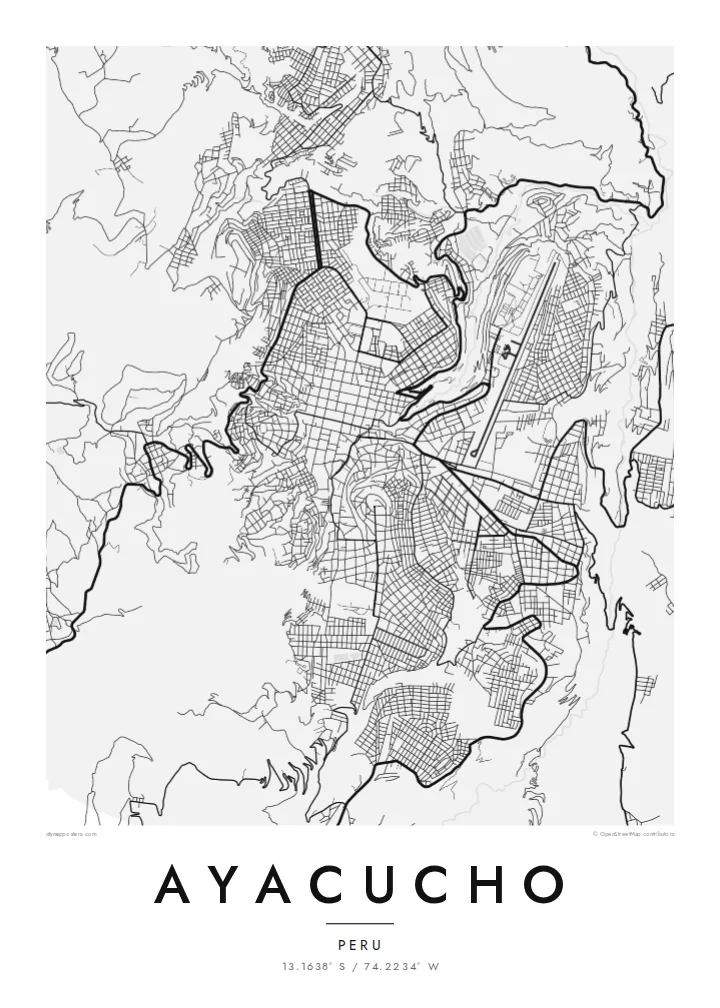
Nearby, on the Pampa de Quinua, the Battle of Ayacucho in 1824 effectively ended Spanish rule in South America. An Ayacucho map poster shows the ordered centre giving way to newer districts that climb the surrounding slopes, their streets bending with the terrain. The whole city reads as a grid set inside a bowl of mountains.
The main square sits at the heart of the colonial grid, a single open block surrounded by the tightest and most regular streets in the city.
Straight streets meet at right angles across the historic centre, where many of Ayacucho's churches stand. This gives the poster a crisp, orderly core.
Newer neighbourhoods spread up the valley slopes, where the grid loosens and the streets begin to curve, a clear contrast with the planned centre.
Fai mo oe
Faʻaopoopo se aso, se igoa po o sau lava upu, sui le sitaili, lapoʻa po o le itu.
O le preview e leai se totogi e maualalo le resolution ma iai se watermark. O lolomi ma faila HD e faia i le 300 DPI, e oo atu i le 7,200 × 10,800 px, e aunoa ma se watermark.
Aisea Ayacucho
Ayacucho means a great deal to Peruvians. It is where independence was sealed, and it is a city of faith, music and craft. For anyone from Huamanga, a map of its streets is a piece of home with real weight behind it.
Title it Ayacucho or Huamanga, add a subtitle such as a year or a family name, and adjust the coordinates line. Choose Classic black & white, Noir, Paper, Blueprint or Sand, as $9 digital files or a printed poster.
Faatau le posita Ayacucho| Lapoʻa lolomi | Manino | Faila |
|---|---|---|
| 30 × 40 cm11.8 × 15.7″ | 3,543 × 4,724 px | PNG · PDF |
| 29.7 × 42 cm (A3)11.7 × 16.5″ | 3,508 × 4,961 px | PNG · PDF |
| 42 × 59.4 cm (A2)16.5 × 23.4″ | 4,961 × 7,016 px | PNG · PDF |
| 45.7 × 61 cm18 × 24″ | 5,400 × 7,200 px | PNG · PDF |
| 50 × 70 cm19.7 × 27.6″ | 5,906 × 8,268 px | PNG · PDF |
| 61 × 91.4 cm24 × 36″ | 7,200 × 10,800 px | PNG · PDF |
Ae faʻatusatusa, o le faʻataʻitaʻiga e leai se totogi e 900 px le lautele, e iai le faʻailoga vai ma e mo mata. O faila HD e oʻo atu i le 8× le manino i itu taʻitasi ma e lolomi manino i le lapoʻa atoa o le posta.
Filifili se sitaili i le pito i luga o le itulau, ona filifili lea o le Posita Lolomi — se lapopoa ma, afai e te fiafia, se faavaa — po o Faila HD Numera. E na o le tasi laasaga o le Checkout, ma o le a fesuia'i lou itulau o oka i le taimi lava e mae'a ai le totogi.
E lolomiina i luga o pepa matte maualuga le tulaga e 200 gsm, i se tasi o lapopoa e ono, mai le 30 × 40 cm i le 24 × 36″. E amata le tau o posita lolomi mai le $39, aofia ai le auina atu.
Ioe. Filifili se faavaa laau malosi i le lanu uliuli, sina, oak masani, po o le laau pogisa. E aofia ai se tioata e le gau ma ua saunia e tautau i luga. E amata le tau o posita faavaa mai le $99, aofia ai le auina atu.
E leai se totogi o le auina atu i atunuu e 60+. O pepa ata taʻitasi e lolomiina e le tasi o matou paaga lolomi e latalata mai i atunuu e 30+, ma e masani ona taunuu i le 3–7 aso faigaluega. E mafai ona e mulimulitaia le tulaga ma le sailiga i lalo o My Orders. O nisi atunuu e 2–5 vaiaso, ma i nofoaga e lei matou auina atu iai, e taʻu atu e le saite ia te oe a o lei totogi.
Auina mai se ata i totonu o le 14 aso talu ona taunuu, ma o le a matou toe lolomiina e leai se totogi po o le toe faafoi atu lau tupe.
Ioe. I totonu o le editor i lenei itulau, suia le ulutala, le ulutala laititi ma le laina o coordinates i soo se mea e te fiafia i ai, ma filifili se sitaili ma le lapopoa. O oka lolomi, faavaa ma numera e faaaoga uma lava lau mamanu.
Mo le $9 e te maua ai faila PNG 300 DPI ma PDF ua saunia mo le lolomi i lapopoa uma e ono, e aunoa ma se watermark, e mafai ona lolomi i soo se mea. Le mautinoa lava? Download muamua se preview e leai se totogi ma le watermark.
