Plaza de Armas
The main square sits at the heart of the historic centre, on the site of the former Inca ceremonial plaza, with streets leading out from its corners into the old stone-walled grid.
Posta faʻafanua faigofie · Peru
13.5319° S / 71.9670° W
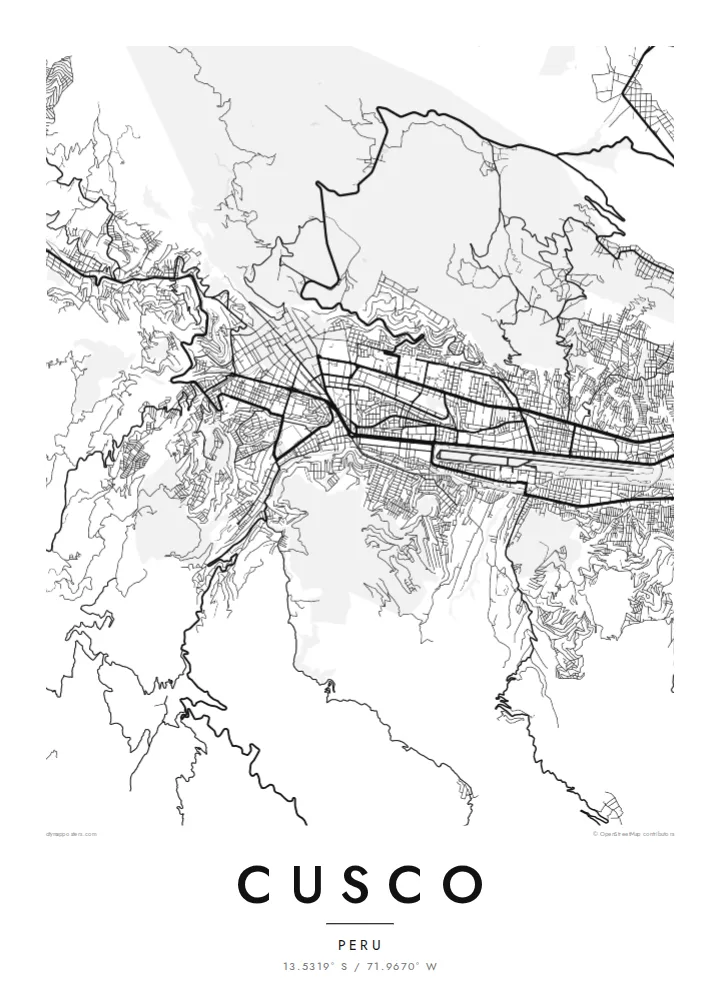
An Inca capital in a high Andean valley, its stone-walled grid climbing the slopes toward Sacsayhuamán above the city.


Tasi le aai, lagona e lima
Tapi se sitaili e vaai ai i luga o le puipui. E tutusa uma le tau o sitaili — pe lolomiina, faapipiiina, pe avea ma faila HD.
 Pika Moni · Faila Lolomi 24 × 36″
Manino mo le lolomi
O se vaega atoa (100%) lenei mai le faila lolomi moni. O posita uma — pe lolomiina, faapipiiina pe download mai — e faia i luga o a matou server i le 300 DPI, e oo atu i le 7,200 × 10,800 pika, ina ia manino pea auala laiti i luga o se lolomiga 24 × 36″.
I luga o le puipui


Le faʻafanua
Cusco lies in a narrow valley in the Peruvian Andes, at around 3,400 metres above sea level, and was the capital of the Inca Empire. Its historic centre still follows the Inca plan in many places: streets run straight between massive stone walls, and later Spanish churches and mansions were built directly on Inca foundations. The city was listed as a UNESCO World Heritage Site in 1983.
Tradition holds that the Inca city was laid out in the shape of a puma, with the fortress of Sacsayhuamán forming the head on the hill above and the meeting of two small rivers forming the tail. At the centre is the Plaza de Armas, once the great Inca square, framed by the cathedral and the Church of the Company of Jesus.
Beyond the core, the city stretches along the valley floor toward the airport, while neighbourhoods such as San Blas climb steep slopes on narrow stepped lanes. A Cusco map poster shows how much of this story is written into the streets themselves: an ancient plan, a colonial overlay and a modern city filling the valley around them.
The main square sits at the heart of the historic centre, on the site of the former Inca ceremonial plaza, with streets leading out from its corners into the old stone-walled grid.
The great Inca fortress on the hill above the city, with its zigzag walls of enormous fitted stones, marks the northern edge of the historic centre on the map.
The artisans' quarter climbs the hillside north-east of the plaza, with narrow lanes and stairways that twist up the slope and contrast with the straighter streets below.
Fai mo oe
Faʻaopoopo se aso, se igoa po o sau lava upu, sui le sitaili, lapoʻa po o le itu.
O le preview e leai se totogi e maualalo le resolution ma iai se watermark. O lolomi ma faila HD e faia i le 300 DPI, e oo atu i le 7,200 × 10,800 px, e aunoa ma se watermark.
Aisea Cusco
Cusco leaves a lasting impression on travellers, whether they came for Machu Picchu, the Sacred Valley or the city itself. A map poster is a quiet way to remember the plaza, the steep lanes and the house or hostel where the journey began.
Personalise the title and subtitle with the dates of a trip or the name of someone you travelled with, and adjust the coordinates line. Choose one of five styles; Paper and Sand suit the city's stone and adobe. Download the HD files or order a framed matte print.
Faatau le posita Cusco| Lapoʻa lolomi | Manino | Faila |
|---|---|---|
| 30 × 40 cm (11.8 × 15.7″) | 3,543 × 4,724 px | PNG · PDF |
| 29.7 × 42 cm (A3, 11.7 × 16.5″) | 3,508 × 4,961 px | PNG · PDF |
| 42 × 59.4 cm (A2, 16.5 × 23.4″) | 4,961 × 7,016 px | PNG · PDF |
| 45.7 × 61 cm (18 × 24″) | 5,400 × 7,200 px | PNG · PDF |
| 50 × 70 cm (19.7 × 27.6″) | 5,906 × 8,268 px | PNG · PDF |
| 61 × 91.4 cm (24 × 36″) | 7,200 × 10,800 px | PNG · PDF |
Ae faʻatusatusa, o le faʻataʻitaʻiga e leai se totogi e 900 px le lautele, e iai le faʻailoga vai ma e mo mata. O faila HD e oʻo atu i le 8× le manino i itu taʻitasi ma e lolomi manino i le lapoʻa atoa o le posta.
Filifili se sitaili i le pito i luga o le itulau, ona filifili lea o le Posita Lolomi — se lapopoa ma, afai e te fiafia, se faavaa — po o Faila HD Numera. E na o le tasi laasaga o le Checkout, ma o le a fesuia'i lou itulau o oka i le taimi lava e mae'a ai le totogi.
E lolomiina i luga o pepa matte maualuga le tulaga e 200 gsm, i se tasi o lapopoa e ono, mai le 30 × 40 cm i le 24 × 36″. E amata le tau o posita lolomi mai le {printFrom}, aofia ai le auina atu.
Ioe. Filifili se faavaa laau malosi i le lanu uliuli, sina, oak masani, po o le laau pogisa. E aofia ai se tioata e le gau ma ua saunia e tautau i luga. E amata le tau o posita faavaa mai le {framedFrom}, aofia ai le auina atu.
E leai se totogi mo le uta i le lalolagi atoa. O poster ta'itasi e lolomi e le paaga lolomi e latalata mai i matou i atunuu e 30+, ma e masani ona taunuu i aso faigaluega e 3–7. E mafai ona e mulimuli i le tulaga ma le tracking i le "Aʻu Oka". O nisi atunuu e 2–5 vaiaso, ma i atunuu matou te lei tuuina atu ai, e taʻu atu e le saite iā te oe ae e te leʻi totogiina.
Auina mai se ata i totonu o le 14 aso talu ona taunuu, ma o le a matou toe lolomiina e leai se totogi po o le toe faafoi atu lau tupe.
Ioe. I totonu o le editor i lenei itulau, suia le ulutala, le ulutala laititi ma le laina o coordinates i soo se mea e te fiafia i ai, ma filifili se sitaili ma le lapopoa. O oka lolomi, faavaa ma numera e faaaoga uma lava lau mamanu.
Mo le $9 e te maua ai faila PNG 300 DPI ma PDF ua saunia mo le lolomi i lapopoa uma e ono, e aunoa ma se watermark, e mafai ona lolomi i soo se mea. Le mautinoa lava? Download muamua se preview e leai se totogi ma le watermark.
