River-bound core
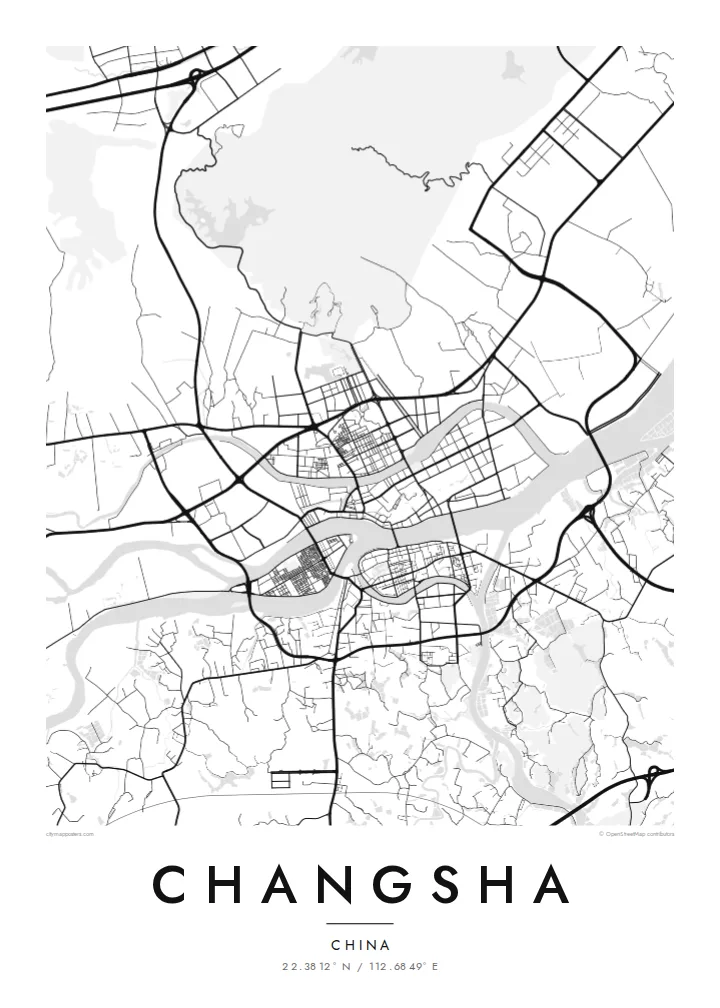
The older, denser streets sit close to the river, where the road network tightens into short blocks before loosening into wider avenues further inland.
Posta faʻafanua faigofie · China
22.3812° N / 112.6849° E
A compact river town in the Kaiping area of western Guangdong, its streets folded into bends of water and low farmland


Tasi le aai, lagona e lima
Tapi se sitaili e vaai ai i luga o le puipui. E tutusa uma le tau o sitaili — pe lolomiina, faapipiiina, pe avea ma faila HD.
 Pika Moni · Faila Lolomi 24 × 36″
Manino mo le lolomi
O se vaega atoa (100%) lenei mai le faila lolomi moni. O posita uma — pe lolomiina, faapipiiina pe download mai — e faia i luga o a matou server i le 300 DPI, e oo atu i le 7,200 × 10,800 pika, ina ia manino pea auala laiti i luga o se lolomiga 24 × 36″.
I luga o le puipui


Le faʻafanua
This Changsha is not the provincial capital of Hunan. It is a town in Guangdong, west of the Pearl River Delta, within the Jiangmen area around Kaiping. From above it reads as a dense urban core pressed against a slow river. Roads fan out across flat, well-watered ground, and small channels, ponds and field boundaries fill the gaps between built-up districts.
The wider Kaiping countryside is best known for its diaolou. These fortified multi-storey watchtowers were built in the early twentieth century, largely with money sent home by emigrants, and are listed by UNESCO. They stand among villages and paddies, so the land around the town is a patchwork rather than an empty margin. Linework picks up that texture well: village clusters, irrigation lines and lanes that curve with the water.
A Changsha map poster of this place shows a river town at modest scale, without the sprawl of a megacity. It suits people with family roots in the Kaiping region, which sent many emigrants abroad, and anyone who wants a map of an ordinary southern Chinese town. The shape is quiet, and the river holds it together.
The older, denser streets sit close to the river, where the road network tightens into short blocks before loosening into wider avenues further inland.
Around the town, ponds, channels and field edges form a fine mesh. It prints as a delicate texture that sets off the solid lines of the urban roads.
The Kaiping area is closely linked to overseas Chinese communities, and its village landscape, dotted with historic watchtowers, carries that story in the map's outer rings.
Fai mo oe
Faʻaopoopo se aso, se igoa po o sau lava upu, sui le sitaili, lapoʻa po o le itu.
O le preview e leai se totogi e maualalo le resolution ma iai se watermark. O lolomi ma faila HD e faia i le 300 DPI, e oo atu i le 7,200 × 10,800 px, e aunoa ma se watermark.
Aisea Changsha
For many families abroad, this corner of Guangdong is where the story began. A map of the town is a plain, lasting way to keep that origin on the wall, closer and more specific than a map of the province.
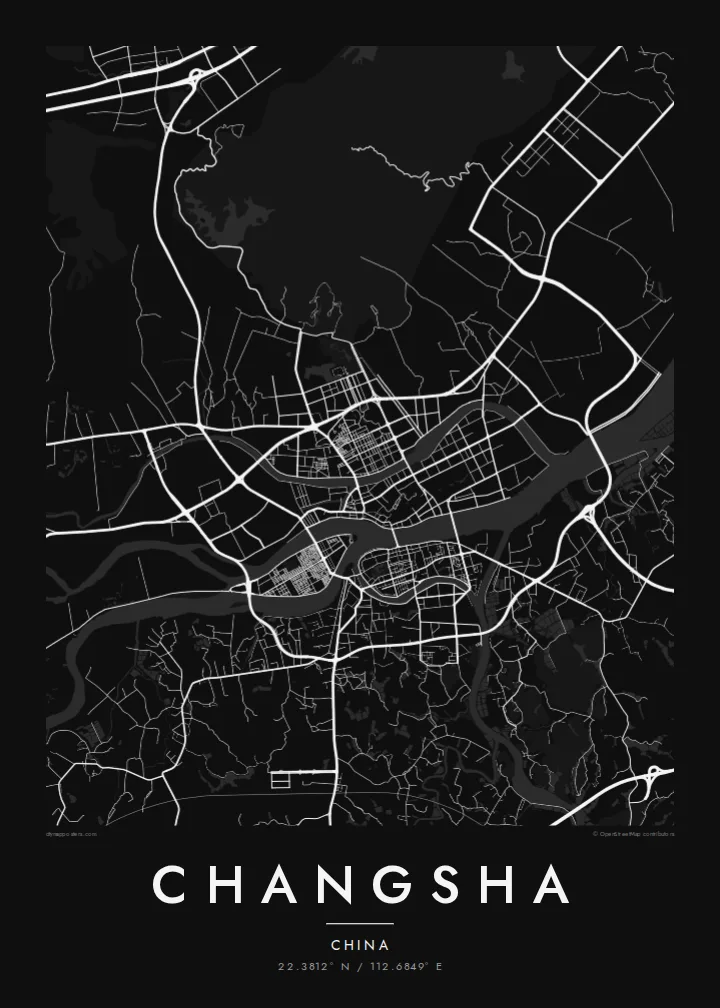
You can add a family name, a year of departure or the coordinates of an ancestral village to the title and subtitle. Then choose from five styles: Classic black & white, Noir, Paper, Blueprint or Sand.
Faatau le posita Changsha| Lapoʻa lolomi | Manino | Faila |
|---|---|---|
| 30 × 40 cm11.8 × 15.7″ | 3,543 × 4,724 px | PNG · PDF |
| 29.7 × 42 cm (A3)11.7 × 16.5″ | 3,508 × 4,961 px | PNG · PDF |
| 42 × 59.4 cm (A2)16.5 × 23.4″ | 4,961 × 7,016 px | PNG · PDF |
| 45.7 × 61 cm18 × 24″ | 5,400 × 7,200 px | PNG · PDF |
| 50 × 70 cm19.7 × 27.6″ | 5,906 × 8,268 px | PNG · PDF |
| 61 × 91.4 cm24 × 36″ | 7,200 × 10,800 px | PNG · PDF |
Ae faʻatusatusa, o le faʻataʻitaʻiga e leai se totogi e 900 px le lautele, e iai le faʻailoga vai ma e mo mata. O faila HD e oʻo atu i le 8× le manino i itu taʻitasi ma e lolomi manino i le lapoʻa atoa o le posta.
Filifili se sitaili i le pito i luga o le itulau, ona filifili lea o le Posita Lolomi — se lapopoa ma, afai e te fiafia, se faavaa — po o Faila HD Numera. E na o le tasi laasaga o le Checkout, ma o le a fesuia'i lou itulau o oka i le taimi lava e mae'a ai le totogi.
E lolomiina i luga o pepa matte maualuga le tulaga e 200 gsm, i se tasi o lapopoa e ono, mai le 30 × 40 cm i le 24 × 36″. E amata le tau o posita lolomi mai le $39, aofia ai le auina atu.
Ioe. Filifili se faavaa laau malosi i le lanu uliuli, sina, oak masani, po o le laau pogisa. E aofia ai se tioata e le gau ma ua saunia e tautau i luga. E amata le tau o posita faavaa mai le $99, aofia ai le auina atu.
E leai se totogi o le auina atu i atunuu e 60+. O pepa ata taʻitasi e lolomiina e le tasi o matou paaga lolomi e latalata mai i atunuu e 30+, ma e masani ona taunuu i le 3–7 aso faigaluega. E mafai ona e mulimulitaia le tulaga ma le sailiga i lalo o My Orders. O nisi atunuu e 2–5 vaiaso, ma i nofoaga e lei matou auina atu iai, e taʻu atu e le saite ia te oe a o lei totogi.
Auina mai se ata i totonu o le 14 aso talu ona taunuu, ma o le a matou toe lolomiina e leai se totogi po o le toe faafoi atu lau tupe.
Ioe. I totonu o le editor i lenei itulau, suia le ulutala, le ulutala laititi ma le laina o coordinates i soo se mea e te fiafia i ai, ma filifili se sitaili ma le lapopoa. O oka lolomi, faavaa ma numera e faaaoga uma lava lau mamanu.
Mo le $9 e te maua ai faila PNG 300 DPI ma PDF ua saunia mo le lolomi i lapopoa uma e ono, e aunoa ma se watermark, e mafai ona lolomi i soo se mea. Le mautinoa lava? Download muamua se preview e leai se totogi ma le watermark.
Latalata ane
