Sabinas River edge
The river bends along the town's edge. Its curve is the one soft line in a drawing otherwise made of straight streets, and it marks where the built-up blocks end.
Posta faʻafanua faigofie · Mexico
26.5019° N / 100.1812° W
A compact northern grid beside the Sabinas River, with the highway to the border running straight past its blocks
Tasi le aai, lagona e lima
Tapi se sitaili e vaai ai i luga o le puipui. E tutusa uma le tau o sitaili — pe lolomiina, faapipiiina, pe avea ma faila HD.
 Pika Moni · Faila Lolomi 24 × 36″
Manino mo le lolomi
O se vaega atoa (100%) lenei mai le faila lolomi moni. O posita uma — pe lolomiina, faapipiiina pe download mai — e faia i luga o a matou server i le 300 DPI, e oo atu i le 7,200 × 10,800 pika, ina ia manino pea auala laiti i luga o se lolomiga 24 × 36″.
I luga o le puipui


Le faʻafanua
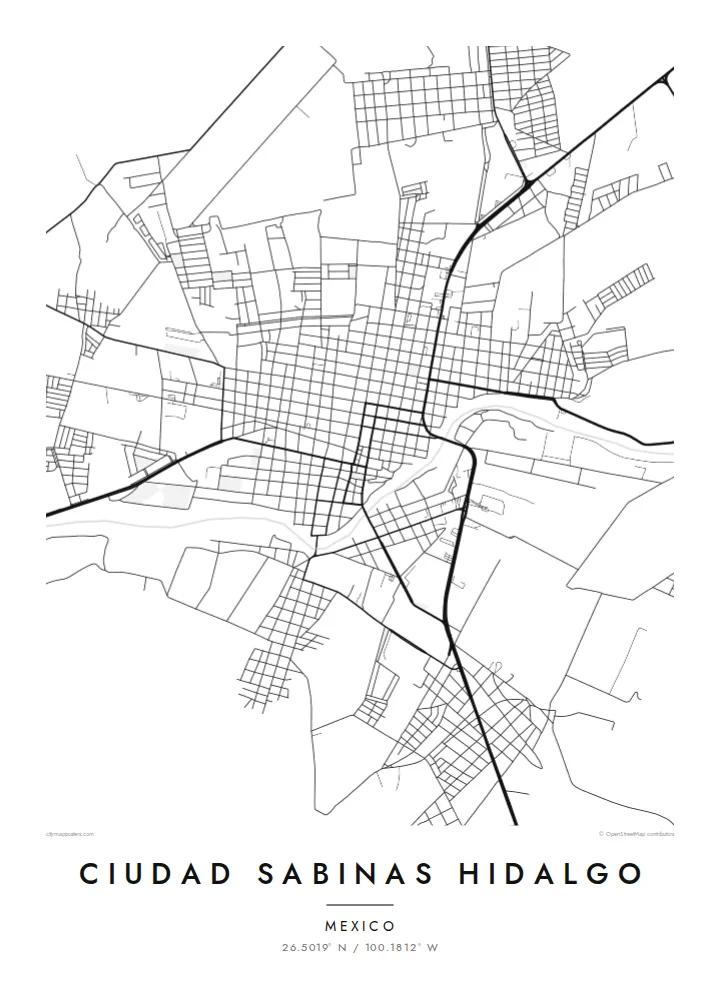
Ciudad Sabinas Hidalgo sits in the north of Nuevo León, on the long stretch of dry country between Monterrey and the United States border. From above, the town is a tight cluster of rectangular blocks set against open scrubland. The Sabinas River, which gives the town its name, runs along one side, and a green line of trees follows its banks.
The main road north runs close to the town, a long straight stroke across the plain that links Monterrey with the border crossings. The streets meet it at a slight angle. The core is laid out as an even grid around a central square, and the blocks get looser toward the edges, where lots and fields take over.
A Ciudad Sabinas Hidalgo map poster shows how much order a small place can hold. There is a firm rectangle of streets, one winding river and a highway that seems to go on forever. With so few elements, the composition reads clearly even at the smallest print size, and the empty land around the town gives it room.
The river bends along the town's edge. Its curve is the one soft line in a drawing otherwise made of straight streets, and it marks where the built-up blocks end.
The historic centre follows a regular grid of near-square blocks around the main plaza, the pattern used across northern Mexico. On paper it reads as a fine, even mesh.
The highway toward the border runs past the town as a long, unbroken line. It adds direction to the poster and a reminder of the town's place on an important route.
Fai mo oe
Faʻaopoopo se aso, se igoa po o sau lava upu, sui le sitaili, lapoʻa po o le itu.
O le preview e leai se totogi e maualalo le resolution ma iai se watermark. O lolomi ma faila HD e faia i le 300 DPI, e oo atu i le 7,200 × 10,800 px, e aunoa ma se watermark.
Aisea Ciudad Sabinas Hidalgo
People who grew up in Sabinas Hidalgo, or whose families come from there, often want something that shows the town as it is: small, orderly and tied to its river. A map shows that plainly, with no postcard sentiment.
You can personalise the title, subtitle and coordinates line, for example with a family name or the year someone left for Monterrey. Then choose one of five styles: Classic black & white, Noir, Paper, Blueprint or Sand.
Faatau le posita Ciudad Sabinas Hidalgo| Lapoʻa lolomi | Manino | Faila |
|---|---|---|
| 30 × 40 cm11.8 × 15.7″ | 3,543 × 4,724 px | PNG · PDF |
| 29.7 × 42 cm (A3)11.7 × 16.5″ | 3,508 × 4,961 px | PNG · PDF |
| 42 × 59.4 cm (A2)16.5 × 23.4″ | 4,961 × 7,016 px | PNG · PDF |
| 45.7 × 61 cm18 × 24″ | 5,400 × 7,200 px | PNG · PDF |
| 50 × 70 cm19.7 × 27.6″ | 5,906 × 8,268 px | PNG · PDF |
| 61 × 91.4 cm24 × 36″ | 7,200 × 10,800 px | PNG · PDF |
Ae faʻatusatusa, o le faʻataʻitaʻiga e leai se totogi e 900 px le lautele, e iai le faʻailoga vai ma e mo mata. O faila HD e oʻo atu i le 8× le manino i itu taʻitasi ma e lolomi manino i le lapoʻa atoa o le posta.
Filifili se sitaili i le pito i luga o le itulau, ona filifili lea o le Posita Lolomi — se lapopoa ma, afai e te fiafia, se faavaa — po o Faila HD Numera. E na o le tasi laasaga o le Checkout, ma o le a fesuia'i lou itulau o oka i le taimi lava e mae'a ai le totogi.
E lolomiina i luga o pepa matte maualuga le tulaga e 200 gsm, i se tasi o lapopoa e ono, mai le 30 × 40 cm i le 24 × 36″. E amata le tau o posita lolomi mai le $39, aofia ai le auina atu.
Ioe. Filifili se faavaa laau malosi i le lanu uliuli, sina, oak masani, po o le laau pogisa. E aofia ai se tioata e le gau ma ua saunia e tautau i luga. E amata le tau o posita faavaa mai le $99, aofia ai le auina atu.
E leai se totogi o le auina atu i atunuu e 60+. O pepa ata taʻitasi e lolomiina e le tasi o matou paaga lolomi e latalata mai i atunuu e 30+, ma e masani ona taunuu i le 3–7 aso faigaluega. E mafai ona e mulimulitaia le tulaga ma le sailiga i lalo o My Orders. O nisi atunuu e 2–5 vaiaso, ma i nofoaga e lei matou auina atu iai, e taʻu atu e le saite ia te oe a o lei totogi.
Auina mai se ata i totonu o le 14 aso talu ona taunuu, ma o le a matou toe lolomiina e leai se totogi po o le toe faafoi atu lau tupe.
Ioe. I totonu o le editor i lenei itulau, suia le ulutala, le ulutala laititi ma le laina o coordinates i soo se mea e te fiafia i ai, ma filifili se sitaili ma le lapopoa. O oka lolomi, faavaa ma numera e faaaoga uma lava lau mamanu.
Mo le $9 e te maua ai faila PNG 300 DPI ma PDF ua saunia mo le lolomi i lapopoa uma e ono, e aunoa ma se watermark, e mafai ona lolomi i soo se mea. Le mautinoa lava? Download muamua se preview e leai se totogi ma le watermark.
Latalata ane
