Barrancas
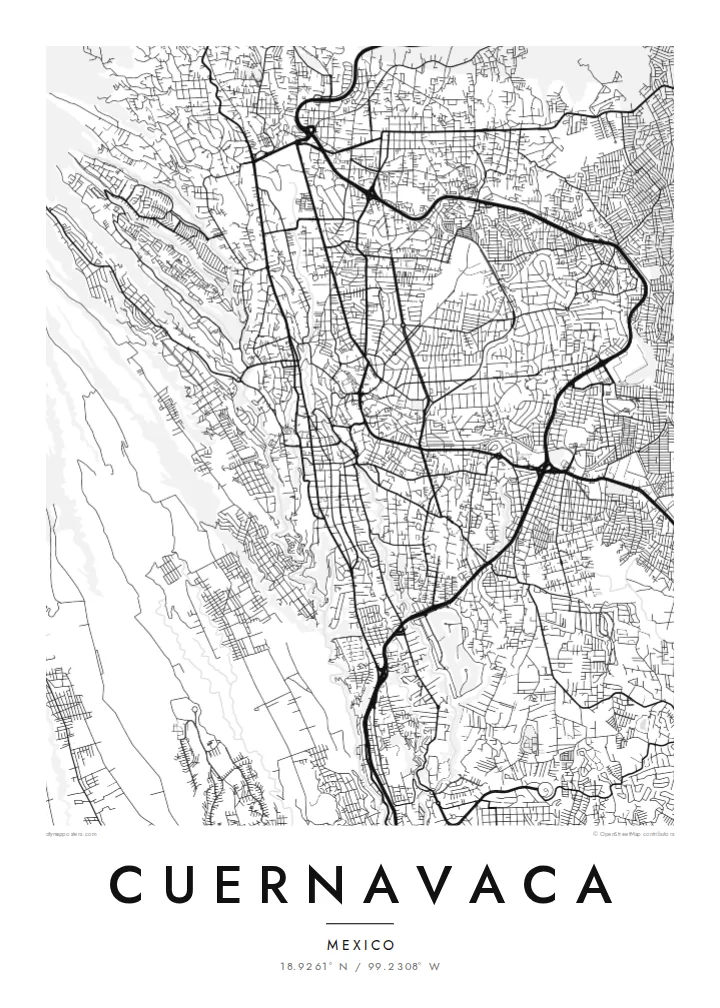
Deep ravines run roughly north to south across the city, appearing on the map as winding gaps that divide neighbourhoods and give Cuernavaca its distinctive pattern.
Posta faʻafanua faigofie · Mexico
18.9261° N / 99.2308° W
A hillside city south of Mexico City, sloping down from forested heights and cut by deep ravines running north to south.


Tasi le aai, lagona e lima
Tapi se sitaili e vaai ai i luga o le puipui. E tutusa uma le tau o sitaili — pe lolomiina, faapipiiina, pe avea ma faila HD.
 Pika Moni · Faila Lolomi 24 × 36″
Manino mo le lolomi
O se vaega atoa (100%) lenei mai le faila lolomi moni. O posita uma — pe lolomiina, faapipiiina pe download mai — e faia i luga o a matou server i le 300 DPI, e oo atu i le 7,200 × 10,800 pika, ina ia manino pea auala laiti i luga o se lolomiga 24 × 36″.
I luga o le puipui


Le faʻafanua
Cuernavaca, the capital of Morelos, lies on the southern slopes of the mountains that separate it from Mexico City. Its map is shaped by terrain: the city descends from north to south, and deep ravines, known locally as barrancas, run through it in the same direction. Streets follow the ridges between them, so many neighbourhoods are long and narrow rather than square.
Its mild climate earned it the nickname City of Eternal Spring, and it has long drawn residents and visitors from the capital. The historic centre includes the Palace of Cortés, one of the oldest surviving colonial civil buildings in the Americas, and the cathedral complex, part of a UNESCO listing of early sixteenth-century monasteries. The Jardín Borda lies nearby.
A Cuernavaca map poster makes this unusual structure visible. The barrancas appear as winding breaks in the urban fabric, the streets thread along the ridges, and the centre sits as a denser knot among them. In clean black and white lines, the city looks almost like a leaf with its veins, a design that rewards a second look.
Deep ravines run roughly north to south across the city, appearing on the map as winding gaps that divide neighbourhoods and give Cuernavaca its distinctive pattern.
Main roads and residential streets follow the high ground between the ravines, producing long, parallel neighbourhoods rather than a conventional grid.
Around the Palace of Cortés and the cathedral, the older streets form a compact core, a denser area where the colonial layout is still readable.
Fai mo oe
Faʻaopoopo se aso, se igoa po o sau lava upu, sui le sitaili, lapoʻa po o le itu.
O le preview e leai se totogi e maualalo le resolution ma iai se watermark. O lolomi ma faila HD e faia i le 300 DPI, e oo atu i le 7,200 × 10,800 px, e aunoa ma se watermark.
Aisea Cuernavaca
Cuernavaca is a place of weekend homes, family gatherings and long stays in gentle weather. Its map carries those memories in a form that is both graphic and precise, which is why it works equally well as a gift or a personal keepsake.
Change the title, subtitle and coordinates line to mark a house, a wedding or a year spent there, and choose one of five styles: Classic black and white, Noir, Paper, Blueprint or Sand. Download HD files for $9 or order a printed, framed poster.
Faatau le posita Cuernavaca| Lapoʻa lolomi | Manino | Faila |
|---|---|---|
| 30 × 40 cm (11.8 × 15.7″) | 3,543 × 4,724 px | PNG · PDF |
| 29.7 × 42 cm (A3, 11.7 × 16.5″) | 3,508 × 4,961 px | PNG · PDF |
| 42 × 59.4 cm (A2, 16.5 × 23.4″) | 4,961 × 7,016 px | PNG · PDF |
| 45.7 × 61 cm (18 × 24″) | 5,400 × 7,200 px | PNG · PDF |
| 50 × 70 cm (19.7 × 27.6″) | 5,906 × 8,268 px | PNG · PDF |
| 61 × 91.4 cm (24 × 36″) | 7,200 × 10,800 px | PNG · PDF |
Ae faʻatusatusa, o le faʻataʻitaʻiga e leai se totogi e 900 px le lautele, e iai le faʻailoga vai ma e mo mata. O faila HD e oʻo atu i le 8× le manino i itu taʻitasi ma e lolomi manino i le lapoʻa atoa o le posta.
Filifili se sitaili i le pito i luga o le itulau, ona filifili lea o le Posita Lolomi — se lapopoa ma, afai e te fiafia, se faavaa — po o Faila HD Numera. E na o le tasi laasaga o le Checkout, ma o le a fesuia'i lou itulau o oka i le taimi lava e mae'a ai le totogi.
E lolomiina i luga o pepa matte maualuga le tulaga e 200 gsm, i se tasi o lapopoa e ono, mai le 30 × 40 cm i le 24 × 36″. E amata le tau o posita lolomi mai le {printFrom}, aofia ai le auina atu.
Ioe. Filifili se faavaa laau malosi i le lanu uliuli, sina, oak masani, po o le laau pogisa. E aofia ai se tioata e le gau ma ua saunia e tautau i luga. E amata le tau o posita faavaa mai le {framedFrom}, aofia ai le auina atu.
E leai se totogi mo le uta i le lalolagi atoa. O poster ta'itasi e lolomi e le paaga lolomi e latalata mai i matou i atunuu e 30+, ma e masani ona taunuu i aso faigaluega e 3–7. E mafai ona e mulimuli i le tulaga ma le tracking i le "Aʻu Oka". O nisi atunuu e 2–5 vaiaso, ma i atunuu matou te lei tuuina atu ai, e taʻu atu e le saite iā te oe ae e te leʻi totogiina.
Auina mai se ata i totonu o le 14 aso talu ona taunuu, ma o le a matou toe lolomiina e leai se totogi po o le toe faafoi atu lau tupe.
Ioe. I totonu o le editor i lenei itulau, suia le ulutala, le ulutala laititi ma le laina o coordinates i soo se mea e te fiafia i ai, ma filifili se sitaili ma le lapopoa. O oka lolomi, faavaa ma numera e faaaoga uma lava lau mamanu.
Mo le $9 e te maua ai faila PNG 300 DPI ma PDF ua saunia mo le lolomi i lapopoa uma e ono, e aunoa ma se watermark, e mafai ona lolomi i soo se mea. Le mautinoa lava? Download muamua se preview e leai se totogi ma le watermark.
