Old town core
Near the centre, narrow streets and small blocks follow the older pattern of the village, forming a dense cluster that stands out against the wider layout around it.
Posta faʻafanua faigofie · Mexico
18.8814° N / 99.1778° W
A warm-valley city east of Cuernavaca, where an old village core meets a planned industrial zone and new housing.




Tasi le aai, lagona e lima
Tapi se sitaili e vaai ai i luga o le puipui. E tutusa uma le tau o sitaili — pe lolomiina, faapipiiina, pe avea ma faila HD.
 Pika Moni · Faila Lolomi 24 × 36″
Manino mo le lolomi
O se vaega atoa (100%) lenei mai le faila lolomi moni. O posita uma — pe lolomiina, faapipiiina pe download mai — e faia i luga o a matou server i le 300 DPI, e oo atu i le 7,200 × 10,800 pika, ina ia manino pea auala laiti i luga o se lolomiga 24 × 36″.
I luga o le puipui


Le faʻafanua
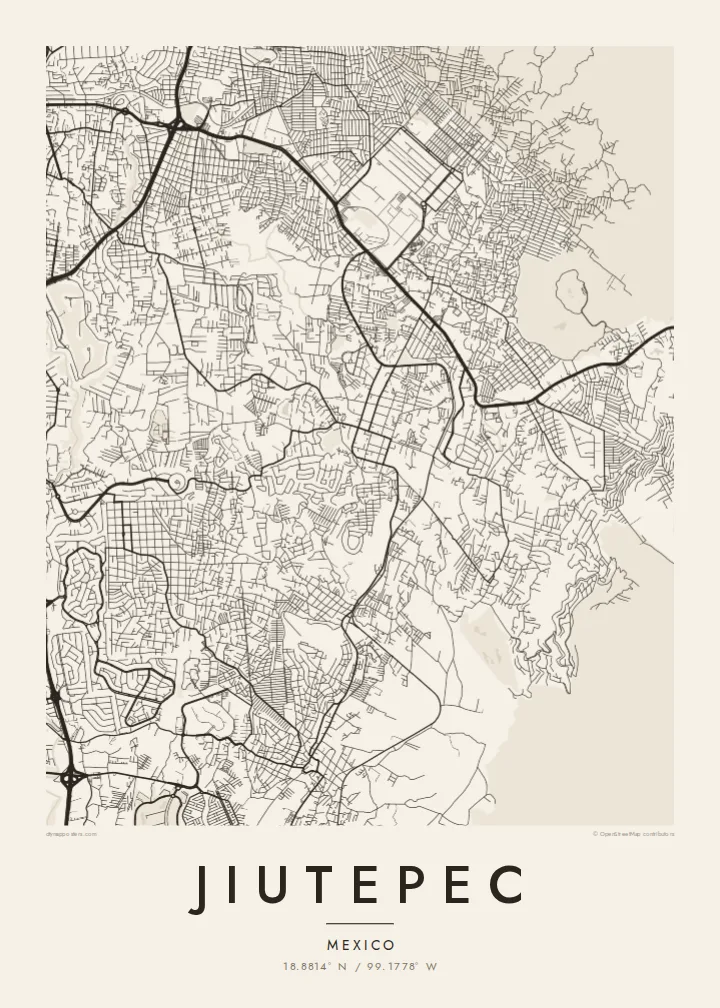
Jiutepec lies in the state of Morelos in central Mexico, directly east of Cuernavaca and now part of its wider metropolitan area. On a map the city spreads across gently sloping land in the Cuernavaca valley, with the streets of the older centre surrounded by newer residential districts and an extensive industrial zone. The boundaries between Jiutepec and its neighbours are hard to see, as the built-up area runs continuously.
In the 1960s the Ciudad Industrial del Valle de Cuernavaca, known as CIVAC, was established here, and it drove Jiutepec's growth into one of the most populous municipalities in Morelos. Before that the area was mainly agricultural, and traces of the older village layout remain near the centre. The mild climate of the valley has also drawn steady residential development.
A Jiutepec map poster shows a city in transition: an older core with irregular streets, the broad, regular blocks of the industrial zone and neighbourhoods that curve around ravines and slopes. It is a varied map, full of texture, and a fitting picture of how cities in central Mexico have grown outward from their older towns.
Near the centre, narrow streets and small blocks follow the older pattern of the village, forming a dense cluster that stands out against the wider layout around it.
The planned industrial city occupies a large area with long, straight roads and wide plots, giving part of the map a clear geometric order.
Barrancas and changes in elevation shape the outer neighbourhoods, where streets curve and branch to follow the land instead of forming a straight grid.
Fai mo oe
Faʻaopoopo se aso, se igoa po o sau lava upu, sui le sitaili, lapoʻa po o le itu.
O le preview e leai se totogi e maualalo le resolution ma iai se watermark. O lolomi ma faila HD e faia i le 300 DPI, e oo atu i le 7,200 × 10,800 px, e aunoa ma se watermark.
Aisea Jiutepec
Jiutepec is hung by families who have lived in Morelos for generations, people who worked in CIVAC and residents who moved to the valley for its climate. The map records a place that is home to many but rarely pictured.
Change the title, subtitle and coordinates line to include your colonia or a date, and choose one of five styles: Classic black & white, Noir, Paper, Blueprint or Sand. Printed posters ship from partners in more than 30 countries.
Faatau le posita Jiutepec| Lapoʻa lolomi | Manino | Faila |
|---|---|---|
| 30 × 40 cm (11.8 × 15.7″) | 3,543 × 4,724 px | PNG · PDF |
| 29.7 × 42 cm (A3, 11.7 × 16.5″) | 3,508 × 4,961 px | PNG · PDF |
| 42 × 59.4 cm (A2, 16.5 × 23.4″) | 4,961 × 7,016 px | PNG · PDF |
| 45.7 × 61 cm (18 × 24″) | 5,400 × 7,200 px | PNG · PDF |
| 50 × 70 cm (19.7 × 27.6″) | 5,906 × 8,268 px | PNG · PDF |
| 61 × 91.4 cm (24 × 36″) | 7,200 × 10,800 px | PNG · PDF |
Ae faʻatusatusa, o le faʻataʻitaʻiga e leai se totogi e 900 px le lautele, e iai le faʻailoga vai ma e mo mata. O faila HD e oʻo atu i le 8× le manino i itu taʻitasi ma e lolomi manino i le lapoʻa atoa o le posta.
Filifili se sitaili i le pito i luga o le itulau, ona filifili lea o le Posita Lolomi — se lapopoa ma, afai e te fiafia, se faavaa — po o Faila HD Numera. E na o le tasi laasaga o le Checkout, ma o le a fesuia'i lou itulau o oka i le taimi lava e mae'a ai le totogi.
E lolomiina i luga o pepa matte maualuga le tulaga e 200 gsm, i se tasi o lapopoa e ono, mai le 30 × 40 cm i le 24 × 36″. E amata le tau o posita lolomi mai le $39, aofia ai le auina atu.
Ioe. Filifili se faavaa laau malosi i le lanu uliuli, sina, oak masani, po o le laau pogisa. E aofia ai se tioata e le gau ma ua saunia e tautau i luga. E amata le tau o posita faavaa mai le $99, aofia ai le auina atu.
E leai se totogi mo le uta i le lalolagi atoa. O poster ta'itasi e lolomi e le paaga lolomi e latalata mai i matou i atunuu e 30+, ma e masani ona taunuu i aso faigaluega e 3–7. E mafai ona e mulimuli i le tulaga ma le tracking i le "Aʻu Oka". O nisi atunuu e 2–5 vaiaso, ma i atunuu matou te lei tuuina atu ai, e taʻu atu e le saite iā te oe ae e te leʻi totogiina.
Auina mai se ata i totonu o le 14 aso talu ona taunuu, ma o le a matou toe lolomiina e leai se totogi po o le toe faafoi atu lau tupe.
Ioe. I totonu o le editor i lenei itulau, suia le ulutala, le ulutala laititi ma le laina o coordinates i soo se mea e te fiafia i ai, ma filifili se sitaili ma le lapopoa. O oka lolomi, faavaa ma numera e faaaoga uma lava lau mamanu.
Mo le $9 e te maua ai faila PNG 300 DPI ma PDF ua saunia mo le lolomi i lapopoa uma e ono, e aunoa ma se watermark, e mafai ona lolomi i soo se mea. Le mautinoa lava? Download muamua se preview e leai se totogi ma le watermark.
