Bazaar spine
The long covered bazaar runs through the historic centre as a single unbroken line, with narrow lanes and courtyards branching off it on both sides.
Posta faʻafanua faigofie · Iran
30.2832° N / 57.0788° E
A desert city on a high plateau, with its long covered bazaar forming a spine through the old centre.


Tasi le aai, lagona e lima
Tapi se sitaili e vaai ai i luga o le puipui. E tutusa uma le tau o sitaili — pe lolomiina, faapipiiina, pe avea ma faila HD.
 Pika Moni · Faila Lolomi 24 × 36″
Manino mo le lolomi
O se vaega atoa (100%) lenei mai le faila lolomi moni. O posita uma — pe lolomiina, faapipiiina pe download mai — e faia i luga o a matou server i le 300 DPI, e oo atu i le 7,200 × 10,800 pika, ina ia manino pea auala laiti i luga o se lolomiga 24 × 36″.
I luga o le puipui
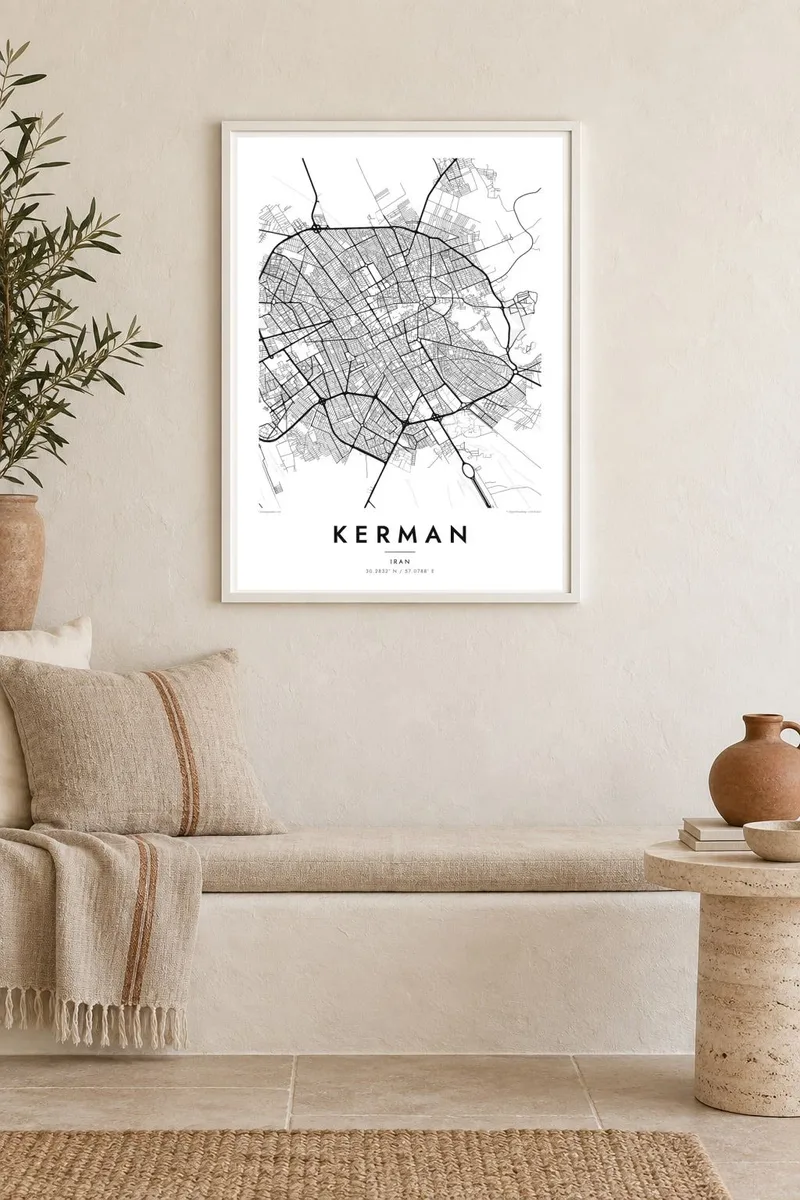
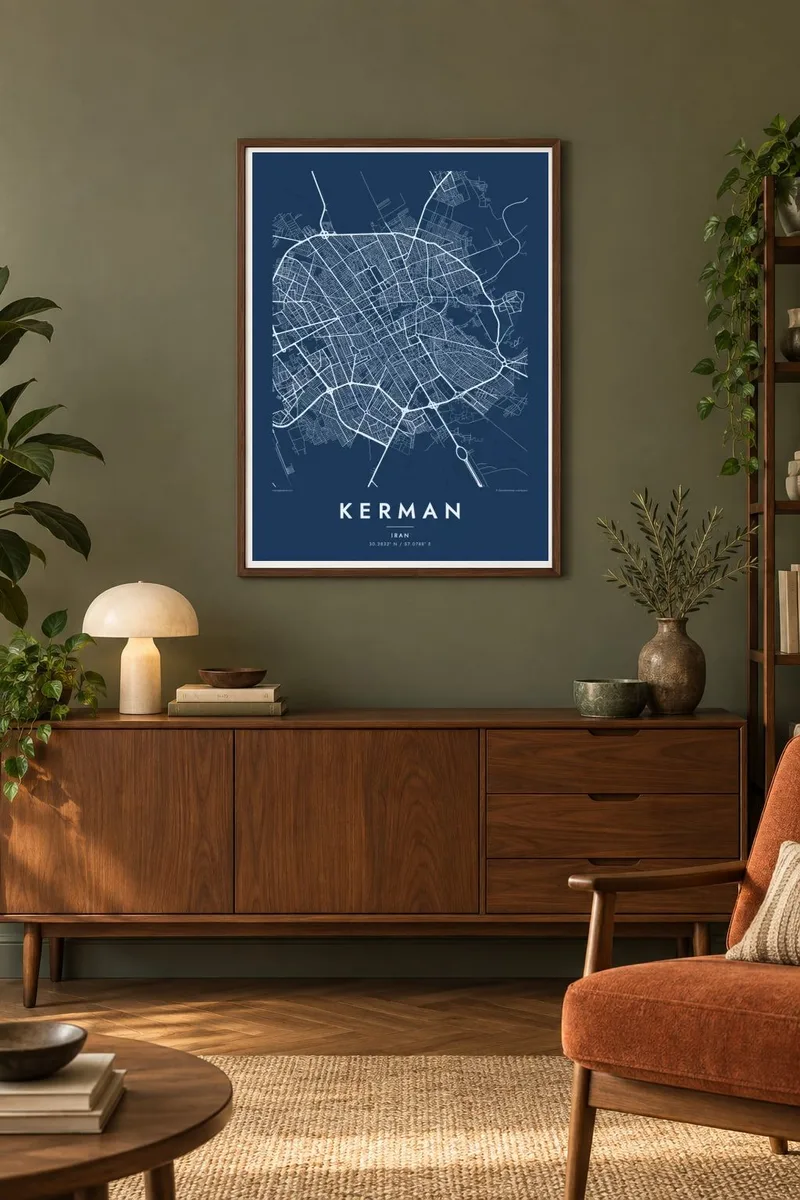
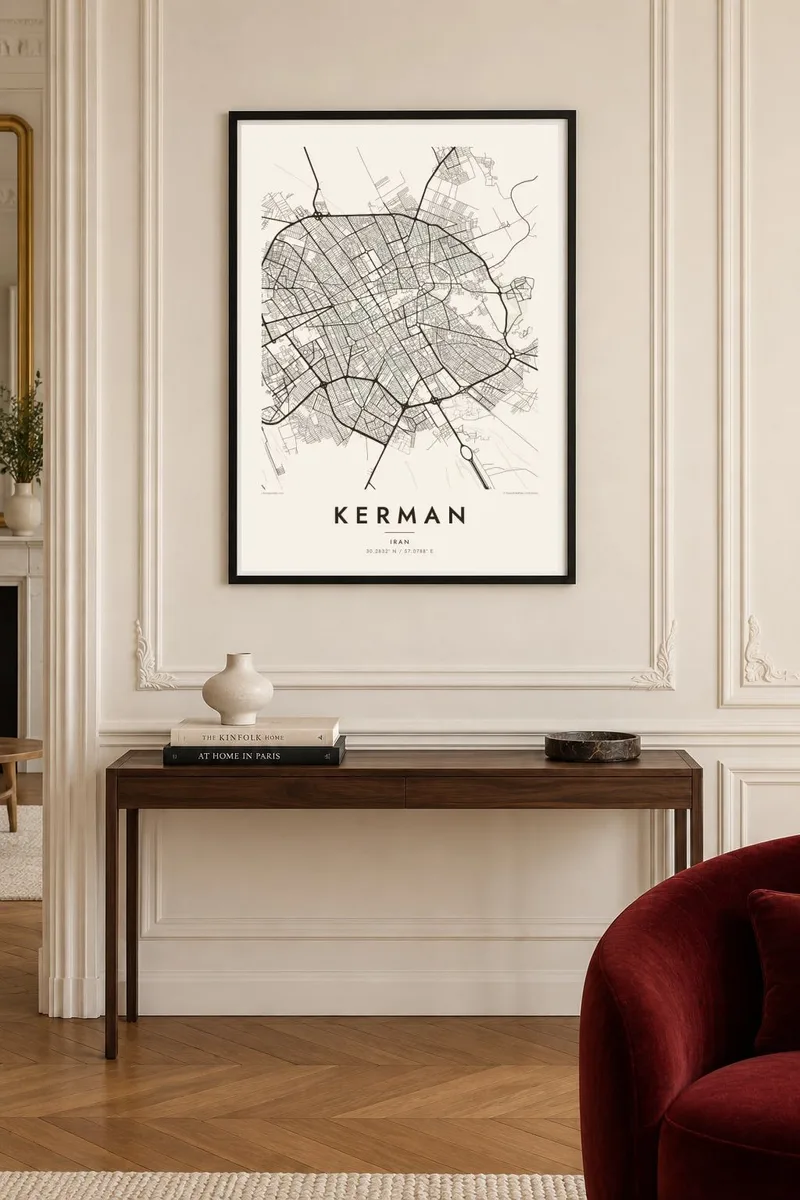
Le faʻafanua
Kerman sits at around 1,750 metres on a plateau in southeastern Iran, with the Lut Desert beyond the mountains to the east. On a map the city spreads across open, arid ground in a broad and fairly regular pattern of avenues and blocks. Its edges are set not by rivers or coasts but by the dry landscape and the ridges that frame it.
The historic core is built around the bazaar, one of the longest in Iran, a covered route running roughly east to west through the old city. Along it lies the Ganjali Khan complex, a Safavid-era group of square, bathhouse and caravanserai. On the map the bazaar appears as one unbroken thread, with finer lanes branching off on either side.
The city is known for its carpets and for the pistachio orchards of the surrounding province. A Kerman map poster reduces this desert city to its essential lines. It shows how the old bazaar spine meets the wider modern avenues, and how the built area gives way at its edges to open land, the plateau and distant mountains.
The long covered bazaar runs through the historic centre as a single unbroken line, with narrow lanes and courtyards branching off it on both sides.
A rectangular Safavid-era square along the bazaar, surrounded by a bathhouse, mosque and caravanserai, forms a clear geometric opening in the dense old streets.
At the city's edges the street pattern thins out quickly into open, arid land, leaving a strong contrast between the built area and the empty plateau.
Fai mo oe
Faʻaopoopo se aso, se igoa po o sau lava upu, sui le sitaili, lapoʻa po o le itu.
O le preview e leai se totogi e maualalo le resolution ma iai se watermark. O lolomi ma faila HD e faia i le 300 DPI, e oo atu i le 7,200 × 10,800 px, e aunoa ma se watermark.
Aisea Kerman
Kerman is a city of long histories and quiet courtyards. For people from the region it carries memories of carpets, pistachios and desert light, and a map poster keeps its outline close, even far from the plateau.
Personalise the title, subtitle and coordinates line with a family name or a year that matters. Choose from Classic black & white, Noir, Paper, Blueprint or Sand, the last especially fitting for a desert city. It comes as a $9 download or a printed poster.
Faatau le posita Kerman| Lapoʻa lolomi | Manino | Faila |
|---|---|---|
| 30 × 40 cm (11.8 × 15.7″) | 3,543 × 4,724 px | PNG · PDF |
| 29.7 × 42 cm (A3, 11.7 × 16.5″) | 3,508 × 4,961 px | PNG · PDF |
| 42 × 59.4 cm (A2, 16.5 × 23.4″) | 4,961 × 7,016 px | PNG · PDF |
| 45.7 × 61 cm (18 × 24″) | 5,400 × 7,200 px | PNG · PDF |
| 50 × 70 cm (19.7 × 27.6″) | 5,906 × 8,268 px | PNG · PDF |
| 61 × 91.4 cm (24 × 36″) | 7,200 × 10,800 px | PNG · PDF |
Ae faʻatusatusa, o le faʻataʻitaʻiga e leai se totogi e 900 px le lautele, e iai le faʻailoga vai ma e mo mata. O faila HD e oʻo atu i le 8× le manino i itu taʻitasi ma e lolomi manino i le lapoʻa atoa o le posta.
Filifili se sitaili i le pito i luga o le itulau, ona filifili lea o le Posita Lolomi — se lapopoa ma, afai e te fiafia, se faavaa — po o Faila HD Numera. E na o le tasi laasaga o le Checkout, ma o le a fesuia'i lou itulau o oka i le taimi lava e mae'a ai le totogi.
E lolomiina i luga o pepa matte maualuga le tulaga e 200 gsm, i se tasi o lapopoa e ono, mai le 30 × 40 cm i le 24 × 36″. E amata le tau o posita lolomi mai le {printFrom}, aofia ai le auina atu.
Ioe. Filifili se faavaa laau malosi i le lanu uliuli, sina, oak masani, po o le laau pogisa. E aofia ai se tioata e le gau ma ua saunia e tautau i luga. E amata le tau o posita faavaa mai le {framedFrom}, aofia ai le auina atu.
E leai se totogi mo le uta i le lalolagi atoa. O poster ta'itasi e lolomi e le paaga lolomi e latalata mai i matou i atunuu e 30+, ma e masani ona taunuu i aso faigaluega e 3–7. E mafai ona e mulimuli i le tulaga ma le tracking i le "Aʻu Oka". O nisi atunuu e 2–5 vaiaso, ma i atunuu matou te lei tuuina atu ai, e taʻu atu e le saite iā te oe ae e te leʻi totogiina.
Auina mai se ata i totonu o le 14 aso talu ona taunuu, ma o le a matou toe lolomiina e leai se totogi po o le toe faafoi atu lau tupe.
Ioe. I totonu o le editor i lenei itulau, suia le ulutala, le ulutala laititi ma le laina o coordinates i soo se mea e te fiafia i ai, ma filifili se sitaili ma le lapopoa. O oka lolomi, faavaa ma numera e faaaoga uma lava lau mamanu.
Mo le $9 e te maua ai faila PNG 300 DPI ma PDF ua saunia mo le lolomi i lapopoa uma e ono, e aunoa ma se watermark, e mafai ona lolomi i soo se mea. Le mautinoa lava? Download muamua se preview e leai se totogi ma le watermark.
