Mountain edge
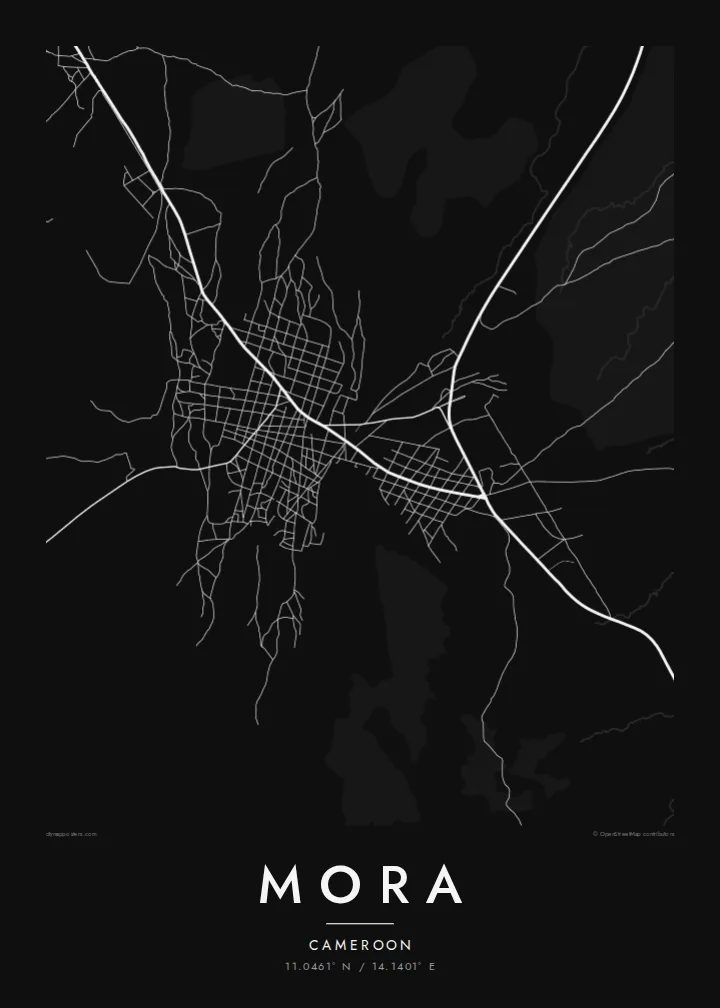
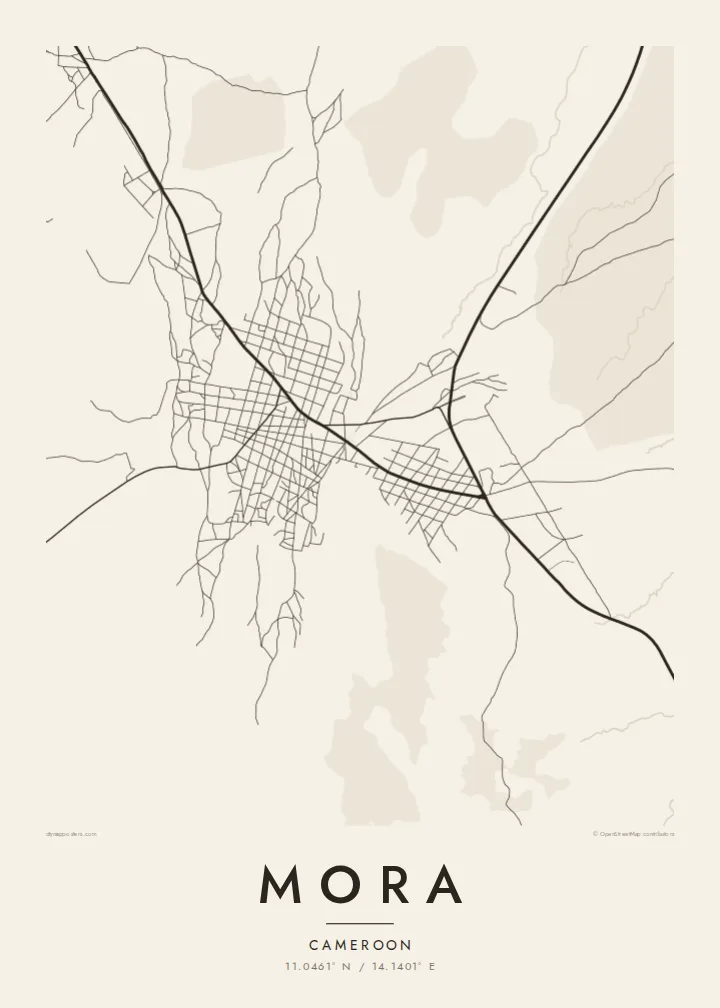
The Mandara Mountains rise close to the town, and the map shows the change from dense streets to sparse tracks where the ground becomes steep.
Posta faʻafanua faigofie · Cameroon
11.0461° N / 14.1401° E
A Sahel market town at the foot of the Mandara Mountains, where rocky slopes meet flat northern plains



Tasi le aai, lagona e lima
Tapi se sitaili e vaai ai i luga o le puipui. E tutusa uma le tau o sitaili — pe lolomiina, faapipiiina, pe avea ma faila HD.
 Pika Moni · Faila Lolomi 24 × 36″
Manino mo le lolomi
O se vaega atoa (100%) lenei mai le faila lolomi moni. O posita uma — pe lolomiina, faapipiiina pe download mai — e faia i luga o a matou server i le 300 DPI, e oo atu i le 7,200 × 10,800 pika, ina ia manino pea auala laiti i luga o se lolomiga 24 × 36″.
I luga o le puipui


Le faʻafanua
Mora is a town in the Far North Region of Cameroon, close to the border with Nigeria. It sits where the Mandara Mountains give way to the flat plains that stretch toward Lake Chad. On a map, that contrast is immediate: to one side, broken high ground with few roads; to the other, open country crossed by straight tracks. The town gathers between them.
The street pattern is simple and low. A few main roads lead into the centre, and around them lie compounds and lanes arranged loosely rather than in a strict grid. Seasonal watercourses cut across the surrounding land, dry for much of the year and visible on the map as thin, wandering lines. The overall impression is of a small settlement shaped by terrain and climate.
Mora is the administrative seat of its department and a meeting point for people from the mountain villages and the plains. A Mora map poster renders this setting in fine black lines on plain paper: the gathering of streets in the middle, roads reaching out across the lowland, and the quieter, more irregular ground where the hills begin to rise.
The Mandara Mountains rise close to the town, and the map shows the change from dense streets to sparse tracks where the ground becomes steep.
Long, fairly straight routes run out across the flat northern country, giving the poster clear directional lines leading away from the centre.
Thin, winding channels cross the land around Mora, tracing where water runs in the rainy season and adding soft curves to the composition.
Fai mo oe
Faʻaopoopo se aso, se igoa po o sau lava upu, sui le sitaili, lapoʻa po o le itu.
O le preview e leai se totogi e maualalo le resolution ma iai se watermark. O lolomi ma faila HD e faia i le 300 DPI, e oo atu i le 7,200 × 10,800 px, e aunoa ma se watermark.
Aisea Mora
A map of Mora suits anyone with roots in the Far North or memories of time spent there. It shows the town as it is placed in the land, between hills and plains, without the need for any landmark to explain it.
The title, subtitle and coordinates line can all be personalised, and the design comes in five styles: Classic black & white, Noir, Paper, Blueprint and Sand. Sand in particular echoes the dry-season colours of the region.
Faatau le posita Mora| Lapoʻa lolomi | Manino | Faila |
|---|---|---|
| 30 × 40 cm (11.8 × 15.7″) | 3,543 × 4,724 px | PNG · PDF |
| 29.7 × 42 cm (A3, 11.7 × 16.5″) | 3,508 × 4,961 px | PNG · PDF |
| 42 × 59.4 cm (A2, 16.5 × 23.4″) | 4,961 × 7,016 px | PNG · PDF |
| 45.7 × 61 cm (18 × 24″) | 5,400 × 7,200 px | PNG · PDF |
| 50 × 70 cm (19.7 × 27.6″) | 5,906 × 8,268 px | PNG · PDF |
| 61 × 91.4 cm (24 × 36″) | 7,200 × 10,800 px | PNG · PDF |
Ae faʻatusatusa, o le faʻataʻitaʻiga e leai se totogi e 900 px le lautele, e iai le faʻailoga vai ma e mo mata. O faila HD e oʻo atu i le 8× le manino i itu taʻitasi ma e lolomi manino i le lapoʻa atoa o le posta.
Filifili se sitaili i le pito i luga o le itulau, ona filifili lea o le Posita Lolomi — se lapopoa ma, afai e te fiafia, se faavaa — po o Faila HD Numera. E na o le tasi laasaga o le Checkout, ma o le a fesuia'i lou itulau o oka i le taimi lava e mae'a ai le totogi.
E lolomiina i luga o pepa matte maualuga le tulaga e 200 gsm, i se tasi o lapopoa e ono, mai le 30 × 40 cm i le 24 × 36″. E amata le tau o posita lolomi mai le {printFrom}, aofia ai le auina atu.
Ioe. Filifili se faavaa laau malosi i le lanu uliuli, sina, oak masani, po o le laau pogisa. E aofia ai se tioata e le gau ma ua saunia e tautau i luga. E amata le tau o posita faavaa mai le {framedFrom}, aofia ai le auina atu.
E leai se totogi mo le uta i le lalolagi atoa. O poster ta'itasi e lolomi e le paaga lolomi e latalata mai i matou i atunuu e 30+, ma e masani ona taunuu i aso faigaluega e 3–7. E mafai ona e mulimuli i le tulaga ma le tracking i le "Aʻu Oka". O nisi atunuu e 2–5 vaiaso, ma i atunuu matou te lei tuuina atu ai, e taʻu atu e le saite iā te oe ae e te leʻi totogiina.
Auina mai se ata i totonu o le 14 aso talu ona taunuu, ma o le a matou toe lolomiina e leai se totogi po o le toe faafoi atu lau tupe.
Ioe. I totonu o le editor i lenei itulau, suia le ulutala, le ulutala laititi ma le laina o coordinates i soo se mea e te fiafia i ai, ma filifili se sitaili ma le lapopoa. O oka lolomi, faavaa ma numera e faaaoga uma lava lau mamanu.
Mo le $9 e te maua ai faila PNG 300 DPI ma PDF ua saunia mo le lolomi i lapopoa uma e ono, e aunoa ma se watermark, e mafai ona lolomi i soo se mea. Le mautinoa lava? Download muamua se preview e leai se totogi ma le watermark.
Latalata ane
