Planned residential grid
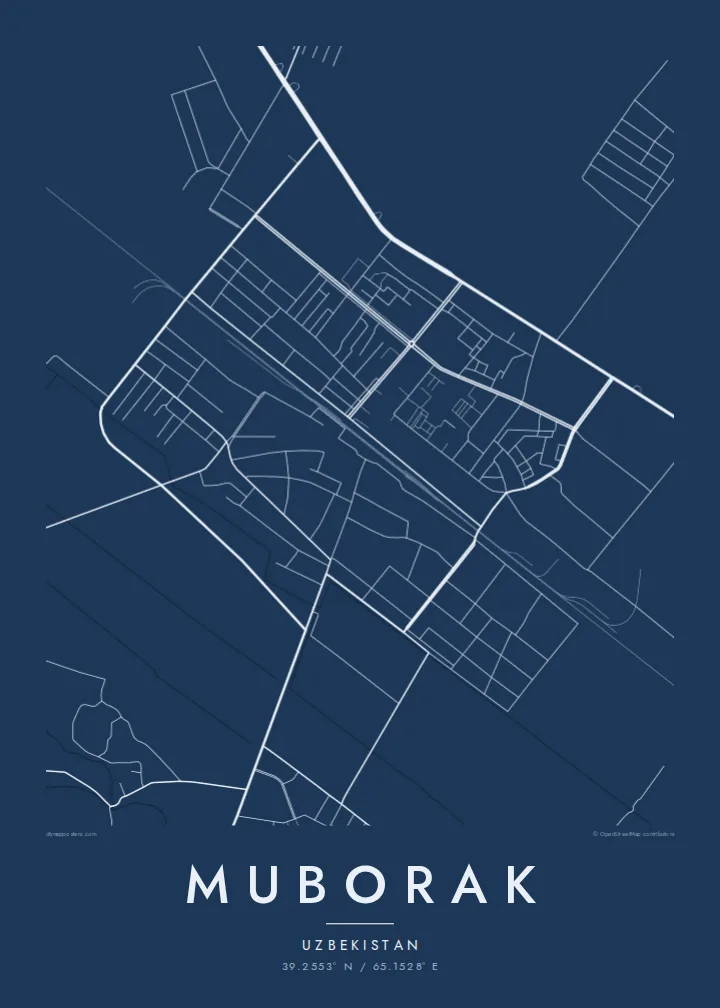
The town's housing districts follow a regular pattern of wide streets and large blocks, clear evidence of a settlement laid out as a whole rather than grown gradually.
Posta faʻafanua faigofie · Uzbekistan
39.2553° N / 65.1528° E
A gas-industry town on the dry steppe of southern Uzbekistan, its planned blocks set against wide open desert ground



Tasi le aai, lagona e lima
Tapi se sitaili e vaai ai i luga o le puipui. E tutusa uma le tau o sitaili — pe lolomiina, faapipiiina, pe avea ma faila HD.
 Pika Moni · Faila Lolomi 24 × 36″
Manino mo le lolomi
O se vaega atoa (100%) lenei mai le faila lolomi moni. O posita uma — pe lolomiina, faapipiiina pe download mai — e faia i luga o a matou server i le 300 DPI, e oo atu i le 7,200 × 10,800 pika, ina ia manino pea auala laiti i luga o se lolomiga 24 × 36″.
I luga o le puipui


Le faʻafanua
Muborak lies in Qashqadaryo region in southern Uzbekistan, northwest of Karshi, on the arid plains that stretch toward the Kyzylkum. The town grew with the development of natural gas fields in the area. It is closely associated with a large gas processing plant and a thermal power station, two of the major industrial sites in the region.
The map reflects that planned, industrial origin. Residential districts are laid out in regular blocks, with broad streets and spacious courtyards typical of late Soviet-era construction. The industrial complexes sit apart from the housing, and they are linked by roads, rail spurs and pipelines that run in long straight lines across the flat, open land.
A Muborak map poster is an image of order set in space. The rectilinear town sits almost alone on the sheet, and around it the steppe opens out with only occasional tracks and canals. The composition is sparse and geometric. It appeals to people who worked in the gas industry here and to anyone drawn to the graphic clarity of planned towns.
The town's housing districts follow a regular pattern of wide streets and large blocks, clear evidence of a settlement laid out as a whole rather than grown gradually.
The gas processing plant and power station occupy large separate areas outside the town, appearing on the map as big, precise shapes linked by service roads.
Beyond the town, the dry plain leaves most of the map empty, crossed only by a few straight roads, rail lines and irrigation channels.
Fai mo oe
Faʻaopoopo se aso, se igoa po o sau lava upu, sui le sitaili, lapoʻa po o le itu.
O le preview e leai se totogi e maualalo le resolution ma iai se watermark. O lolomi ma faila HD e faia i le 300 DPI, e oo atu i le 7,200 × 10,800 px, e aunoa ma se watermark.
Aisea Muborak
For families who came to Muborak to work in the gas fields, or who grew up in its apartment blocks, this map is a direct portrait of home. Its clean, planned lines also make it a strong graphic piece in a modern interior.
Personalise the title, subtitle and coordinates line with a name, a year or a dedication. Then choose one of five styles, Classic black & white, Noir, Paper, Blueprint or Sand, to finish it.
Faatau le posita Muborak| Lapoʻa lolomi | Manino | Faila |
|---|---|---|
| 30 × 40 cm11.8 × 15.7″ | 3,543 × 4,724 px | PNG · PDF |
| 29.7 × 42 cm (A3)11.7 × 16.5″ | 3,508 × 4,961 px | PNG · PDF |
| 42 × 59.4 cm (A2)16.5 × 23.4″ | 4,961 × 7,016 px | PNG · PDF |
| 45.7 × 61 cm18 × 24″ | 5,400 × 7,200 px | PNG · PDF |
| 50 × 70 cm19.7 × 27.6″ | 5,906 × 8,268 px | PNG · PDF |
| 61 × 91.4 cm24 × 36″ | 7,200 × 10,800 px | PNG · PDF |
Ae faʻatusatusa, o le faʻataʻitaʻiga e leai se totogi e 900 px le lautele, e iai le faʻailoga vai ma e mo mata. O faila HD e oʻo atu i le 8× le manino i itu taʻitasi ma e lolomi manino i le lapoʻa atoa o le posta.
Filifili se sitaili i le pito i luga o le itulau, ona filifili lea o le Posita Lolomi — se lapopoa ma, afai e te fiafia, se faavaa — po o Faila HD Numera. E na o le tasi laasaga o le Checkout, ma o le a fesuia'i lou itulau o oka i le taimi lava e mae'a ai le totogi.
E lolomiina i luga o pepa matte maualuga le tulaga e 200 gsm, i se tasi o lapopoa e ono, mai le 30 × 40 cm i le 24 × 36″. E amata le tau o posita lolomi mai le $39, aofia ai le auina atu.
Ioe. Filifili se faavaa laau malosi i le lanu uliuli, sina, oak masani, po o le laau pogisa. E aofia ai se tioata e le gau ma ua saunia e tautau i luga. E amata le tau o posita faavaa mai le $99, aofia ai le auina atu.
E leai se totogi o le auina atu i atunuu e 60+. O pepa ata taʻitasi e lolomiina e le tasi o matou paaga lolomi e latalata mai i atunuu e 30+, ma e masani ona taunuu i le 3–7 aso faigaluega. E mafai ona e mulimulitaia le tulaga ma le sailiga i lalo o My Orders. O nisi atunuu e 2–5 vaiaso, ma i nofoaga e lei matou auina atu iai, e taʻu atu e le saite ia te oe a o lei totogi.
Auina mai se ata i totonu o le 14 aso talu ona taunuu, ma o le a matou toe lolomiina e leai se totogi po o le toe faafoi atu lau tupe.
Ioe. I totonu o le editor i lenei itulau, suia le ulutala, le ulutala laititi ma le laina o coordinates i soo se mea e te fiafia i ai, ma filifili se sitaili ma le lapopoa. O oka lolomi, faavaa ma numera e faaaoga uma lava lau mamanu.
Mo le $9 e te maua ai faila PNG 300 DPI ma PDF ua saunia mo le lolomi i lapopoa uma e ono, e aunoa ma se watermark, e mafai ona lolomi i soo se mea. Le mautinoa lava? Download muamua se preview e leai se totogi ma le watermark.
