Higuamo estuary
The river widens as it reaches the sea along the western side of town, a broad curve of water crossed by the highway bridge toward Santo Domingo.
Posta faʻafanua faigofie · Dominican Republic
18.4539° N / 69.3086° W
A Caribbean port at the mouth of the Higuamo River, with a seafront boulevard and a compact grid of sugar-era streets.


Tasi le aai, lagona e lima
Tapi se sitaili e vaai ai i luga o le puipui. E tutusa uma le tau o sitaili — pe lolomiina, faapipiiina, pe avea ma faila HD.
 Pika Moni · Faila Lolomi 24 × 36″
Manino mo le lolomi
O se vaega atoa (100%) lenei mai le faila lolomi moni. O posita uma — pe lolomiina, faapipiiina pe download mai — e faia i luga o a matou server i le 300 DPI, e oo atu i le 7,200 × 10,800 pika, ina ia manino pea auala laiti i luga o se lolomiga 24 × 36″.
I luga o le puipui


Le faʻafanua
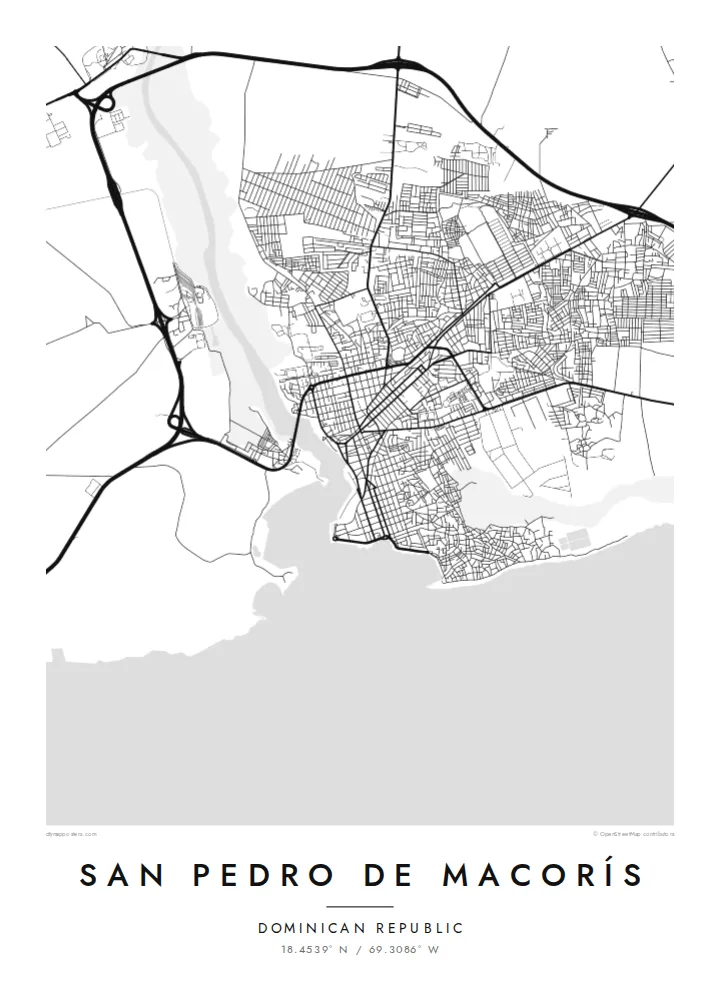
San Pedro de Macorís grew where the Higuamo River meets the Caribbean Sea on the south-east coast of the Dominican Republic. On the map the river runs down to the coast along the city's western edge, the historic grid fills the corner between river and sea, and a long malecón follows the shoreline eastward. A bridge carries the coastal highway over the estuary toward Santo Domingo.
The town prospered from sugar in the late nineteenth and early twentieth centuries, drawing workers from across the Caribbean, and that period left elegant civic buildings and a neo-Gothic church near the river. Beyond the centre, newer neighbourhoods spread inland in looser blocks, with cane land and industrial sites on the fringes of the city.
The city is also famous for baseball: an unusually large number of major-league players have come from here, and the game is part of daily life. A San Pedro de Macorís map poster pairs the clean line of the coast with the curve of the estuary, a strong, simple composition that recalls sea breezes, cane fields and evening games.
The river widens as it reaches the sea along the western side of town, a broad curve of water crossed by the highway bridge toward Santo Domingo.
A seafront avenue follows the Caribbean shore, giving the map a long, clean edge where the street grid meets open water.
Blocks laid out during the sugar boom sit between river and sea, a compact grid anchored by the neo-Gothic church of San Pedro Apóstol near the waterfront.
Fai mo oe
Faʻaopoopo se aso, se igoa po o sau lava upu, sui le sitaili, lapoʻa po o le itu.
O le preview e leai se totogi e maualalo le resolution ma iai se watermark. O lolomi ma faila HD e faia i le 300 DPI, e oo atu i le 7,200 × 10,800 px, e aunoa ma se watermark.
Aisea San Pedro de Macorís
Families with roots in San Pedro, baseball fans and anyone who has walked the malecón at sunset recognise this outline instantly. The meeting of river and sea gives the poster a natural frame, so it reads well even from across a room.
Personalise the title and subtitle, for example with a neighbourhood, a team or a date, and keep or edit the coordinates line. Choose Classic black & white, Noir, Paper, Blueprint or Sand. The $9 download includes six sizes as 300 DPI PNG and print-ready PDF.
Faatau le posita San Pedro de Macorís| Lapoʻa lolomi | Manino | Faila |
|---|---|---|
| 30 × 40 cm11.8 × 15.7″ | 3,543 × 4,724 px | PNG · PDF |
| 29.7 × 42 cm (A3)11.7 × 16.5″ | 3,508 × 4,961 px | PNG · PDF |
| 42 × 59.4 cm (A2)16.5 × 23.4″ | 4,961 × 7,016 px | PNG · PDF |
| 45.7 × 61 cm18 × 24″ | 5,400 × 7,200 px | PNG · PDF |
| 50 × 70 cm19.7 × 27.6″ | 5,906 × 8,268 px | PNG · PDF |
| 61 × 91.4 cm24 × 36″ | 7,200 × 10,800 px | PNG · PDF |
Ae faʻatusatusa, o le faʻataʻitaʻiga e leai se totogi e 900 px le lautele, e iai le faʻailoga vai ma e mo mata. O faila HD e oʻo atu i le 8× le manino i itu taʻitasi ma e lolomi manino i le lapoʻa atoa o le posta.
Filifili se sitaili i le pito i luga o le itulau, ona filifili lea o le Posita Lolomi — se lapopoa ma, afai e te fiafia, se faavaa — po o Faila HD Numera. E na o le tasi laasaga o le Checkout, ma o le a fesuia'i lou itulau o oka i le taimi lava e mae'a ai le totogi.
E lolomiina i luga o pepa matte maualuga le tulaga e 200 gsm, i se tasi o lapopoa e ono, mai le 30 × 40 cm i le 24 × 36″. E amata le tau o posita lolomi mai le $39, aofia ai le auina atu.
Ioe. Filifili se faavaa laau malosi i le lanu uliuli, sina, oak masani, po o le laau pogisa. E aofia ai se tioata e le gau ma ua saunia e tautau i luga. E amata le tau o posita faavaa mai le $99, aofia ai le auina atu.
E leai se totogi o le auina atu i atunuu e 60+. O pepa ata taʻitasi e lolomiina e le tasi o matou paaga lolomi e latalata mai i atunuu e 30+, ma e masani ona taunuu i le 3–7 aso faigaluega. E mafai ona e mulimulitaia le tulaga ma le sailiga i lalo o My Orders. O nisi atunuu e 2–5 vaiaso, ma i nofoaga e lei matou auina atu iai, e taʻu atu e le saite ia te oe a o lei totogi.
Auina mai se ata i totonu o le 14 aso talu ona taunuu, ma o le a matou toe lolomiina e leai se totogi po o le toe faafoi atu lau tupe.
Ioe. I totonu o le editor i lenei itulau, suia le ulutala, le ulutala laititi ma le laina o coordinates i soo se mea e te fiafia i ai, ma filifili se sitaili ma le lapopoa. O oka lolomi, faavaa ma numera e faaaoga uma lava lau mamanu.
Mo le $9 e te maua ai faila PNG 300 DPI ma PDF ua saunia mo le lolomi i lapopoa uma e ono, e aunoa ma se watermark, e mafai ona lolomi i soo se mea. Le mautinoa lava? Download muamua se preview e leai se totogi ma le watermark.
Latalata ane
