The Dniester curve
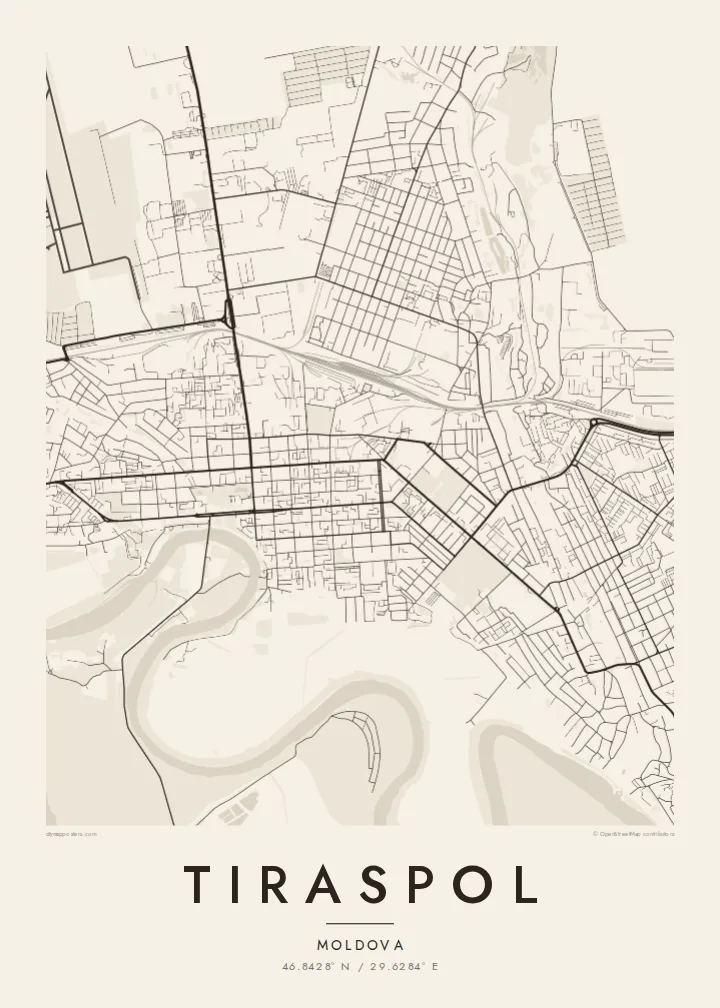
The river runs past the city's western and southern sides in a wide, gentle arc. It sets a natural border to the street pattern and gives the composition a strong, flowing line.
Posta faʻafanua faigofie · Moldova
46.8428° N / 29.6284° E
A regular street grid on the east bank of the Dniester, with one long avenue running parallel to the river's broad curve




Tasi le aai, lagona e lima
Tapi se sitaili e vaai ai i luga o le puipui. E tutusa uma le tau o sitaili — pe lolomiina, faapipiiina, pe avea ma faila HD.
 Pika Moni · Faila Lolomi 24 × 36″
Manino mo le lolomi
O se vaega atoa (100%) lenei mai le faila lolomi moni. O posita uma — pe lolomiina, faapipiiina pe download mai — e faia i luga o a matou server i le 300 DPI, e oo atu i le 7,200 × 10,800 pika, ina ia manino pea auala laiti i luga o se lolomiga 24 × 36″.
I luga o le puipui


Le faʻafanua
Tiraspol sits on the left bank of the Dniester in Transnistria, the breakaway region of Moldova. From above, the city looks orderly. A near-rectangular grid of streets spreads back from the river, and the long main avenue, 25 October Street, crosses the centre. The Dniester bends along the western and southern edges, so the water frames the town on one side and open farmland wraps the other.
The town began as a fortress in 1792, built on Alexander Suvorov's orders when the Russian Empire's border reached the Dniester. That start as a planned settlement still shows in the layout. Blocks follow straight lines instead of old winding lanes, and the wide boulevards cross at right angles. On the edges of the city the grid gives way to rail lines, industrial yards and bands of greenery along the riverbank.
A Tiraspol map poster turns that clear geometry into a quiet graphic. The dense grid in the centre, the thinner streets towards the outskirts and the smooth line of the Dniester give the print a balanced shape. Bender lies just across the water, joined by a bridge, and it sits within the same frame. The two towns read as neighbours facing each other over the river.
The river runs past the city's western and southern sides in a wide, gentle arc. It sets a natural border to the street pattern and gives the composition a strong, flowing line.
Straight streets and rectangular blocks cover the centre, laid out after the town's founding as a fortress. On a monochrome print the result is an even, rhythmic texture.
The town of Bender stands on the opposite bank, linked to Tiraspol by a road bridge. With both included, the map reads as a pair of settlements facing each other over the river.
Fai mo oe
Faʻaopoopo se aso, se igoa po o sau lava upu, sui le sitaili, lapoʻa po o le itu.
O le preview e leai se totogi e maualalo le resolution ma iai se watermark. O lolomi ma faila HD e faia i le 300 DPI, e oo atu i le 7,200 × 10,800 px, e aunoa ma se watermark.
Aisea Tiraspol
Some people frame Tiraspol because they grew up there, studied there, or have family on the left bank of the Dniester. Others are drawn to the plain design of a planned city beside a river. Either way, the map holds a personal place in a calm, understated form that suits a hallway, a study or a living room.
You can change the title, the subtitle and the coordinates line to add a family name, a meaningful date or a short phrase. You can pick one of five styles: Classic black & white, Noir, Paper, Blueprint or Sand. Buy it as a $9 set of HD digital files, or order a matte print with an optional wooden frame.
Faatau le posita Tiraspol| Lapoʻa lolomi | Manino | Faila |
|---|---|---|
| 30 × 40 cm11.8 × 15.7″ | 3,543 × 4,724 px | PNG · PDF |
| 29.7 × 42 cm (A3)11.7 × 16.5″ | 3,508 × 4,961 px | PNG · PDF |
| 42 × 59.4 cm (A2)16.5 × 23.4″ | 4,961 × 7,016 px | PNG · PDF |
| 45.7 × 61 cm18 × 24″ | 5,400 × 7,200 px | PNG · PDF |
| 50 × 70 cm19.7 × 27.6″ | 5,906 × 8,268 px | PNG · PDF |
| 61 × 91.4 cm24 × 36″ | 7,200 × 10,800 px | PNG · PDF |
Ae faʻatusatusa, o le faʻataʻitaʻiga e leai se totogi e 900 px le lautele, e iai le faʻailoga vai ma e mo mata. O faila HD e oʻo atu i le 8× le manino i itu taʻitasi ma e lolomi manino i le lapoʻa atoa o le posta.
Filifili se sitaili i le pito i luga o le itulau, ona filifili lea o le Posita Lolomi — se lapopoa ma, afai e te fiafia, se faavaa — po o Faila HD Numera. E na o le tasi laasaga o le Checkout, ma o le a fesuia'i lou itulau o oka i le taimi lava e mae'a ai le totogi.
E lolomiina i luga o pepa matte maualuga le tulaga e 200 gsm, i se tasi o lapopoa e ono, mai le 30 × 40 cm i le 24 × 36″. E amata le tau o posita lolomi mai le $39, aofia ai le auina atu.
Ioe. Filifili se faavaa laau malosi i le lanu uliuli, sina, oak masani, po o le laau pogisa. E aofia ai se tioata e le gau ma ua saunia e tautau i luga. E amata le tau o posita faavaa mai le $99, aofia ai le auina atu.
E leai se totogi o le auina atu i atunuu e 60+. O pepa ata taʻitasi e lolomiina e le tasi o matou paaga lolomi e latalata mai i atunuu e 30+, ma e masani ona taunuu i le 3–7 aso faigaluega. E mafai ona e mulimulitaia le tulaga ma le sailiga i lalo o My Orders. O nisi atunuu e 2–5 vaiaso, ma i nofoaga e lei matou auina atu iai, e taʻu atu e le saite ia te oe a o lei totogi.
Auina mai se ata i totonu o le 14 aso talu ona taunuu, ma o le a matou toe lolomiina e leai se totogi po o le toe faafoi atu lau tupe.
Ioe. I totonu o le editor i lenei itulau, suia le ulutala, le ulutala laititi ma le laina o coordinates i soo se mea e te fiafia i ai, ma filifili se sitaili ma le lapopoa. O oka lolomi, faavaa ma numera e faaaoga uma lava lau mamanu.
Mo le $9 e te maua ai faila PNG 300 DPI ma PDF ua saunia mo le lolomi i lapopoa uma e ono, e aunoa ma se watermark, e mafai ona lolomi i soo se mea. Le mautinoa lava? Download muamua se preview e leai se totogi ma le watermark.
Latalata ane
