Irrigation canals
Water channels fed by the valley's river system cross the town and its outskirts. They form thin lines that follow field edges and run alongside many streets.
Pōhita mape faigofie · Uzbekistan
40.5220° N / 72.0729° E
A Fergana Valley town of low-rise streets, irrigation canals and orchards spread across the flat, fertile valley floor.


Taone e tahi, lagona e lima
Pa'i se ata ke va'ai ai i luga o te pā. E tutusa te tau o ata uma — i lomiga, fakapipi'i i faleata, pe ko faila HD.
 Pixels mo'i · Faila lomiga 24 × 36″
Manino mo te lomiga
Ko se kupega 100% mai te faila lomiga mo'i. Poster uma — pe lomiina, fakapipi'i i faleata, pe download-ina — e fakaatagia i luga o a matou setula i te 300 DPI, e oo atu ki te 7,200 × 10,800 pixels, ina ia mautinoa e ma'ai pea auala tuai foki i luga o se lomiga 24 × 36″.
I luga o te pa


Te mape
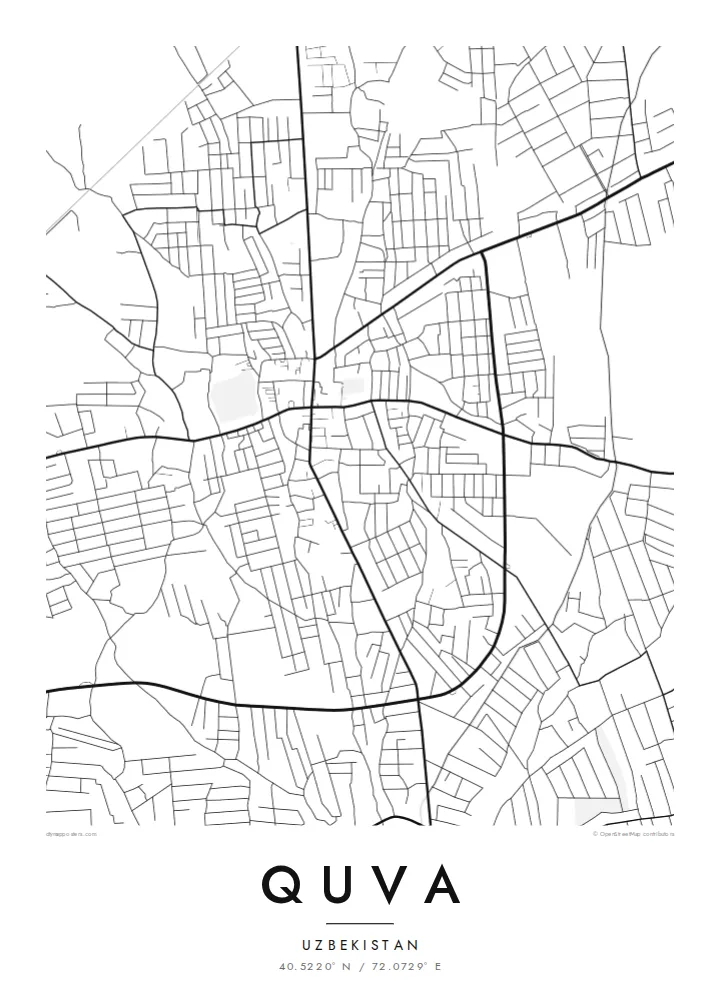
Quva is a town in the Fergana region of eastern Uzbekistan, in the broad valley enclosed by the Tian Shan and Pamir-Alay ranges. The valley floor is flat and heavily irrigated. On the map, Quva appears as a compact centre surrounded by a dense mesh of canals, field boundaries and village roads spreading outward in every direction.
The town has deep roots. Archaeologists have studied the remains of a medieval settlement here, known in early sources as Quba, and the finds include traces of a Buddhist sanctuary from the early medieval period. Today Quva is also known across Uzbekistan for its pomegranates, grown in the orchards and household gardens that fill much of the surrounding land.
A Quva map poster records the pattern of an old oasis town. Courtyard houses are packed along narrow lanes, larger roads carry traffic toward Fergana and the other valley towns, and canals thread through it all. In black and white, the fine grain of the gardens and water channels gives the map a texture quite unlike the planned grids of newer cities.
Water channels fed by the valley's river system cross the town and its outskirts. They form thin lines that follow field edges and run alongside many streets.
The archaeological remains of medieval Quva lie within the modern town, a reminder that people have lived here for well over a thousand years.
Around the centre, gardens and pomegranate orchards fill the spaces between roads, giving the map a soft, fragmented pattern of small plots and lanes.
Fai mo koe
Fakaopoopo he aho, he igoa pe he upu a koe, hui te faiga, te lahi pe te tūlaga.
Ko te va'aiga e leai se totogi e maualalo tona resolution ma iai se fakailoga vai. E fakaatagia lomiga ma faila HD i te 300 DPI, e oo atu ki te 7,200 × 10,800 px, e aunoa ma se fakailoga vai.
Aiheā Quva
Many families from the Fergana Valley keep long ties to towns like Quva, even after moving to Tashkent or abroad. A map poster brings back the familiar street layout. The title, subtitle and coordinates line can be personalised with a family name, a greeting from home or a date.
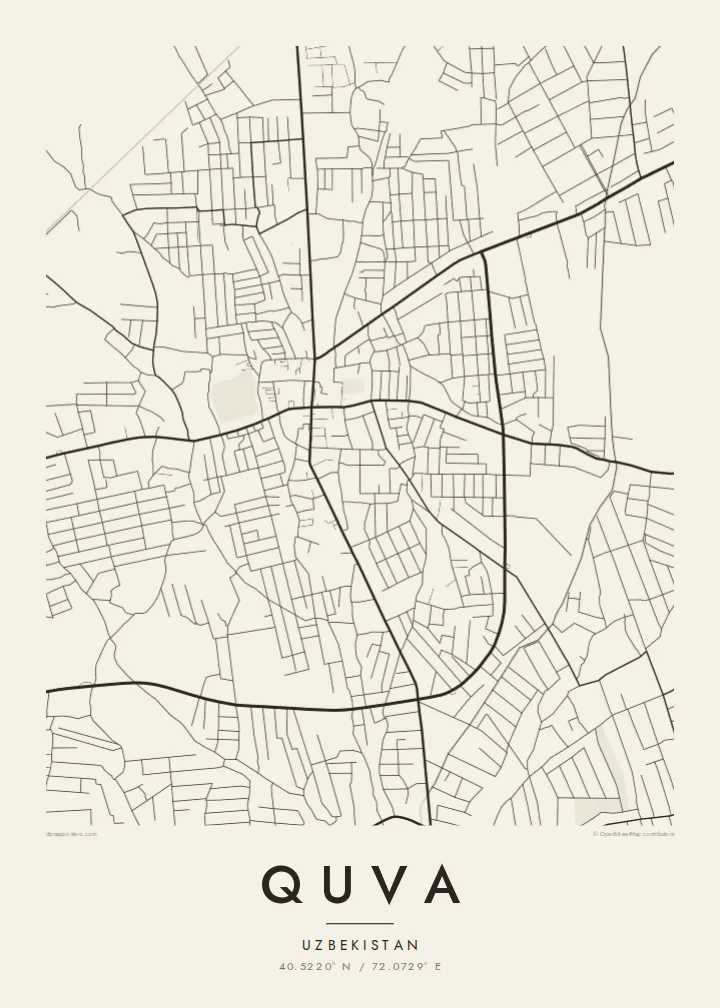
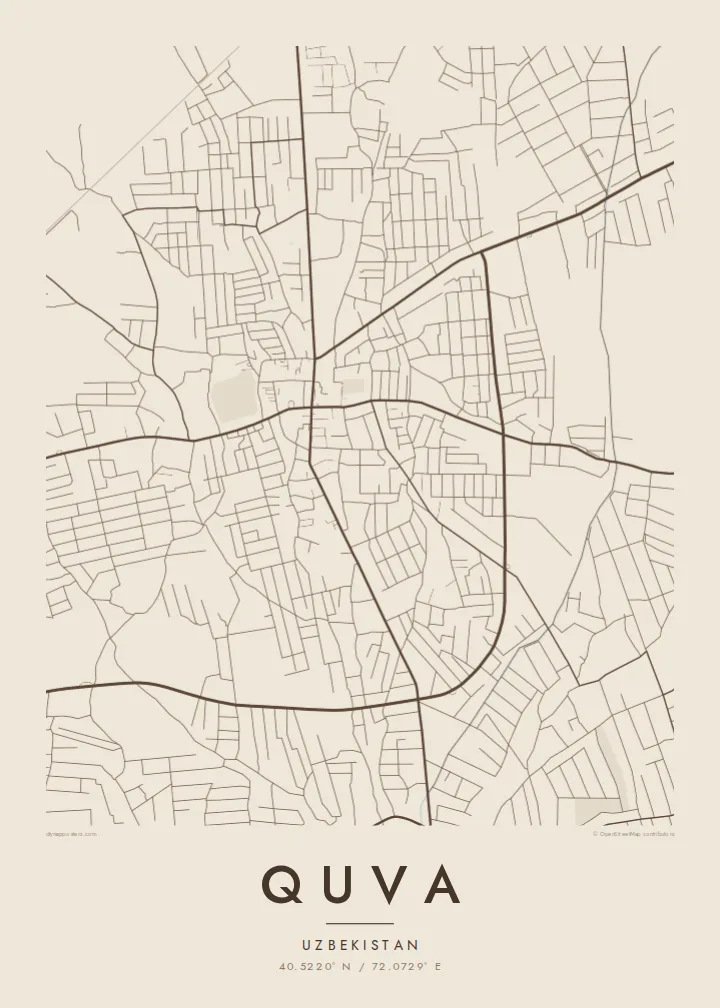
The design is available in Classic black & white, Noir, Paper, Blueprint and Sand. A free 900 px preview shows the result before you buy. The $9 download includes six print-ready sizes, and printed posters ship from print partners in more than 30 countries.
Oka te poster Quva| Lahi o te lomiga | Manino | Faila |
|---|---|---|
| 30 × 40 cm11.8 × 15.7″ | 3,543 × 4,724 px | PNG · PDF |
| 29.7 × 42 cm (A3)11.7 × 16.5″ | 3,508 × 4,961 px | PNG · PDF |
| 42 × 59.4 cm (A2)16.5 × 23.4″ | 4,961 × 7,016 px | PNG · PDF |
| 45.7 × 61 cm18 × 24″ | 5,400 × 7,200 px | PNG · PDF |
| 50 × 70 cm19.7 × 27.6″ | 5,906 × 8,268 px | PNG · PDF |
| 61 × 91.4 cm24 × 36″ | 7,200 × 10,800 px | PNG · PDF |
Mo te fakatatau, ko te fakaakoakoga e hē totogi e 900 px te lautele, e ihi te fakailoga ma mo te lau komipiuta. Ko nā faila HD e oko ki te 8× te manino i itū taki tahi ma e lomia lelei i te lahi kātoa o te pōhita.
Filifili se ata i te pito i luga o te itulau, ona filifili lea o te Poster Lomiina — se lapoa ma, ka manako ai koe, se faleata — pe ko Faila HD Fakaonaonaina. E tasi te laasaga o te ōkaina, ma ka fakafou loa lau itulau ōkaina pe a mae'a te totogi.
E lomiina i luga o se pepa matte kaliki maualuga e 200 gsm, i se tasi o ni lapoa e ono, mai le 30 × 40 cm ki te 24 × 36″. E kamata te tau o poster lomiina mai le $39, aofia ai te uta.
Ioe. Filifili se faleata lakau malō i te lanu uli, tea, oki masani pe lakau pouli. E aumai fakatasi mo se tioata e le gagamu ma ua sauni ke tautau. E kamata te tau o poster fakapipi'i i se faleata mai le $99, aofia ai te uta.
E tuku uma te uta ki fenua e 60+. Ko te pepa takitasi e lomi e te tasi o a matou paaga lomi i fenua e 30+, ka tae mai i aso galue e 3–7. E mafai ke e maimoa ki te tulaga mo te tulitaki i lalo o Taku Fakatonuga. E lauiti nei fenua e 2–5 wiki, ka ko nei fenua e le o tuku atu ai, e fakamatala atu e te weepisi i mua o te totogi.
Auina mai se ata pikitia i loto o te 14 aso mai te taimi na oo mai ai, ka toe lomiina e matou e leai se totogi pe toe totogi atu lau tupe.
Ioe. I te mea fakasa'o i luga o lenei itulau, sui te ulutala, te ulutala lalo ma te laina fakamaoniga tulaga ki so se mea e manako ai koe, ona filifili lea o se ata ma se lapoa. Okaina lomiina, fakapipi'i i faleata, ma fakaonaonaina e fakaaogā uma i tau ata tonu.
Mo le $9 e maua e koe ni faila PNG 300 DPI ma PDF sauni-mo-lomiga i lapoa e ono uma, e aunoa ma se fakailoga vai, ke lomiina i so se mea. E le'i mautinoa? Download muamua se va'aiga fakailoga vai e leai se totogi.
