Station valley
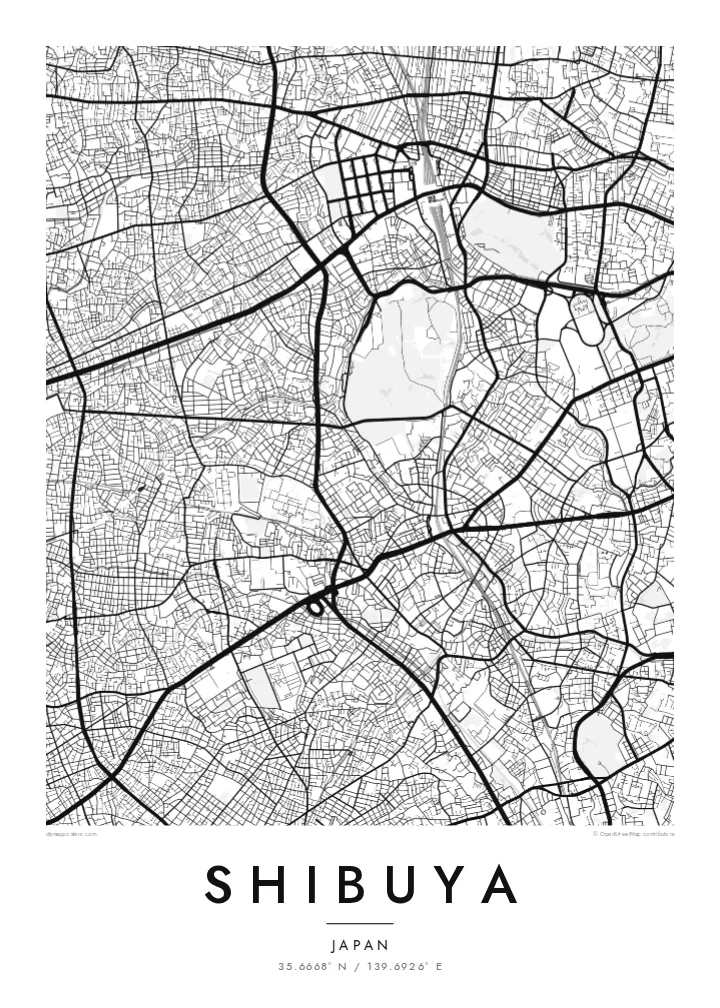
All the main roads slope down to Shibuya Station. On the map they converge like streams into a single low point where rail tracks and elevated roads overlap.
Pōhita mape faigofie · Japan
35.6668° N / 139.6926° E
Streets pour down into a valley where rail lines, expressways and a famous crossing all converge


Taone e tahi, lagona e lima
Pa'i se ata ke va'ai ai i luga o te pā. E tutusa te tau o ata uma — i lomiga, fakapipi'i i faleata, pe ko faila HD.
 Pixels mo'i · Faila lomiga 24 × 36″
Manino mo te lomiga
Ko se kupega 100% mai te faila lomiga mo'i. Poster uma — pe lomiina, fakapipi'i i faleata, pe download-ina — e fakaatagia i luga o a matou setula i te 300 DPI, e oo atu ki te 7,200 × 10,800 pixels, ina ia mautinoa e ma'ai pea auala tuai foki i luga o se lomiga 24 × 36″.
I luga o te pa


Te mape
Shibuya takes its name from a valley, and the map still shows it. Streets descend from the surrounding heights of Aoyama, Dogenzaka and Daikanyama toward the station, where the JR Yamanote Line, several metro lines and the elevated expressway meet at the lowest point. The old Shibuya River now runs mostly underground, but its course still shapes the streets that follow it south.
Around the station the street pattern is dense and irregular, full of lanes that climb at odd angles. To the north the grid gives way to the large green spaces of Yoyogi Park and the forest around Meiji Shrine, both inside the ward. The scramble crossing and the Hachiko statue outside the station are among the most photographed places in Tokyo.
A Shibuya map poster captures how much of Tokyo's energy flows through one small basin. In black and white the rail lines read as strong, straight strokes crossing a fine mesh of alleys, while the parks to the north open up as calm, empty shapes that balance the density of the centre.
All the main roads slope down to Shibuya Station. On the map they converge like streams into a single low point where rail tracks and elevated roads overlap.
North of the centre, Yoyogi Park and the wooded Meiji Shrine grounds form one of the largest open areas in central Tokyo, a broad quiet patch on the poster.
The famous crossing sits where several wide roads meet outside the station. On paper it is a small, clear junction that anyone who has stood there will recognise immediately.
Fai mo koe
Fakaopoopo he aho, he igoa pe he upu a koe, hui te faiga, te lahi pe te tūlaga.
Ko te va'aiga e leai se totogi e maualalo tona resolution ma iai se fakailoga vai. E fakaatagia lomiga ma faila HD i te 300 DPI, e oo atu ki te 7,200 × 10,800 px, e aunoa ma se fakailoga vai.
Aiheā Shibuya
Shibuya is where many first trips to Tokyo begin, and where many people have lived, studied or worked for a season. A map of it is a reminder of crowded crossings, late trains and side streets that led somewhere unexpected.
You can set your own title and subtitle, perhaps a date or a neighbourhood name, and adjust the coordinates line. Noir suits the neon-lit reputation of the district, while Classic black and white keeps the dense street pattern crisp.
Oka te poster Shibuya| Lahi o te lomiga | Manino | Faila |
|---|---|---|
| 30 × 40 cm11.8 × 15.7″ | 3,543 × 4,724 px | PNG · PDF |
| 29.7 × 42 cm (A3)11.7 × 16.5″ | 3,508 × 4,961 px | PNG · PDF |
| 42 × 59.4 cm (A2)16.5 × 23.4″ | 4,961 × 7,016 px | PNG · PDF |
| 45.7 × 61 cm18 × 24″ | 5,400 × 7,200 px | PNG · PDF |
| 50 × 70 cm19.7 × 27.6″ | 5,906 × 8,268 px | PNG · PDF |
| 61 × 91.4 cm24 × 36″ | 7,200 × 10,800 px | PNG · PDF |
Mo te fakatatau, ko te fakaakoakoga e hē totogi e 900 px te lautele, e ihi te fakailoga ma mo te lau komipiuta. Ko nā faila HD e oko ki te 8× te manino i itū taki tahi ma e lomia lelei i te lahi kātoa o te pōhita.
Filifili se ata i te pito i luga o te itulau, ona filifili lea o te Poster Lomiina — se lapoa ma, ka manako ai koe, se faleata — pe ko Faila HD Fakaonaonaina. E tasi te laasaga o te ōkaina, ma ka fakafou loa lau itulau ōkaina pe a mae'a te totogi.
E lomiina i luga o se pepa matte kaliki maualuga e 200 gsm, i se tasi o ni lapoa e ono, mai le 30 × 40 cm ki te 24 × 36″. E kamata te tau o poster lomiina mai le $39, aofia ai te uta.
Ioe. Filifili se faleata lakau malō i te lanu uli, tea, oki masani pe lakau pouli. E aumai fakatasi mo se tioata e le gagamu ma ua sauni ke tautau. E kamata te tau o poster fakapipi'i i se faleata mai le $99, aofia ai te uta.
E tuku uma te uta ki fenua e 60+. Ko te pepa takitasi e lomi e te tasi o a matou paaga lomi i fenua e 30+, ka tae mai i aso galue e 3–7. E mafai ke e maimoa ki te tulaga mo te tulitaki i lalo o Taku Fakatonuga. E lauiti nei fenua e 2–5 wiki, ka ko nei fenua e le o tuku atu ai, e fakamatala atu e te weepisi i mua o te totogi.
Auina mai se ata pikitia i loto o te 14 aso mai te taimi na oo mai ai, ka toe lomiina e matou e leai se totogi pe toe totogi atu lau tupe.
Ioe. I te mea fakasa'o i luga o lenei itulau, sui te ulutala, te ulutala lalo ma te laina fakamaoniga tulaga ki so se mea e manako ai koe, ona filifili lea o se ata ma se lapoa. Okaina lomiina, fakapipi'i i faleata, ma fakaonaonaina e fakaaogā uma i tau ata tonu.
Mo le $9 e maua e koe ni faila PNG 300 DPI ma PDF sauni-mo-lomiga i lapoa e ono uma, e aunoa ma se fakailoga vai, ke lomiina i so se mea. E le'i mautinoa? Download muamua se va'aiga fakailoga vai e leai se totogi.
Latalata
