The Neisse border
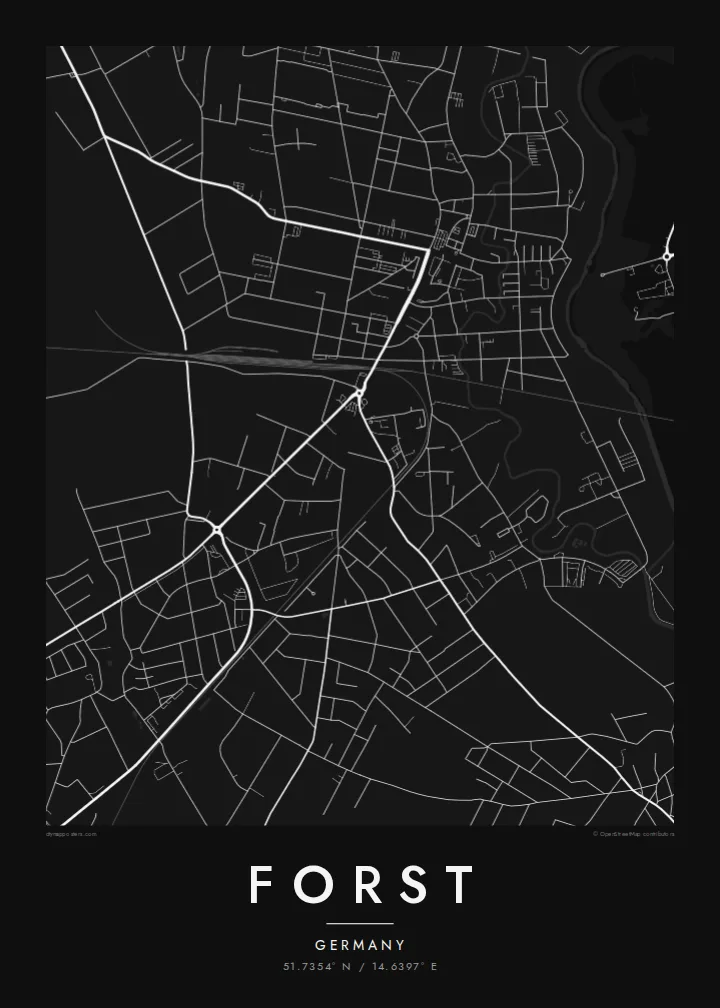
The Lusatian Neisse forms the eastern edge of the town and the frontier with Poland. It gives the map one strong vertical line, with the bridges crossing it clearly marked.
Poster minimalist tal-mappa · il-Ġermanja
51.7354° N / 14.6397° E
A textile town pressed against the Neisse, its streets stopping at the river that marks the Polish border



Belt waħda, ħames atmosferi
Agħfas fuq stil biex tarah fuq il-ħajt. Kull stil jiswa l-istess — stampat, inkurnat jew bħala fajls HD.
 Pixels reali · fajl tal-istampar 24 × 36″
Preċiż għall-istampar
Dan huwa qtugħ ta' 100% mill-fajl tal-istampar reali. Kull poster — stampat, inkurnat jew iddawnlowdjat — jiġi ġġenerat fuq is-servers tagħna b'300 DPI, sa 7,200 × 10,800 pixel, biex saħansitra l-iżgħar toroq jibqgħu ċari fuq stampa ta' 24 × 36″.
Fuq il-ħajt


Il-mappa
Forst sits in Lower Lusatia on the west bank of the Lusatian Neisse. From above the river is the town's most defined edge: it runs north to south along the eastern side, and across the water lies Poland. The streets fan out westward from the river in a loose, uneven layout. That layout owes more to a century of industrial growth than to any one plan, and the river keeps the whole map oriented.
For much of the nineteenth and early twentieth centuries Forst was a centre of cloth production, known then as a German Manchester. The mills needed rail sidings, long factory plots and workers' housing close by, and that industrial past still shows in the size of the blocks. Some districts have large, regular parcels. Others are tighter, where terraced housing filled the space between works.
The town's best-known green space is the East German Rose Garden, laid out near the river in the early twentieth century and still one of the larger rose gardens in the country. On a Forst map poster it appears as a patch of curving paths set against the straighter streets around it. The eye tends to settle there, between the town's grid and the river.
The Lusatian Neisse forms the eastern edge of the town and the frontier with Poland. It gives the map one strong vertical line, with the bridges crossing it clearly marked.
The East German Rose Garden adds a cluster of curved walks and beds near the river, a softer pattern than the streets and industrial plots that surround it.
Large parcels left by the cloth industry sit beside denser housing streets. The result is a clear contrast in scale across the town that works well in black and white.
Agħmlu tiegħek
Żid data, isem jew sentenza tiegħek, ibdel l-istil, id-daqs jew l-orjentazzjoni.
Il-preview b'xejn hija b'riżoluzzjoni baxxa u bil-watermark. L-istampi u l-fajls HD jiġu ġġenerati b'300 DPI, sa 7,200 × 10,800 px, mingħajr watermark.
Għaliex Forst
People from Forst often want a map that shows how close the town and the border are, with the river running right past the old streets. It also suits anyone with family ties to Lusatia's textile past, or to both sides of the Neisse.
Add a title, a family name or a meaningful date, and choose from Classic black & white, Noir, Paper, Blueprint or Sand. The digital files cost $9 and cover six print sizes. Printed posters on matte paper, with an optional wooden frame, ship from partners in more than 30 countries.
Ordna l-poster Forst| Daqs tal-istampa | Riżoluzzjoni | Fajls |
|---|---|---|
| 30 × 40 cm (11.8 × 15.7″) | 3,543 × 4,724 px | PNG · PDF |
| 29.7 × 42 cm (A3, 11.7 × 16.5″) | 3,508 × 4,961 px | PNG · PDF |
| 42 × 59.4 cm (A2, 16.5 × 23.4″) | 4,961 × 7,016 px | PNG · PDF |
| 45.7 × 61 cm (18 × 24″) | 5,400 × 7,200 px | PNG · PDF |
| 50 × 70 cm (19.7 × 27.6″) | 5,906 × 8,268 px | PNG · PDF |
| 61 × 91.4 cm (24 × 36″) | 7,200 × 10,800 px | PNG · PDF |
Għal paragun, il-preview b'xejn huwa wiesa' 900 px, għandu watermark u huwa maħsub għall-iskrins. Il-fajls HD għandhom sa 8× ir-riżoluzzjoni f'kull direzzjoni u jiġu stampati b'mod nadif fid-daqs sħiħ tal-poster.
Agħżel stil fin-naħa ta' fuq tal-paġna, imbagħad agħżel Poster Stampat — daqs u, jekk trid, kurniċa — jew Fajls Diġitali HD. Il-ħlas isir f'pass wieħed, u l-paġna tal-ordni tiegħek tiġi aġġornata malli l-ħlas jgħaddi.
Jiġi stampat fuq karta matte premium ta' 200 gsm f'wieħed minn sitt daqsijiet, minn 30 × 40 cm sa 24 × 36″. Il-posters stampati jibdew minn {printFrom}, bil-kunsinna inkluża.
Iva. Agħżel kurniċa tal-injam solidu f'iswed, abjad, ballut naturali jew injam skur. Tiġi bi ħġieġ li ma jinkisirx u lesta biex tittella'. Il-posters inkurnati jibdew minn {framedFrom}, bil-kunsinna inkluża.
Il-kunsinna hija b'xejn madwar id-dinja. Kull poster jiġi stampat mill-eqreb sieħeb tal-istampar tagħna f'aktar minn 30 pajjiż u ġeneralment jasal fi 3–7 ijiem tax-xogħol. Tista' ssegwi l-istatus u t-tracking taħt L-Ordnijiet Tiegħi.
Ibgħatilna ritratt fi żmien 14-il jum mill-kunsinna u aħna nistampawh mill-ġdid b'xejn jew nirrimborżawk.
Iva. Fl-editur ta' din il-paġna, biddel it-titlu, is-sottotitlu u l-linja tal-koordinati għal kwalunkwe ħaġa trid, u agħżel stil u daqs. L-ordnijiet stampati, inkurnati u diġitali kollha jużaw eżattament id-disinn tiegħek.
Għal $9 tikseb fajls PNG b'300 DPI u PDF lesti għall-istampar fis-sitt daqsijiet kollha, mingħajr watermark, biex tistampa kullimkien. Għadek mhux ċert? L-ewwel iddawnlowdja preview b'xejn bil-watermark.
