Kopet Dag foothills
The mountains rise just south of town, and their slopes mark a firm edge on the map where the regular street pattern stops and open terrain begins.
Fakatino mape mukamuka · Turkmenistan
37.8875° N / 58.5160° E
A town at the foot of the Kopet Dag, just east of Ashgabat, with streets running out toward the desert plain.

Taha e taone, lima e onoonoaga
Tapaki e taha puhala ke kitia ai ki luga he puipui. Kua tatai e totogi he tau puhala oti — pete he lolomi, poloka, po ke faila HD.
 Tau pikselo mooli · faila lolomi 24 × 36″
Maama mitaki ke lolomi
Ko e 100% e fahi mooli mai he faila lolomi. Ko e tau poster oti — pete kua lolomi, poloka, po ke utu hifo — kua taute ke he ha mautolu a tau tokoluga (server) ke he 300 DPI, hokotia ke he 7,200 × 10,800 piksela, ke maeke ai e tau ala ikiiki tote ke maaliali fakamitaki he lolomi 24 × 36″.
He Pā
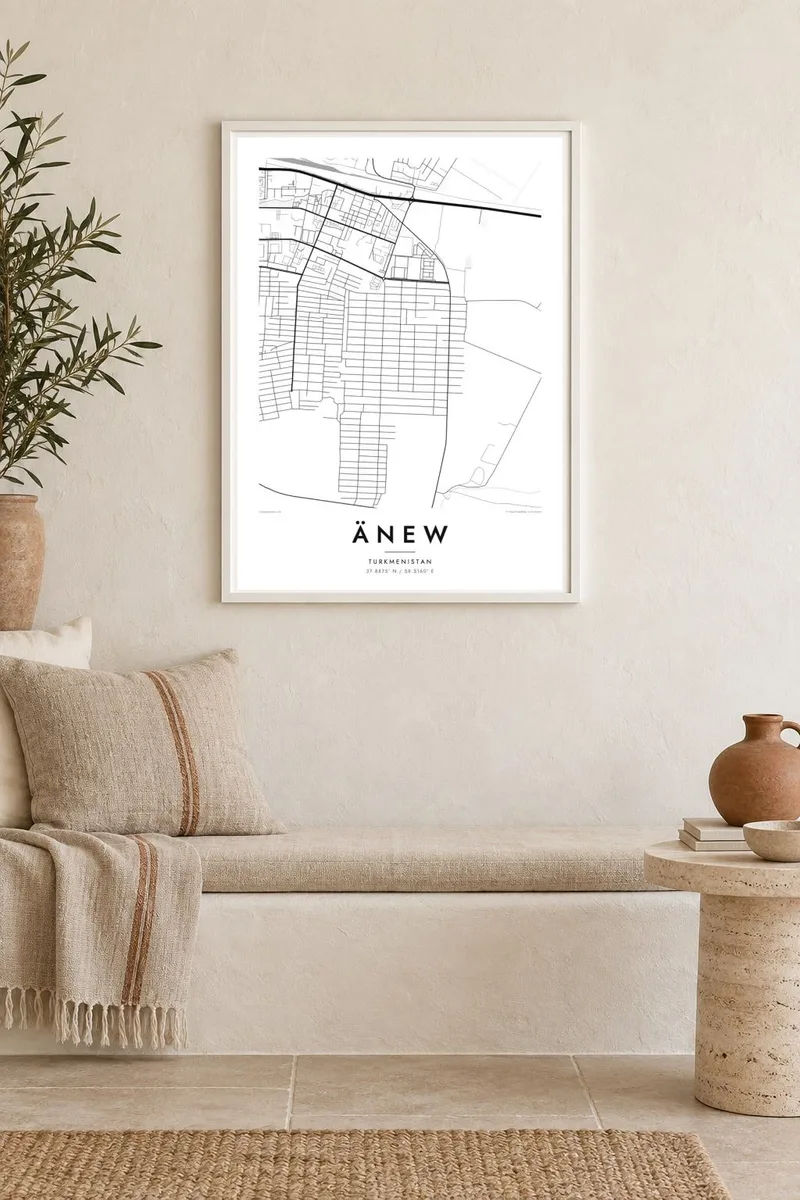


Ko e mape
Änew, also known as Anau, lies a short distance east of Ashgabat, on the strip of irrigated land between the Kopet Dag mountains to the south and the Karakum desert to the north. From above, the town forms an orderly set of blocks and broad roads, with the foothills rising on one side and flat, open ground stretching away on the other.
The area is known to archaeologists for the Anau mounds, settlement sites excavated in the early twentieth century that revealed some of the earliest farming communities in Central Asia. Nearby stand the ruins of the fifteenth-century Seyit Jamal ad-Din mosque, badly damaged in the 1948 Ashgabat earthquake. Änew has also served as an administrative centre for Ahal Region.
An Änew map poster brings out the meeting of mountain and plain. Straight roads run north across the flat land, irrigation lines and field edges add fine texture, and the built-up area thins as it approaches the foothills. The result is a clean, structured image of a town shaped by water, slope and its closeness to the capital.
The mountains rise just south of town, and their slopes mark a firm edge on the map where the regular street pattern stops and open terrain begins.
Ancient settlement mounds lie close to the town, remnants of early farming villages that were among the first in the region to be studied systematically.
A main road links Änew westward to the capital, forming a strong axis that ties the town into the wider Ashgabat area.
Taute ke ha hau
Lafi e aho, taha higoa po ke taha kupu haau, hiki e fakatino, lahi po ke tuaga.
Ko e kitiaaga nakai totogi kua tote e maaliali mo e fakamailoga vai. Ko e tau lolomi mo e tau faila HD kua taute ke he 300 DPI, hokotia ke he 7,200 × 10,800 px, nakai fai fakamailoga vai.
Ko e ha Änew
For people from Änew or with family ties to Ahal, the poster is a personal reminder of home. For others, it is an unusual map of a place where some of Central Asia's oldest settlements stand beside a modern town.
Add a title, subtitle and your own coordinates line to mark a date or a name, and choose the style that suits the room: Classic black & white, Noir, Paper, Blueprint or Sand. HD files come in six print sizes as PNG and PDF.
Talaage e poster Änew| Lahi he lolomi | Maama | Tau faila |
|---|---|---|
| 30 × 40 cm11.8 × 15.7″ | 3,543 × 4,724 px | PNG · PDF |
| 29.7 × 42 cm (A3)11.7 × 16.5″ | 3,508 × 4,961 px | PNG · PDF |
| 42 × 59.4 cm (A2)16.5 × 23.4″ | 4,961 × 7,016 px | PNG · PDF |
| 45.7 × 61 cm18 × 24″ | 5,400 × 7,200 px | PNG · PDF |
| 50 × 70 cm19.7 × 27.6″ | 5,906 × 8,268 px | PNG · PDF |
| 61 × 91.4 cm24 × 36″ | 7,200 × 10,800 px | PNG · PDF |
Ke fakatatai, ko e fakatino noa kua 900 px e laulahi, fai fakamailoga mo e mo e tau mata komipiuta ni. Ko e tau faila HD kua ato hoko ke he 8× e maama ke he tau faahi takitaha mo e lolomi mitaki he lahi katoa he fakatino.
Fifili e taha puhala i luga he kupega, ti fifili e Poster Lolomi — e lahi mo e, kaeke ke manako ai koe, taha poloka — po ke Tau Faila HD Fakaeletonika. Ko e fakaotiaga totogi ko e taha gahua ni, ti ko e kupega he hau a talaaga ka fakafou fakahaga i mua he fakaotiaga e totogi.
Kua lolomi ai ke he pepa mitaki 200 gsm matte he taha he tau lahi ono, mai he 30 × 40 cm ke hoko ke he 24 × 36″. Kamata e tau poster lolomi mai he $39, kua putoia ai e utaaga.
E. Fifili e poloka akau malolō ke he lanu uli, tea, akau oki mooli, po ke akau pouli. Kua fakalataha mo e sioga malolō nakai malepe ti kua mautali ke tautau. Kamata e tau poster poloka mai he $99, kua putoia ai e utaaga.
Nakai totogi e fakafano ke he motu 60+. Ko e fakatino taha kua lolomi he fenoga lolomi ha mautolu kua tata mo e tau motu 30+, kua hoko mai he tau aho gahua 3–7. Maeke ia koe ke kikite e tuaga mo e fakamuitua he lalo he Haku Tau Fakatonu. Ke he falu motu kua 2–5 e tau tapu, ti ka nakai fakafano a mautolu ki ai, to fakaha he api tupe ia ki mua he totogi.
Fakafano mai e taha ata ki a mautolu he loto he 14 e tau aho tali mai he hokoaga, ti to lolomi foki e mautolu nakai totogi po ke liu atu e totogi ki a koe.
E. He editor i luga he kupega nei, hikihiki e matakupu, e matakupu lalo mo e laini coordinates ke he taha mena kua manako a koe ki ai, ti fifili e puhala mo e lahi. Ko e tau talaaga lolomi, poloka mo e fakaeletonika oti kua fakaaoga tonu e hau a fakatino.
Ma e $9 ka moua e koe e tau faila PNG 300 DPI mo e PDF kua mautali ke lolomi he tau lahi ono oti, nakai fai fakamailoga vai, ke lolomi i fe mena. Nakai maopoopo agaia? Utu hifo fakamua e kitiaaga nakai totogi ne fai fakamailoga vai.
